Not to the center of the earth
What Do I Believe?
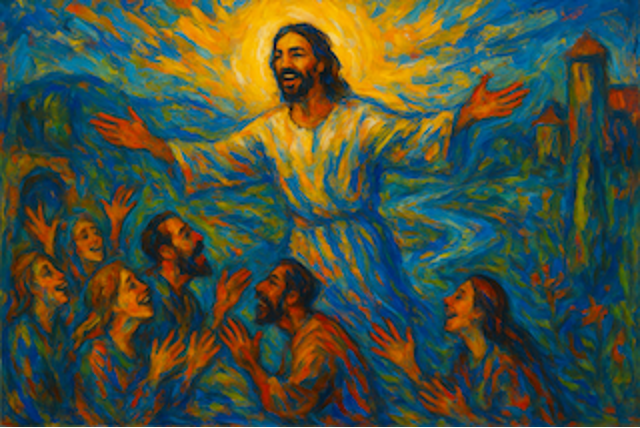
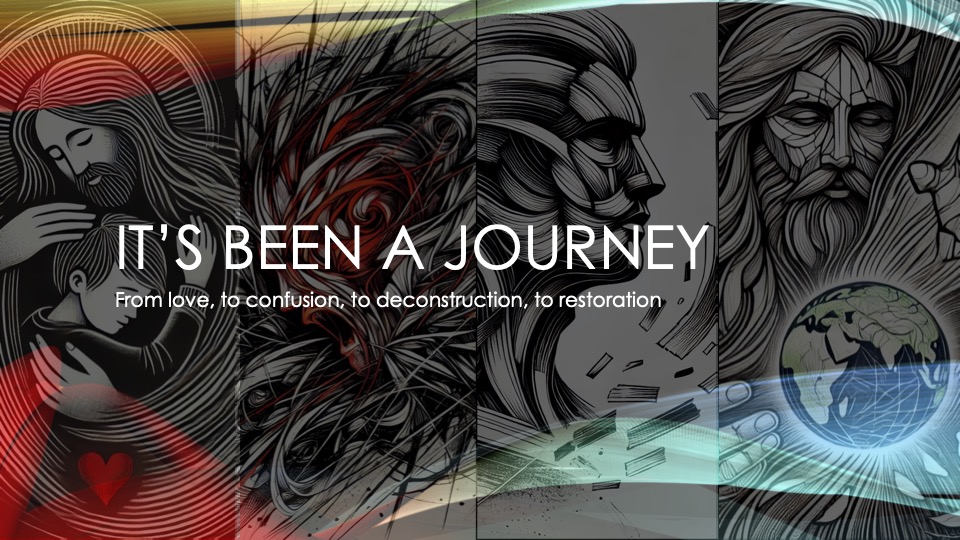
Over the past three years, my beliefs have undergone a profound transformation. Working within a “Christian” organization, I often found myself unsettled by the disconnect between what was professed there and what resonated with my core spiritual convictions. At its heart, my faith has always been anchored in one unshakable truth: the infinite and unconditional love of God, revealed through Jesus.
Before Beliefs: Some Context
I grew up in the United Methodist Church, completing the confirmation process in junior high more out of obligation than genuine faith. While I learned a little about John Wesley and his remarkable life, I didn’t walk away with anything that resembled a personal relationship with God.
By high school, I had decided that, at best, God was distant—if He existed at all. Calling myself agnostic felt more honest than adopting atheism, which struck me as overly confident in rejecting something so unknowable. This mindset persisted into the early years of college, where I honed my ability to argue against the existence of a distant God. I sparred with believers, especially those eager to “save” me, rejecting notions of hell and moral purity as concepts I wanted no part of.
Then, during the second half of my sophomore year, everything changed. I experienced a deep personal heartbreak—a loss that left me unmoored. In my search for solace, I turned to my academic advisor, a gentle and kind man who also happened to be a Catholic priest: Fr. David Smith.
A Conversation That Changed Everything

After offering me comfort, Fr. Smith gently steered our conversation toward faith. He simply asked about mine. I told him I was agnostic. He asked why. I explained my rejection of a God of rules. Who as I’d been told, condemned people to a place called Hell for breaking those rules.
His response surprised me.
“That’s not the God I believe in,” he said. “My faith is in a God who loves unconditionally—infinitely. Jesus showed me that.”
He explained it with such simplicity, yet it felt deeply profound. His words stirred something in me, opening my heart in a way I hadn’t expected.
Looking back, I consider that conversation to be the moment I fell in love with God through Jesus. It was the first time since I was a child, that God attracted me.
And our conversation wasn’t an argument or a theological debate—it was the gentle, unwavering assurance of a love that knows no limits. That truth became the foundation of my faith, and it continues to be, to this day.

After my conversion, I reached out to a guy who had became one of my closest friends. He always had let me know he had a faith, and accepted that I didn’t. He accepted me as I was, despite by unbelief. “No conditions” he’d often say.
When I told him of my conversion, he came to my side in joy, and in a spirit of helping. He gave me a Bible, told me to start in the Gospels – First four books of the New Testament – and took me under his wing. He further encouraged me to “get invovled” and pointed me towards Young Life.
I found Young Life was a mostly volunteer organization that did Christian evangelism in a new way to reach unchurched youth. The core of their approach was befriending youth, accepting them as they were, then over time “earning the right” to say more about serious things – like faith. And it was accepting sometimes this never happened. I later found that this was called “relational ministry” modeled after how Jesus approached people, and drew them in.
After six months of conversations and making friends in this community, I became a “leader” (in a rookie form) in Young Life. My colleagues and I embraced the central belief that “God is love”, a truth revealed through Jesus’ birth, life, death, and resurrection. Working with youth taught us an essential lesson: love must come first. Only through genuine love could we “earn the right to be heard.” And earning that right meant being a true friend. As Jesus said, “Greater love has no one than this: to lay down one’s life for one’s friends.” — John 15:13.
This foundational principle shaped everything we did. Theological nuances felt secondary; instead, every action and idea was measured against the standard of Jesus’ love. Agape love – the love of friends. If a belief reflected that love, we embraced; if it not, it was set aside.
This uncomplicated, love-centered approach to faith was the lens through which I viewed spirituality for about 10 years. Young Life was my community and faith foundation.
Into the Wilderness – Confusion
Then our family decided it was time to move—move up—bigger house, etc. ‘i had picked up a graduate degree, and moved into a career I loved – management consulting. Physically it was not far. But far enough for my community to not be as convenient. Plus we were all getting older, more mature. – me focusing on my work, all of us starting to rasie kids, . This prompted a search for a church closer to home. And hopefully some new community. Surely, I thought, every church community believed in God’s love story like I did..

But I discovered that wasn’t the case.
Over the next 30 years, I journeyed through the evolving landscape of the American church – mostly in the American evangelical church. I spent time in a variety of congregations – Evangelical Free and Converge (formerly Baptist General Conference) were the primary denominational influences. My spiritual beliefs by then was a tapestry, woven with threads from different traditions: from the Methodism of my childhood, the Catholicism that shaped my college years, the formative impact of Young Life, and now the some of the evangelical traditions – somehow Hell found it’s way into my beliefs. But, I also never got comfortable.
And the journey was far from smooth, marked by its share of highs and lows. Jesus was present, but not always in a fully realized way. Much of the focus was on dissecting right and wrong from Paul’s letters, searching for guidance on how to live. Love often felt secondary. Overshadowed by an emphasis on God’s sovereignty and the relentless aim to please Him, the pastors of these churches, and members of the congregations. It often felt more like a club than a way of life. Conformity to a particular interpretation of God’s justice – retributive – took priority. And the concept of Hell lingered as a seemingly more ever-present and daunting possibility. Yet, through it all, I clung to my faith—and the core of God’s love—even as moments of doubt crept in..
Master of the Universe

Also, during this time, my career took center stage. I spent years pursing my work helping clients solve their problems, then taking on leadership roles within global consulting and enterprise software firms It was a heady environment – the business thrived during the explosive growth of these interrelated areas of business and technology. It was a dynamic, exhilarating time, and I was fortunate to lead initiatives within and for some of the world’s largest organizations. However, the demands of these high-stakes roles, combined with their international scope, often pulled me away from my family and community and contributed to my personal shortcomings.


Reflecting on those years, I see how I embraced the mindset of a “master of the universe” – a nod to the 1987 bestseller, by Tom Wolfe, Bonfire of the Vanities. Convinced that the work I was doing was of paramount importance and I was essential to make it work..

A Change for the Better?
After many years, I moved away from large global consulting and software platforms – my time was over. I began doing consulting in a smaller environment closer to home.
But, I decided to take one more shot. I started work for a Boston-based consulting firm that advised CEOs on “right-sizing”—a euphemism for cutting costs. Most of these executives were driven by greed, power, and personal ambition. The firm’s leadership mirrored their clients.

The breaking point came with a major plastics manufacturer. Publicly, they preached “recycle, recycle, recycle.” Internally, they slashed costs in ways that undermined recycling efforts while pushing more single-use plastics—knowing full well that 95% of plastics marked for recycling would go to poor nations’ landfills and then end up in the ocean.
Craving a deeper sense of purpose, I pivoted, trying to align my values with what I did. I had been serving with a non-profit that provided technology education to under-served schools. One of the schools, a private, Christian k-12 was interested in bringing the technology education in-house. After helping them do some planning, they decided to offer a role to me—to implement the programs we’d defined—a position that allowed me to merge my expertise in business and technology with my faith and an evolving passion for social justice.
I was to implement new learning programs beyond the school’s traditional “Classic Education” model—introducing technology, art, business, and healthcare.

At first, things went incredibly well. The technology program thrived, and I also had a chance to teach. Then to assist with the college and career program. This provided direct and meaningful time with the students.
However, given it was a Christian school there was a strong religious emphasis. Daily staff devotionals, leadership meetings deeply rooted in faith, and events or training always carried a faith-based component.
Although the school was described as non-denominational, it quickly became evident that its theology didn’t align with my understanding of an all-loving God. Their God was different.
Deconstructing

I noticed recurring themes with this god. He demanded absolute submission and obedience. Humanity was described in stark, unforgiving terms—depraved, utterly sinful, corrupted, and wicked—far worse than anything I had ever believed about myself or others. He (a definite He) seemed distant, unapproachable, depicted as supreme, immense, and fearsome. This god was in control of every event in the world, including suffering, disasters, disease and evil. God controls evil? Everything was woven into His unknowable divine plan.
These ideas were deeply unsettling.
Over time, I came to realize that, despite being labeled non-denominational, the school’s faith tradition was firmly rooted in Calvinism. It was a perspective that stood in sharp contrast to the all-loving God I thought I had been attracted to and come to know so long ago during my personal conversion.
During my first year in the school, I often found myself cringing at what was said and believed.
The second year that discomfort was transforming into anger. An anger I couldn’t quite put my finger on at the time. It was a mystery to me.

The third year reached a troubling climax when school leadership called an all-staff meeting to declare opposition to anything related to LGBTQ+. We were instructed to sign an anti-LGBTQ+ Statement of Faith clearly Calvinist in substance. Then commit to “educate ourselves” on the evils of anything LGBTQ+ – the school would hereby provide this instruction. And finally to prepare for a fight—a “culture war,” as they phrased it. Of course, this was all to be done “in love,” under the familiar guise of “love the person, hate the sin.” It’s a term I now phrase, “Love to Hate.”
By this time, I was a spiritual wreck. I was consumed by cognitive dissonance. I was torn between my core belief in an all-loving God, and this supreme, sovereign all-controlling, angry god. Then further torn from believing I’d been made in the image of God, yet being told to confront my personal depravity. This rhetoric was a daily feeding. Anxiety, inner turmoil and anger had become my constant companions. I felt unmoored from my core sense of faith and spiritual clarity.

At this stage my spiritual deconstruction was in full motion. The journey was anything but easy. A struggle I now understand to be completely normal. What I was experiencing was spiritual trauma. It propelled me into an unrelenting quest for finding answers. I consumed anything I could get my hands on—books, podcasts, videos—desperately trying to make sense of my faith.
I told my leader, “I’m here for the kids, not for this toxic culture war nonsense. I’ll stay, but if that’s a problem, fire me!” Two weeks later, he did and I left at the end of that school year.
Reconstucting – the Beginning
In my new quest for spiritual truth, or at least something I could believe in again, I discovered treasures like Fr. Richard Rohr and his many books, but especially Universal Christ where the premise is that Jesus was the incarnation of God, in the role of the Messiah, the Christ – and is the savior of all creation. Yes, including, but not limited to humanity.

Then N.T. Wright and his book The Day the Revolution Began where he proposes that our aim as humans is not to “be good”, die and go to heaven; rather to live and work on God’s behalf in our intended vocation as part of the Kingdom of God, and look forward to the day all creation – the Earth – is restored to what God intended in the beginning.

And The Bible Project. Where a Hebrew Bible/Jewish Scholar, Tim Mackie, PhD; has combined his scholarship with a visual storyteller, Jon Collins, to oversee the making of resources to help people understand the the Scriptures,

At the Bible Project, in addition to deep Judaic scholarship, they show how all scriptures ought to help people see the Bible as a “Unified Story That Leads to Jesus.”
All of these resources and many others offered what seemd profound insights.
Yet, I also encountered a lot of noise. i found myself sifting through content that failed to truly connect with my mind and heart – and in many cases God. It seemed lots of personal, social and political agendas were on full display with the occasional mention of Jesus got people social platforms – and the “christian” label.
Deepening Reconstruction
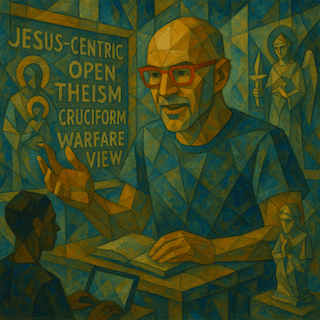
I was venting to a like-minded friend one day about my flailing quest to find the God I once knew. He asked if I was familiar with Greg Boyd. The name rang a bell —I ’d read his book, Letters from a Skeptic, years ago—but I hadn’t explored his work any further. My friend encouraged me to investigate Boyd and the church he’d founded, Woodland Hills Church in Maplewood, MN, and see what they had. Intrigued, I decided to dive in.
I first did my research first to find out if Greg Boyd was legit.
As referred previously, Christianity today seems littered wiI’h people who’s only aim is to gain a social platform – I’ve learned these are called “social entrepreneurs” – often seemingly out of thin air. They use their platform to create a reputation, gain fame, and, most importantly make money. There are outright charlatans, those who preach the heretical “prosperity gospel” and those who just have elevated views of themselves and want to make a buck. This is often done without any real credentials. Little in education, background and experience to justify paying them any attention . They state opinions, or make proclamations pushing human power agendas disguised as “of Jesus”. They are not about living a life of following Jesus, service to others, nor discerning the truth of God. Many freely espouse “whatever it takes” to take over society – including violence.
However, in Greg, I found legitimacy. Raised in the Twin Cities, educated at the U of MN, Bachelor of Arts (B.A.) in Philosophy, Master of Divinity (M.Div.), Yale Divinity School (graduated cum laude, 1982), Doctor of Philosophy (Ph.D.), Princeton Theological Seminary, graduated magna cum laude, 1988.
He then returned to Minnesota to teach at Bethel University/Seminary. He also founded a church, Woodland Hills. It quickly became a quite a large church,
But his teaching and published views invited controversy. It seemed to follow him. First was his feud with a prominent Twin Cities Calvinist, pastor and theologian, who vehemently opposed his views on “Open Theism”. Admittedly Greg Boyd didn’t pick the feud other than publishing his views and being a professor at the Baptist General Conference – Bethel Seminary.

Then preaching a series at Woodland Hills called “The Cross and the Sword” against what is now known and as Christian Nationalism losing 20% of the members of the church. He preached for “enemy love, non-violence” as opposed to killing every terrorist and better nukes. It seemed he was not afraid of stating views outside the popular and established norm. Controversy certainly followed him.
These were controversies I could get behind – he advocated for a God being beyond this sovereign, wrathful, all-powerful, all-knowing being in control of everything, including the future, including suffering and evil; Instead he describes a god of ultimate love, who created beings with “free will” and who does not control everything, certainly not evil. A god who loves creation and fights against evil and suffering. He advocated for the church staying the church and not getting entangled in politics, especially the nationalistic violent forms.
I also found despite becoming a world-renowned theologian, author and pastor of a “mega-church”, he lived his beliefs. His home was in the inner city of St. Paul – trying to be a living example and advocate for racial reconciliation. He drove a “beater” car proudly. And he dressed in mostly t-shirts and jeans, shorts in the summer. This was not the typical mega-church pastor living a material-focused lifestyle benefitting from his fame. The church he led, also strove to be multicultural and to give in ways most don’t – giving to the least, versus fancy internally-focused programs. Finally, he was committed to a Jesus-Centric theology and had helped start a movement in the church at-large called The Jesus Collective.
I started listening to Greg’s podcasts (ReKnew.com), reading his books, and then tuning into his Woodland Hills Church sermons. It didn’t take long before I was hooked. Within a year, I had become a devoted “podrishioner,” eagerly tuning in every Sunday to hear his insightful, yet often wild messages. What really struck me was the alignment that I felt – this place said what I believed – God is love! And that love is most reflected in God’s most full revelation, as God incarnate Jesus of Nazareth.

Around that time, I began considering seminary to satisfy what felt like an unquenchable thirst for deeper spiritual understanding—a path to rebuilding my faith. As it happened, Woodland Hills offered its own version of seminary: the School for Everyday Mission (SEM), encouraging those interested to apply. After some reflection, I decided to take the leap and applied. I was eventually accepted for the fall of 2024; and embarked on the three-year program. The rest, as they say, is history—or perhaps more accurately, a story still unfolding.
Old and New Beliefs
And that brings me to where I am now: delving into a comparative study of the beginnings – Judaism, the history of the Church and various Christian traditions. I’ve come to believe that Christianity should be understood as an outgrowth of Judaism, and this realization has profoundly shaped my journey.
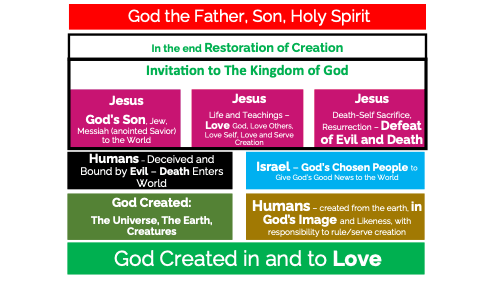
I embrace foundational dogmas of Christian faith:
- God as the Creator,
- Humanity’s deception and bondge to the evil of this world and to death itself,
- The Jewish people as God’s chosen people to reflect devotion to God and God’s desire for not just societal goodness, but human thriving.
- Jesus as the incarnation of God in human form.
- Jesus as Messiah, to the Jewish people and to the world.
- Jesus life, teaching and actions.
- Jesus’ crucifixion death by the earthy authorities – including his own people’s religious authorities
- Jesus bodily resurrection three days after his death and then being with his followers for another 40 days.
- The mystery of the Trinity – the infinite and unending love between Father, Son, Spirit.
- God’s promised return to restore the world at the end of the age.
Alongside these dogmas, I also align with the principles of the Neo-Anabaptist theology, which emphasize God’s radical love and nonviolence.
At the core of these beliefs lies a transformative truth about the character of God: love is the very essence of God. This is most powerfully revealed through the life and person of Jesus. and especially his self-sacrificial death for our release from boindage to evil and death.
Back to the future for me. This understanding has not only reconnected me with the foundation of what originally drew me to Christianity but has also deepened and expanded my faith in profound ways. I am grounded in the conviction that Jesus, as the ultimate revelation of God throughout history embodies divine love in its purest form. This perspective has revitalized my faith and enriched my understanding of God’s infinite and boundless love.
Drawing from my first year in the seminary program, which focused on the Meta-Narrative of Christianity, I have developed a clearer ability to articulate and share my faith. By exploring the historical, cultural, and theological context of the Bible and learning from prominent theologians—most notably Greg Boyd himself—I have gained a deeper and more nuanced understanding of Christianity and its teachings
I have also come to understand that Christianity is not just a set of beliefs or rituals but a way of life. It calls us to love our neighbors as ourselves, and not only that, but to love our enemies. It calls us to seek restorative justice for all people, especially the oppressed – the widow, the orphan, the immigrant. It calls us to care for the earth – for God’s creation. This holistic approach has helped me see the interconnectedness of faith and action, and how they work together in bringing about God’s kingdom on earth.
So, I am finally able to share, with both some confidence (although these may change – as I’ve found is natural) and humility, the core beliefs that now form the foundation of my faith. These core beliefs are shown visually as follows:
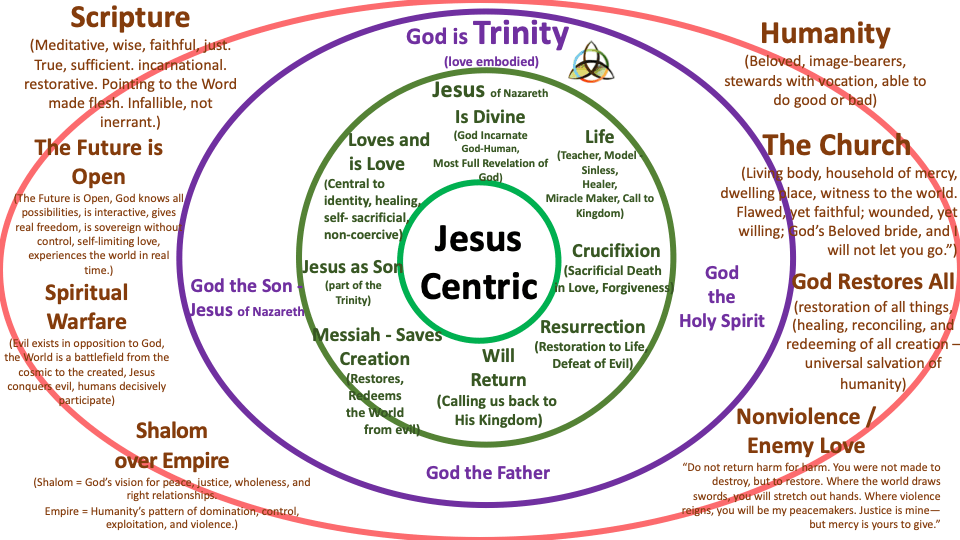
Next I will offer some explanations of this visual in further blog posts, But some of these subjects are deep beyond what I can provide – so my explanations may feel brief. Lifetimes of study and been spent on these subjects, entire theologies defined and adopted, books written, dissertations given, curricula developed, classes taught, etc. – you get the picture.
But, each post will hopefully whet your appetite for more. And I’ll try to provide explanations in the following outline:
- What is the belief?
- How does the belief fit within other alternatives?
- Why I chose to believe what I do?
- What scriptural passages support my belief?
- Who are supporters for this belief (Jewish, Old and New Christian Voices)?
So, the next blog posts will be on these core doctrines of my Christian beliefs:
- Being a Jesus-Centric Christian
- Not Being a Jesus-Centric Christian – examples of those belief systems that change, add or subtract from applying Jesus as the central focal point of their beliefs.
- Jesus of Nazareth, some of his Attributes
- Jesus Devine – Jesus is God
- Jesus Life – Jesus lived amongst us humans
- Jesus Crucified – The world, the powers at the time executed Jesus, and Jesus let them
- Jesus Resurrected – Jesus returned from being dead, and either interacted with or was seen by over 500 people.
- Jesus Return – Jesus promises to return to call us and bring us fully into God’s Kingdom.
- Jesus as Messiah – Jesus came to fulfill God’s promise of a Messiah for the Jews and the world.\
- Jesus as Son – Jesus’ is one part of who God as the Son, in addition to the Father and the Spirit.
- Jesus is Love – Jesus essential essence as God/human is love – offering up his life self-sacrificially to save humanity and all creation from evil..
- God as Trinity – Father, Son, Spirit – providing the model of perfect love in relationship.
- About Humans, Evil, Scriptures, the Church, the Future, How We Ought to Be and What to Hope For
 SeePhas