Lately, King David—the second king of Israel in the 10th century BC—keeps surfacing in my world. This weekend I’ll see the Sight and Sound production of David in Branson, MO.
Over the past few years, I’ve spent time in the Hebrew Bible, trying to understand its literature and what it means for God’s kingdom. David’s story often gets elevated into legend: “the shepherd boy who killed Goliath,” “Israel’s greatest king,” “the warrior who never lost a battle,” “the man after God’s own heart.”

But the reality is more complicated. David did rise to the throne, but within a generation Israel was divided, eventually to be conquered. He established Jerusalem as the political and religious capital, though even that was done under God’s questioning of whether He needed a “house.” David fought as a warrior and sought God’s heart, but he also committed adultery, abused his power, and orchestrated murder. His family was chaos—multiple wives, children at odds, and two sons who tried to kill him. His household was marked by rivalry, violence, and rebellion.
More recently, I’ve heard David compared to the current U.S. president. Some Christians acclaim Trump by pointing to David: both deeply flawed, yet used by God. The argument goes: “If God used David despite his failures, can’t He also use Trump?”

Let’s explore that.
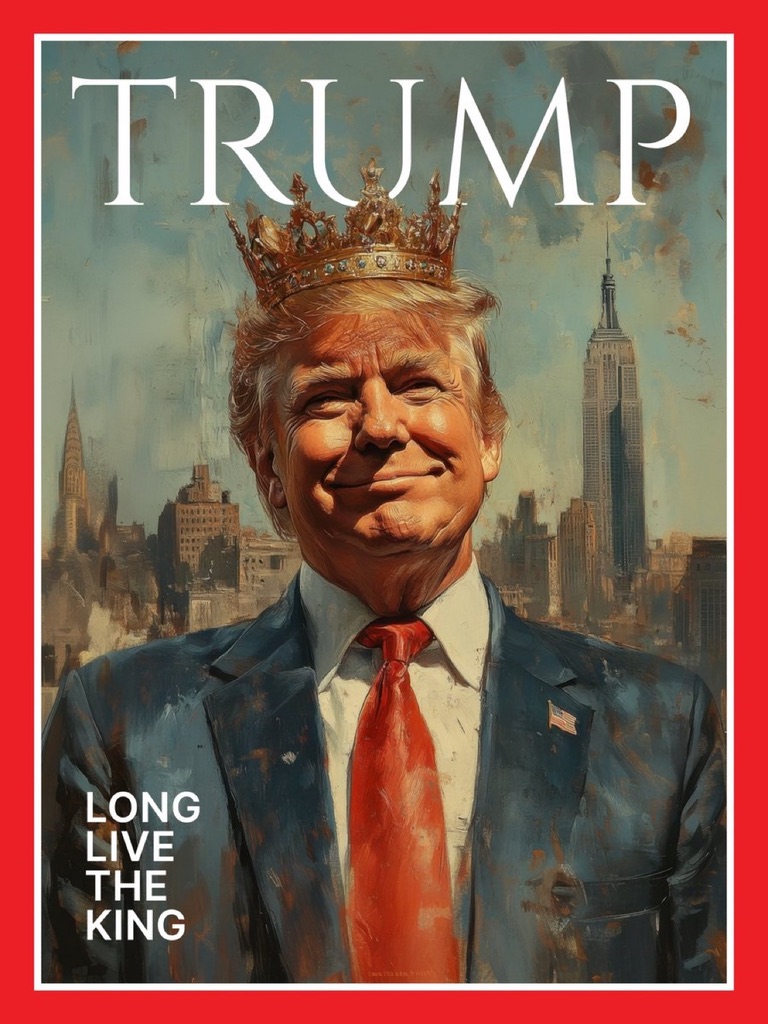
Anyone who knows me knows I’m disturbed and disheartened about what’s happening in the US through Donald Trump. I am troubled by his relentless self-adulation. I am disturbed by his willingness to do whatever he craves—even when destructive and evil—then dismiss it, most often without consequence. But what alarms me most is his unquenchable thirst for absolute power.
Yet even more disheartening than Trump himself are his followers. Many see him as the “strong man” needed to restore America to what they imagine is its rightful heritage: white, male, and “Christian.”
This last claim is most disheartening when we look at the numbers:
- 56% of professing Christians voted for Trump.
- 72% of white Christians.
- 82% of white evangelicals.
Politics and Government: From Representation to Power
Politics was once about electing representatives to govern within the limits of law and duty. Today, it has largely become about disruption and seizing power. So, who is most benefiting from this shift?
- Wealthy elites and corporations
- White cultural Christian conservatives
- White nationalist groups
- Media who thrive on division
- Foreign authoritarian leaders who benefit from division
- Above all, Trump himself—his family, loyalists, and insiders
Christian Nationalism, and the Kingdom Question
The Rise of Christian Nationalism

Many cultural Christian conservatives have embraced what is now called Christian Nationalism—the merging of faux-faith with political identity. Surveys suggest that half of America’s professing Christians identify with this ideology.
One of the most troubling traits is a willingness to justify violence to achieve political ends. We saw this on January 6, 2021, where it has been estimated that up to 60% of participants and those arrested/convicted identified as evangelical or conservative Christians.
A Theological Crossroads
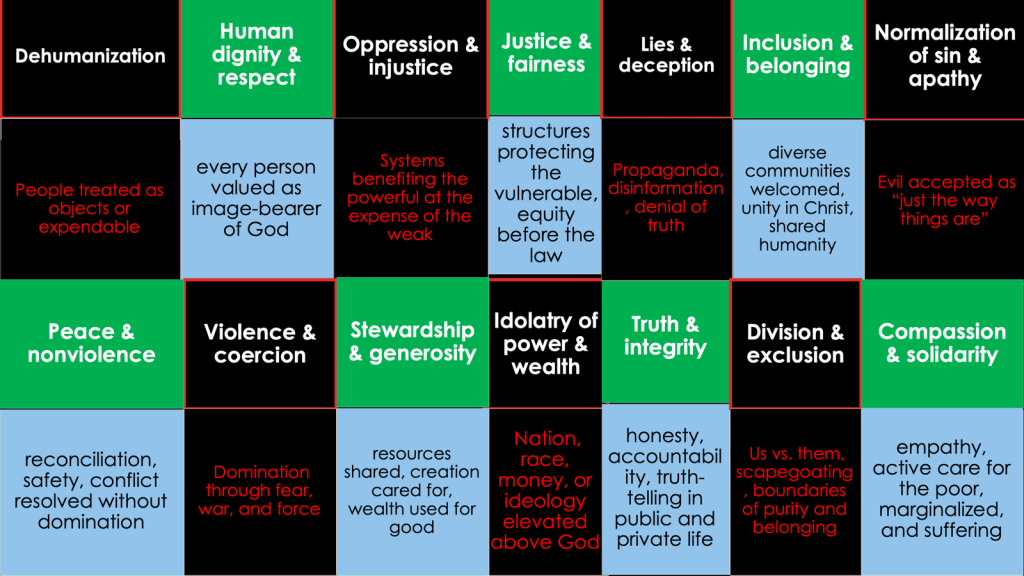
The crucial question is this: Do actions being taken now align with the vision of the Kingdom of God—or with the vision of the empire and powers of this world?
- The Kingdom of God is marked by restorative justice, peace, humility, and truth.
- The empire of this world is built on power, domination, violence, deceit, and exclusion.
How is our vision?
Is this our vision?
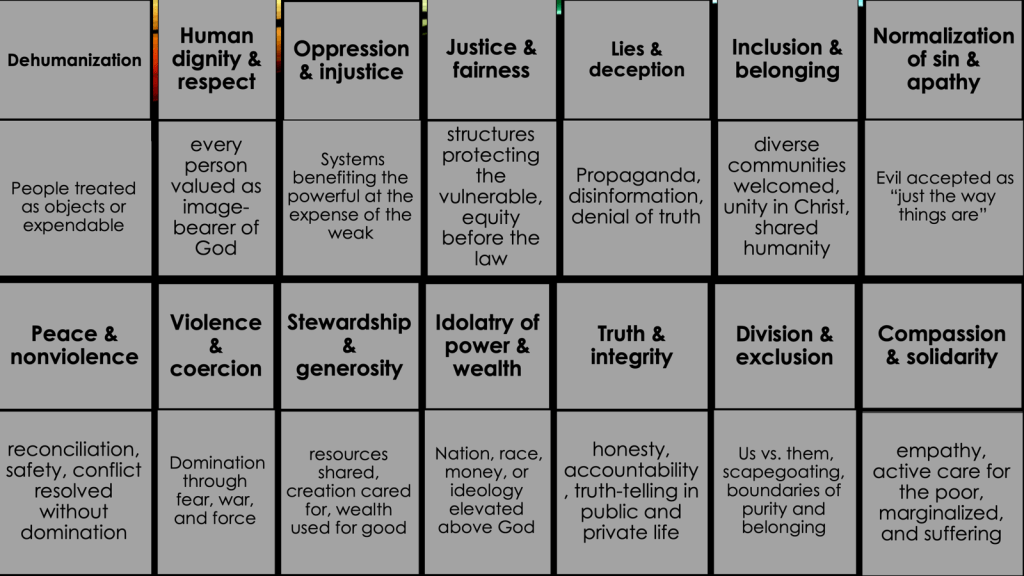
Which story are Christians choosing when they align with vision being played out?
The “Flawed Leader” Argument
Some Christians defend Trump by pointing to biblical figures like King David. David was deeply flawed yet chosen by God. The argument goes: “If God used David despite his failures, can’t He also use Trump?”
It’s a serious question—but also a dangerous one if it blinds us to the difference between God’s kingdom and human empires.
David: The Flawed King After God’s Heart
David’s story is anything but sanitized. Scripture records his triumphs—defeating Goliath, uniting Israel, writing psalms of worship. But it also records his darkest failures—abusing power with Bathsheba, arranging Uriah’s death, and enduring rebellion in his own household.
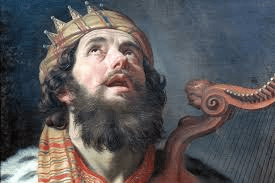
What sets David apart is not political genius or charisma but repentance. When the prophet Nathan confronted him, David didn’t double down. He collapsed in sorrow, fasting and confessing: “Create in me a clean heart, O God” (Psalm 51). His greatness lay not in perfection but in brokenness transformed by grace.
Trump: The Disruptor Without Contrition
Donald Trump’s appeal, like David’s, lies in disruption. He positions himself against elites and inspires loyalty among supporters who believe he fights for them. To many, he is the “strong man” in a chaotic world.

But here the comparison breaks down. Trump is not known for repentance but for defiance. His brand is not humility but bravado. Where David waited for God’s timing to seize power, Trump pursues power as an end in itself. Where David made worship central to his reign, Trump makes symbolic religious gestures while seeking power, and domination.
The Heart of the Difference
Superficially, both men were flawed, controversial, and influential. But the essence of David’s story is not that God blesses corruption to achieve political goals—it’s that repentance matters. David’s failures did not define him because he turned back to God with a contrite heart.
That is the pivot we do not see in Trump. The biblical lesson is not: “God uses flawed men, so character doesn’t matter.” It is: “God calls flawed men to repentance, and His Kingdom purposes advance through contrite hearts.”
Why This Matters Now
When we compare, aren’t we revealing more about ourselves than about them. Do we excuse wrong-doing in the name of effectiveness? Do we believe political power is the ultimate stage for God’s work? Or do we measure leaders by humility, repentance, and service to something greater than themselves?
David’s story warns us: leadership without repentance is doomed, no matter how effective it looks in the moment.
Is this the vision corerection we need?

✦ Final Word
Yes, God can use anyone—David, Trump, you, me. But if we flatten David into a political mascot, we miss the point. David’s greatness was not his throne but his tears. Not his power but his psalms. Not his victories but his contrition.
 SeePhas