By Peter Brandt | SeePhas

The Socioeconomics of Enough
A Reflection on Economics, History, Scripture and a Conversation with a Young Buck
Every one of us eventually faces the question:
How much do I need? Do I have enough?
Not enough in the shallow, consumer sense — but enough in the sense of our flourishing.

Over Thanksgiving this year, that question surfaced again for me — not in quiet contemplation, but in an unexpected conversation with a bright young man, a GOP legislative aide whom I affectionately will call a “young buck.”
He’d just aced the LSAT and was ready to tackle law school applications. We quickly got into a deep conversation about politics, economics, morality, and the nation’s future. His energy and strong political views showed he was really keen on a public policy career.
What followed was less a debate and more a journey into the meaning of “enough.”
A Young Buck’s Vision of Fairness
At one point he said something that caught my attention:
“Taxing the wealthy more than everyone else is unfair.
They produce so much for the economy, and they should be able to keep what they earn. They produce value.”
I simply asked:
“For whom?”
“Everybody.” He clarified: “lower taxes for the wealthy, high earners, business owners — those who keep the economic engine growing. Letting them keep their own money,” he argued, “benefits everyone”.
I commented that his views could reflect certain ideologies – perhaps one could be “libertarianism”. He said, “Yes, I would say I admire that ideology.” But there could be others, too.
I have added these as the key ideologies adopted by those who often oppose taxation and regulation.
- Libertarianism says: “It’s their money, you have no right to take it.”
- Supply-Side says: “If you let them keep it, they will create jobs for you.”
- Objectivism says: “They are heroes for making it; you are ungrateful for asking for it.”
- Social Darwinism says: “They have it because they are better than you.”
Then came the question that framed the rest of our discussion:
“Do you believe this kind of policy actually produces a flourishing society?”
He said yes, confidently.
So we turned to history.
The Great Depression:
Our Most Devastating Economic Era
I asked him:
“When has the most devastating economic era in American history?“
He didn’t hesitate:
“The Great Depression.”
“Yes, I agree,” I said. “So what caused it?”
He gave the standard answer — “tariffs, especially the 1930 Smoot-Hawley Act”.
“But tariffs were a response to something,” I said. “What policies led to the 1929 crash and created the felt need for tariffs?”
We walked through some of the socioeconomic philosophy of the 1920s — a set of policies known as Laissez-Faire: This was the advertised economic philosophy of 1920s leaders like Presidents Harding, Coolidge, and Hoover. The theory was that if the government stopped regulating business and cut taxes, the “free market” would naturally create prosperity for everyone.
What we didn’t discuss, but is relevant is that the result of these policies was something different—a socioeconomic period that could be called Oligarchical Capitalism. Without regulation and low taxes a small group of wealthy elites (oligarchs) consolidated massive power. By 1929, the top 0.1% of Americans had an aggregate income equal to the bottom 42%.
| Era | Top 0.1% Income Share | Equivalent Bottom % | Context |
| 1929 | 12% | Bottom 42% | Peak inequality before the Great Depression. |
| 1970s | 2–3% | Bottom 10–15% | The “Great Compression”—a period of high middle-class growth. |
| Today | 10–11% | Bottom ~40% | A return to Gilded Age/1920s levels of concentration. |
This era was not a one time thing – according to the chart above.
1920s: Oligarchical Capitalism

A System Built for Speculation
Consisted of:
1. Extremely low taxes on the wealthy and corporations
(with the top rate cut to 25%)
2. Minimal financial regulation
(with no SEC, no standardized financial reporting)
3. Weak antitrust enforcement
(so that monopolies and trusts flourished)
4. A pro-business, anti-labor philosophy
(“The business of America is business”, Calvin Coolidge, January 17, 1925)
5. Cheap credit and permissive monetary policy
(with large purchases being bought on installment plans that hid interest)
6. High tariffs, low domestic oversight
(with an average of 15.2% on dutiable imports
– today average tariffs are 14–19 % – the highest in 90 years)
7. No meaningful social safety net
(with local charities – states, families, churches, and local communities – being expected to handle crises – they mostly didn’t)
These policies fueled a speculative boom and a fragile economic structure.
It collapsed, and the failure was comprehensive.

The Human Cost
When the crash came:
- Unemployment soared to 25% — and up to 50% in major cities.
- 9,000 of 25,000 (40%) banks failed, wiping out life savings.
- Deflation, falling wages, and rising debt crushed households.
- Breadlines and homelessness became daily realities.
- Families lost homes and farms by the millions.
- The Dust Bowl uprooted 2.5 million people.
- Youth dislocation created a “hobo culture” of teenagers riding rails in search of work.
This wasn’t an abstract economic failure.
It was a moral and human disaster. Instead of flourishing – suffering resulted.
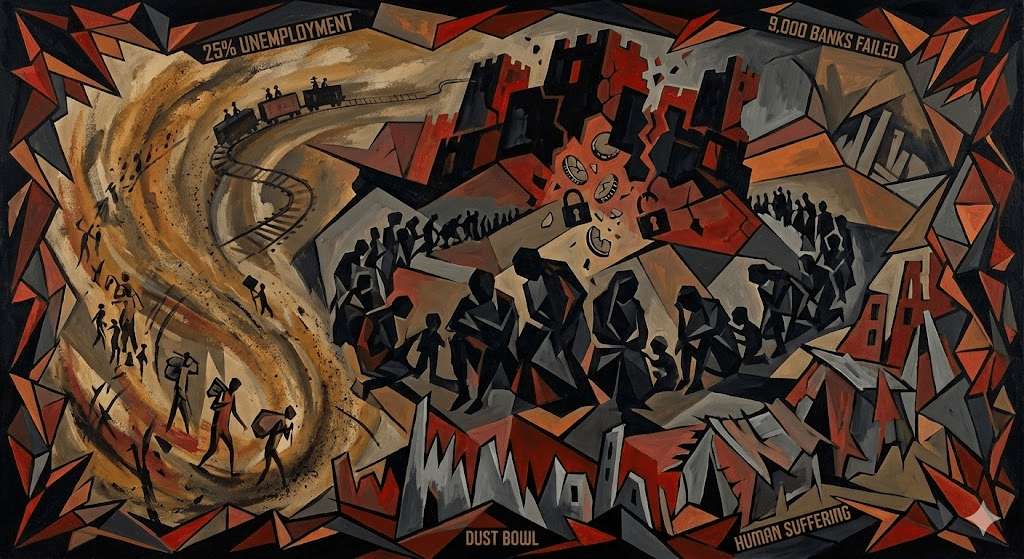
And it emerged from the very philosophy we started with – don’t tax the wealthy, low regulation and free markets will equal everything out.
He grew more thoughtful. Weighing and resisting – but also evaluating.
What follows are thoughts I had later – after our Thanksgiving conversation
First – A Framework for Evaluating Socioeconomic Systems
This is a framework I use to evaluate any socioeconomic system — ancient Israel, modern America, the Roman Empire, or the 1920s — a profile of the socioeconomic ideology can be developed:
1. How it creates wealth
2. Who controls property
3. How wealth and power are distributed
4. How it treats labor and human dignity
5. The role and size of the state
6. How markets and trade function
7. How it protects the vulnerable
8. What worldview or theology it expresses
9. Its demographic and technological realities
10. How it handles security
11. What values it incentivizes
12. How it prevents collapse
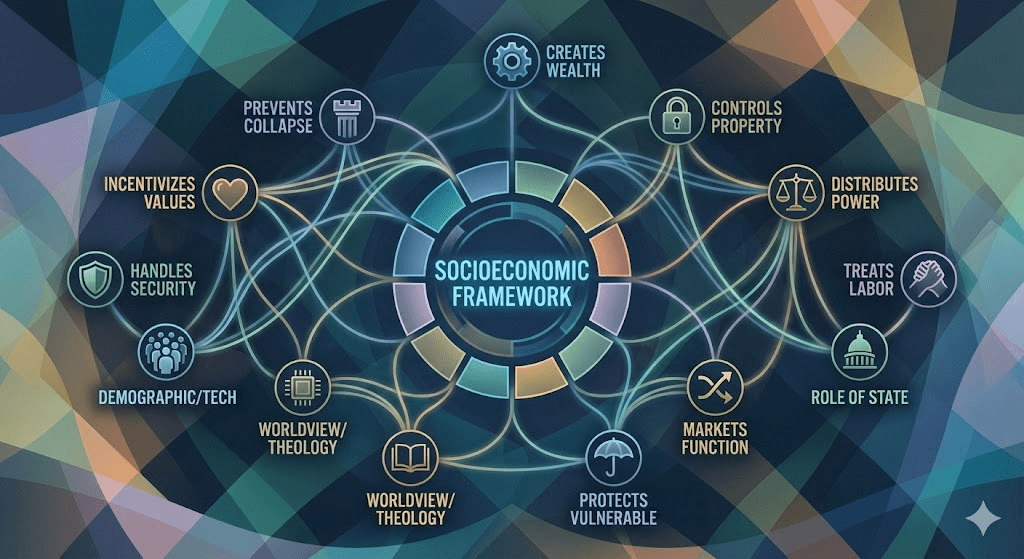
By these measures, the economic order of the 1920s was textbook oligarchical capitalism—a system built around concentrated wealth, concentrated power, and minimal protection for ordinary people.
The New Deal was the deliberate corrective, an attempt to rebuild an economy capable of resilience, shared prosperity, and structural justice. Economist John Kenneth Galbraith later described this approach as countervailing power: a system in which the state intentionally ensures that big business, big labor, and big government balance one another so no single force dominates the whole.
More on the socioeconomic logic of the New Deal in another post.
Second – The Biblical Idea of “Enough”

Turning to Scripture — The Place We Didn’t Have Time to Go
When we talk about economic systems, if we have a faith, there’s another source we to turn to.
Not charts.
Not political talking points.
Not the assumptions of whichever era we happen to inhabit.
Scripture.
Not as a policy manual.
But as a revelation of God’s heart for human life — and that includes economic life.
The God Who Promises “Enough”
From the beginning, God reveals Himself as the One who provides enough.
Not endless accumulation.
Not elite preservation.
Not winner-take-all competition.
Enough.
In Scripture, enough becomes the central rhythm of God’s economic imagination:
- Sabbath → limits woven into creation
- Jubilee → reset for land, labor, and debt
- Gleaning → margin for the poor
- Shared inheritance → broad distribution of property
- Daily bread → sufficiency, not excess
- Hospitality → including the stranger, the immigrant
- Justice for the vulnerable → structural, not optional
- Contentment and generosity → the forming of the human heart
God builds limits into His economic vision.
Limits on exploitation.
Limits on debt.
Limits on accumulation.
Not to restrict life —
but to make room for dignity, community, and resilience.
In Contrast: The Oligarchical Pattern
A system like the Oligarchical Capitalism of the 1920s follows an older script — a script we’ve seen before.
It is marked by:
- concentrated wealth
- concentrated power
- fragile economic structures
- rampant speculation
- abandonment of the vulnerable
- a theology of accumulation
- no meaningful protections for those on the margins
This pattern isn’t new.
Ancient Egypt had it.
Rome had it.
America had it in the 1920s.
It is Empire. The anti-kingdom — the rival to God’s vision for human life.
And if we’re honest, we can feel the drift again today.
What Does God Want for Us — His Humans?
This was the real question simmering beneath my conversation with the young buck.
Not “What tax rate works?”
Not “Which party is right?”
Not “Is capitalism good or bad?”
But something more fundamental:
What kind of human society does our economic system form?
Does God desire a world where:
- the wealthy protect themselves while the poor suffer?
- accumulation is treated as a virtue?
- speculation replaces stewardship?
- the vulnerable must rely on charity rather than justice?
- families absorb the cost of elite decision-making?
- households collapse at the slightest economic shock?
Scripture’s answer is clear:
No.
God desires:
- shared flourishing
- just and protective structures
- limits that honor human dignity
- stable, resilient communities
- systems designed so everyone has enough
- economic rhythms that sustain life rather than extract it
God’s vision is always relational, communal, covenantal —
never oligarchic.
It leads to human flourishing, not human suffering.
A Closing Reflection
Near the end of our conversation, the young buck had paused.
Not defeated — simply quiet.
Had something shifted?
He began the conversation defending a system built to protect the wealth of the few.
He ended it considering a deeper, more searching question:
What kind of world does God call us to build?
And who benefits from the systems we defend?
History offers a parable:
- In the 1920s, America chose wealth concentration and deregulation.
It produced collapse. - In the 1930s, we chose limits, safeguards, and shared responsibility.
It produced stability.
And now, once again, we find ourselves standing at a crossroads.
The question before us isn’t ultimately political or economic.
It’s spiritual:
 SeePhas