Flourishing as the Measure
Why outcomes matter more than ideology

From Ideology to Orientation
Once I let go of party loyalty, I needed a new way to orient myself.
Not a vibe.
Not a tribe.
Not a set of slogans.
A metric.
For years, my political instincts had been trained to ask questions like:
- Is this fiscally restrained?
- Is government staying out of the way?
- Is the market free?

Those questions assume something deeper—that if a system is efficient enough, people will flourish automatically. They are rooted in a story of scarcity: that there is never enough to go around, that some will inevitably win while others lose, and that restraint is the primary moral virtue.
What I learned—first through policy, then through crisis, and eventually through Scripture—is that this simply isn’t true.
So I began asking a different set of questions:
- What if life is not defined by scarcity—but by sufficiency?
- What does it actually mean for human beings to flourish?
- How would we know if it’s happening?
These questions assume something different—that if we attend to conditions, share responsibility, and act with trust, there can be enough. Not limitless abundance, but enough for every life to be lived well.
That shift—from scarcity to sufficiency – became the center of everything that followed.
What Flourishing Is—and Is Not
Flourishing is not comfort.
It is not luxury.
It is not everyone becoming wealthy.
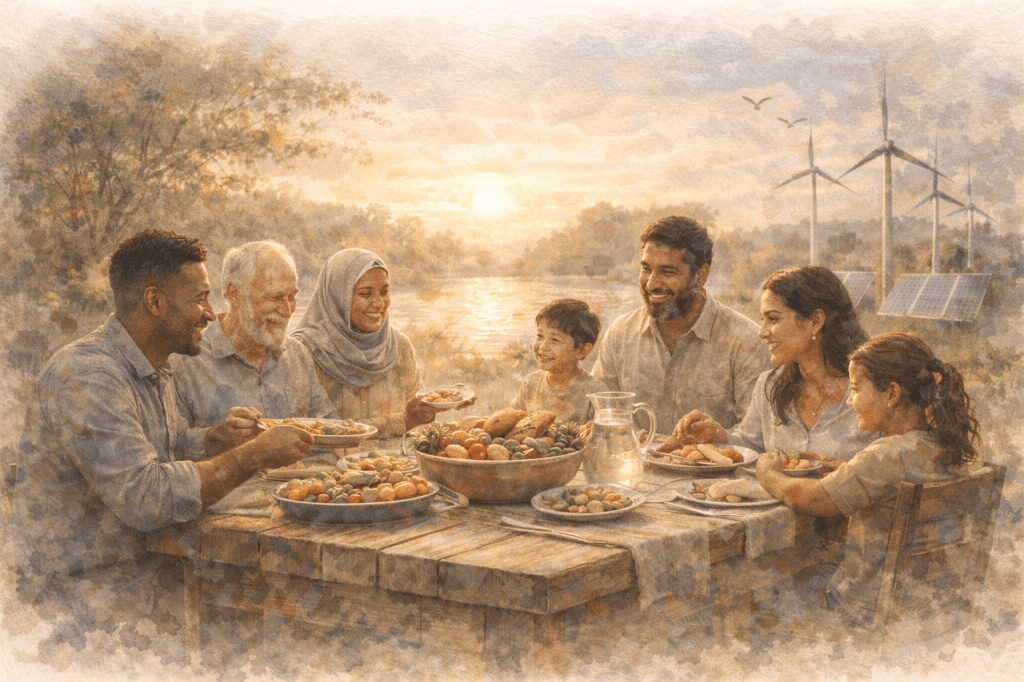
Biblically, flourishing is closer to shalom—a word that names a life that is whole enough to be lived. Not a perfect life, and not a protected one, but a livable one. A life marked by sufficiency rather than excess, safety rather than precarity, belonging rather than isolation.
A flourishing person is not someone who has everything.
It is someone who has enough—enough to live, grow, contribute, and hope.
In practice, flourishing shows up in ordinary and often fragile ways. It looks like bodies that can receive care when they break, and minds that can learn without being crushed by fear. It looks like work that sustains rather than depletes, relationships not constantly strained by scarcity, an economy that provides enough rather than demanding endless more, and a future that feels possible rather than foreclosed.
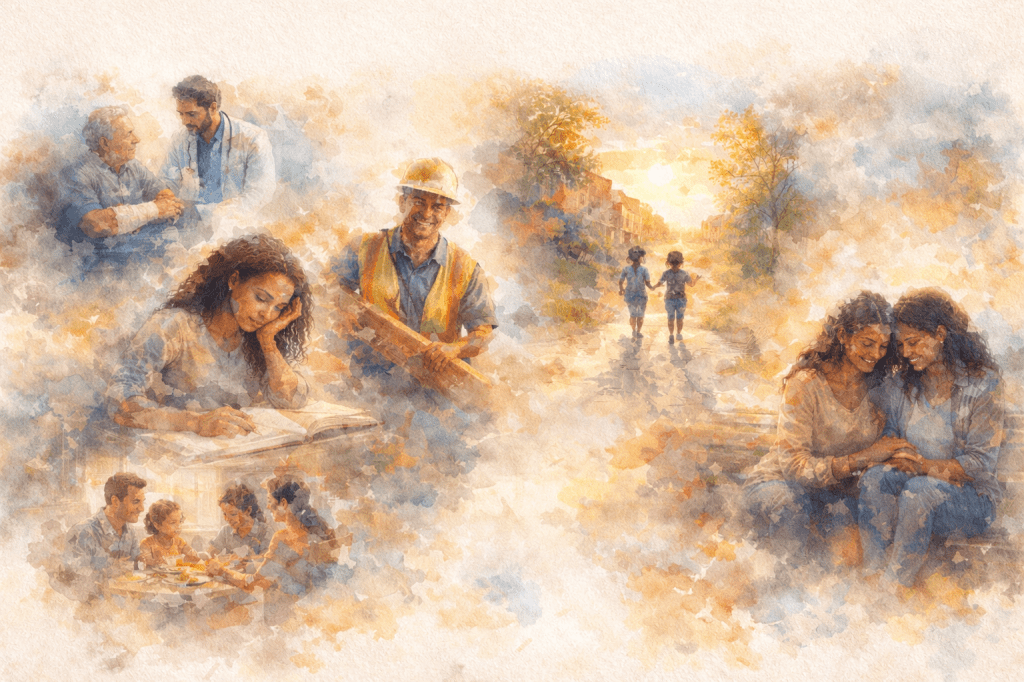
This is why Scripture does not limit itself to personal morality. It speaks about fields and wages, debt and rest, land and care for the vulnerable. God has always been concerned with the conditions under which human lives unfold.
Flourishing is not an abstract virtue.
It is a material, social, and spiritual reality.

It is also not rugged individualism, survival-of-the-fittest economics, or the belief that suffering is primarily a personal failure. Those ideas belong more to Empire than to Kingdom.
Empire explains hardship by turning inward:
If you didn’t make it, you must not have tried hard enough.
The Kingdom asks a different question:
What conditions made this life harder than it needed to be?
If Flourishing Is Real, It Must Be Measurable
This was the turning point for me.
For years, I was told that policies aimed at helping the poor were naïve, wasteful, or economically dangerous. But when I stopped listening to rhetoric and started looking at outcomes, a different story emerged.
If flourishing truly matters, then it should leave evidence. We should be able to ask clear, concrete questions about how people’s lives are actually going.
For example:
- Are people living longer, healthier lives?
- Are fewer people living in true poverty?
- Are mothers and children surviving childbirth and early infancy?
- Are fewer children growing up poor?
- Are fewer families one crisis away from collapse?
- Is social mobility increasing or declining?
- Do people have real access to housing, education, healthcare, and work?
These are not soft or sentimental questions.
They are empirical ones.
Lifespans can be tracked across history.
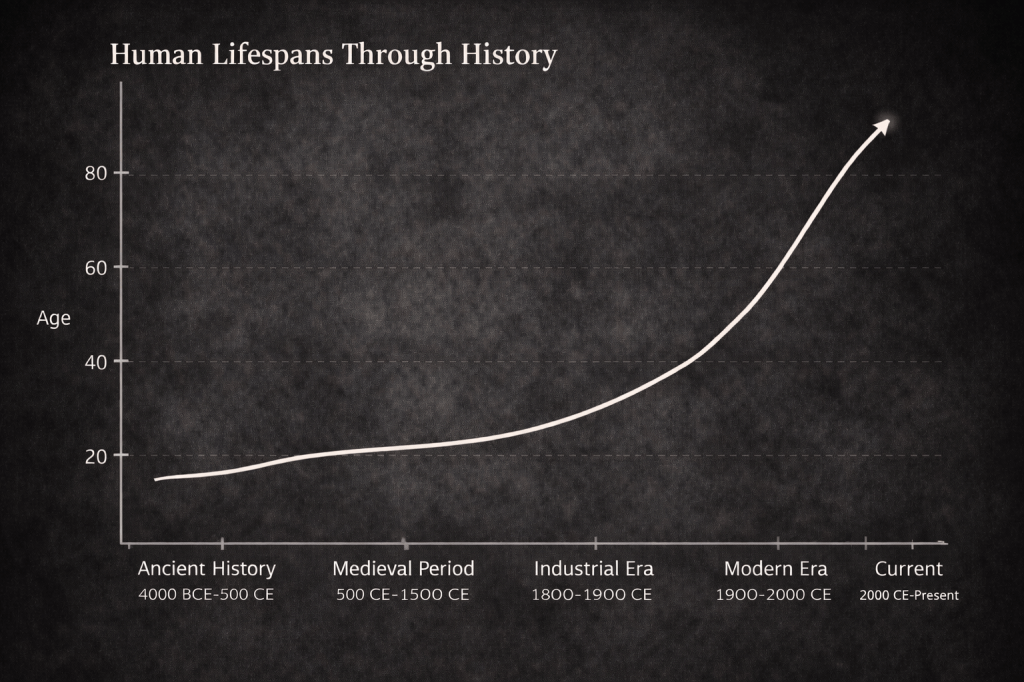
Outcomes can be compared across nations, states, and cities.
And when we do that—again and again—certain patterns appear.
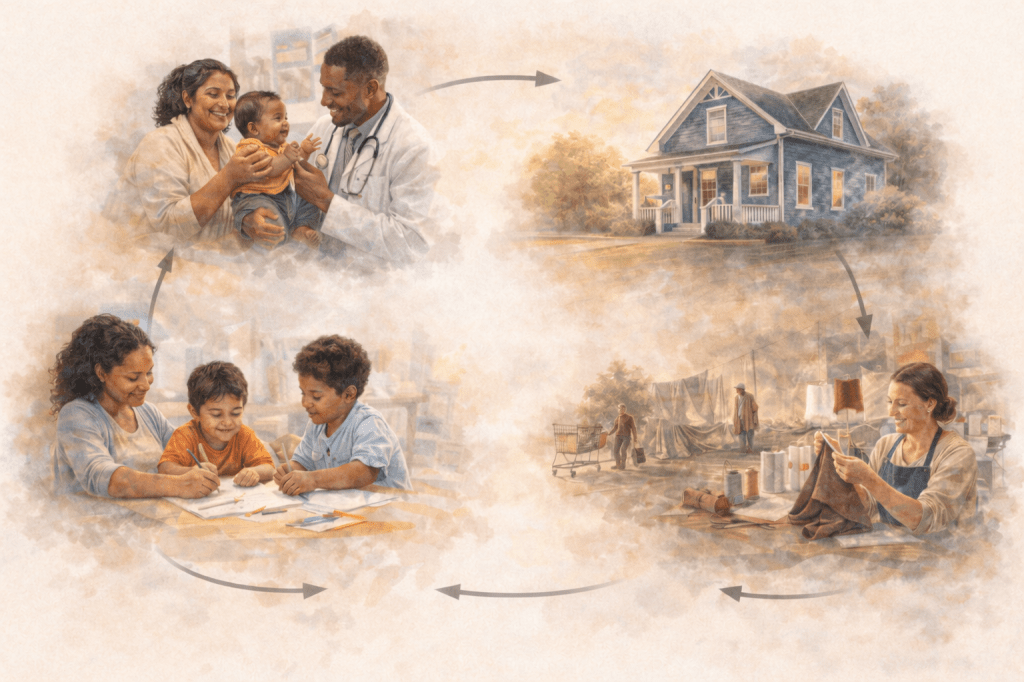
Societies that invest in human capacity tend to grow stronger. Healthcare access stabilizes work and family life. Early childhood education reduces crime and increases lifetime earnings. Housing stability lowers emergency spending, incarceration, and trauma. And safety nets often increase entrepreneurship, because failure is no longer fatal.
Different language.
Same truth.
If Flourishing Is Real, It Must Be Measurable
This was the turning point for me.
For years, I had been told that policies aimed at helping the poor were naïve, wasteful, or economically dangerous. But once I stopped listening to rhetoric and started looking at outcomes, a different story emerged.
If flourishing matters, then we should be able to ask:
- Are people living longer, healthier lives?
- Are fewer people living in true poverty?
- Are mothers and children surviving childbirth and early infancy?
- Are fewer children growing up poor?
- Are fewer families one crisis away from collapse?
- Is social mobility increasing or declining?
- Do people have real access to education, healthcare, and work?
These are not soft questions.
They are empirical ones.
Lifespans can be tracked across history.
Outcomes can be compared across nations, states, and cities.
And again and again, certain patterns appear:
- Investing in human capacity strengthens societies
- Healthcare access stabilizes work and family life
- Early childhood education reduces crime and increases lifetime earnings
- Housing stability lowers emergency spending, incarceration, and trauma
- Safety nets increase entrepreneurship because failure is no longer fatal
Different language. Same truth.
In recent years, a growing body of interdisciplinary research has begun to study human flourishing directly—asking not just how economies grow, but how people actually fare in their lives.
One prominent example is the Global Flourishing Study, a joint effort of Harvard University and Baylor University. Drawing on long-term, global data across psychology, sociology, economics, and public health, the study consistently points to a demanding insight:
People flourish most where meaning, relationships, health, responsibility, and material sufficiency are held together—especially within strong social and civic frameworks.
This is not ideology.
It is observable reality.
The Torah called it leaving the edges of the field.
Modern economics calls it return on investment.
Different language.
Same truth.
A New Scorecard
So I stopped asking:
- Is this program “big” or “small”?
- Is this government or market?
- Is this left or right?
And I started asking:
- Does this increase human flourishing?
- Does it increase lifespans?
- For whom?
- At what scale?
- With what long-term fruit?
Some programs pass that test.
Some don’t.
Some need reform, not removal.
But the test stays the same.
If a policy consistently leaves people with shorter lives—sicker, poorer, more anxious, and more trapped—it is failing, no matter how elegant the theory behind it is.
Why This Changed Everything for Me
Once flourishing became the metric, my politics became both simpler and harder.
Simpler—because I no longer had to defend a team.
Harder—because I had to follow the evidence, even when it challenged my instincts.
It also reshaped my faith.
I no longer see economic policy as separate from discipleship.
How we structure society says something about what—and who—we worship.
Flourishing is not the only value.
But it is a non-negotiable one.
Scripture is unambiguous about this:
God’s Kingdom is revealed wherever life is protected, dignity is preserved, and people are given room to grow.
Anything less may still function.
It may even prosper for some.
But it is not the Kingdom.
Looking Ahead
Once flourishing became my metric, one final question remained:
What does it cost—and what does it save—to build a society like this?
Empire always claims compassion is too expensive.
And the Kingdom keeps replying:
“Compared to what?”
That’s where the journey goes next.
 SeePhas