What Our Belief in Hell Reveals About God
Section 1: Why This Matters

I’ve spent far too much of my life thinking about hell.
That probably sounds like a strange admission. Most Christians don’t spend much time thinking about hell unless they’re trying to avoid it, and most people outside the Church would rather not think about it at all. Yet, for reasons I never expected, it became one of the most significant theological questions I have ever wrestled with.
It wasn’t always that way.
When I first became a Christian, hell was not my focus. In fact, before becoming a Christian, it was one of the reasons I wanted nothing to do with Christianity. I had little interest in a religion that seemed preoccupied with telling people they were destined for eternal punishment in the afterlife. If that was the message, I wasn’t interested.
My attitude was simple: “Leave me alone. If I burn, I burn.”
I also wondered why I should be so concerned about the next life when I was still trying to figure out which way was up in this one. Did anyone really know what happened after death? Had anyone been there and returned to tell us? Why devote so much attention to something about which we seemed to know so little?
Perhaps that reasoning was not entirely wrong. Nevertheless, here I am.
But then something happened that changed my life.
A Catholic priest looked at me and told me, simply but emphatically, that God loved me.
I believed him.
That conviction shaped my faith for the next decade. It was reinforced through my involvement with Young Life, where the emphasis was always on the love of God revealed in Jesus. I came to believe that the good news really was good news—that God loved the world and was inviting people into his kingdom. For the first decade of my Christian life, that understanding was enough.
A decade later, however, I found myself in a very different place. After moving, I became part of churches where the doctrine of hell occupied a much more central place. I accepted what I was taught because I assumed it was biblical. I assumed Jesus had clearly taught Eternal Conscious Torment (ECT) and that faithful Christians simply accepted it, however difficult it might be.
For a long time, I did exactly that. In fact, I often found myself asking others, “You have an eternal destiny no matter what. Where do you want to spend it?”
Eventually, I went to work at an inner-city Christian school from that same theological family, where many of those beliefs were no longer soft-pedaled.


Depravity wasn’t simply taught; it was confessed. Nearly every prayer began with reminders of how corrupt and unworthy we were. God was presented as controlling everything—good and evil, salvation and damnation. The line between “us” and “them” became increasingly defined, and people outside our theological boundaries were sometimes viewed less as neighbors than as those who stood under God’s judgment. Hell was not merely a theological possibility; it was understood to be the eternal destiny of anyone God had not chosen to elect—which meant, in the end, it was never really my choice at all.
During those years, something inside me began to unravel. What I would later recognize as spiritual trauma slowly gave way to a painful process of questioning beliefs I had once assumed were beyond question.
Then, in the midst of that struggle, someone from that theological tradition said to me, in a well-meaning way, that Jesus talked more about hell than almost anything else. If that were true, I needed to rethink my priorities.
Tilt.
I didn’t know how to answer. More importantly, I didn’t know whether it was true.
What had happened to the God who loved me—and whom I believed loved everyone else, unconditionally and infinitely?
Now years later, I have returned to scripture with fresh eyes. Learning to read Jesus within the Jewish world in which he lived transformed the questions I was asking. I wasn’t looking for a different doctrine of hell, nor was I trying to overturn centuries of Christian belief. I simply wanted to know whether the doctrine I had inherited actually arose from the life and teaching of Jesus.
As I continued that study, I realized I had been asking the wrong question.
The question was not simply whether hell exists or even whether Jesus spoke about it. The deeper question was:
Does the doctrine of Eternal Conscious Torment faithfully reflect the character of God revealed in Jesus?
Christianity makes an extraordinary claim: if we want to know what God is like, we look to Jesus. He is “the image of the invisible God” (Colossians 1:15), and he tells Philip, “Whoever has seen me has seen the Father” (John 14:9).
If that is true, then every Christian doctrine—including the doctrine of hell—must ultimately be examined in the light of Jesus’ life, teaching, and character. That conviction became the starting point for everything that follows.
The purpose of this article is to examine Eternal Conscious Torment honestly: what it claims, how it became dominant, and what it has done. Readers can then decide whether it reflects the God revealed in Jesus and what they believe about hell and humanity’s final destiny.
This article does not attempt to determine precisely what happens after death or to construct an argument for any alternative doctrine. Its argument is narrower: Eternal Conscious Torment is not another name for divine judgment, nor is it a doctrine Jesus explicitly or systematically articulated. It is a doctrine that developed over centuries of Christian interpretation and was shaped, in significant ways, by changing understandings of immortality, justice, punishment, authority, and power. In some settings it has been used to frighten, control, exclude, and justify mistreatment of people identified as condemned.
Before examining those claims, however, we must first ask how theological beliefs acquire their authority. How do we know what we think we know?
Section 2: How Do We Know What We Think We Know?
As I grew in my faith, I heard people say a lot of things about Christianity, God, Jesus, the Bible, and nearly every other subject—including hell.
Some of those claims were wildly wrong. I heard that the earth was flat, that the Rapture would occur on May 21, 2011, that dark skin resulted from God’s curse on Ham’s descendants, and that if people would only “sow their seed” into a particular ministry, God would multiply it back to them a hundredfold.
What troubled me was the confidence with which these claims were presented as Christian truth. Bible verses were quoted, sermons were preached, and conclusions were announced as though no faithful Christian could question them. Yet confidence did not make them true, and quoting Scripture did not guarantee that Scripture had been understood faithfully.
Eventually, I had to ask how I had come to believe what I believed. When I applied that question to hell, I realized that I had not reached my conclusions through an independent study of Scripture, history, language, and theology. I had inherited them. People I trusted taught me what hell was, who went there, and how long it lasted. Their interpretation became my belief and, over time, felt nearly indistinguishable from the Bible itself.
But hell is not self-evident or universally understood. Christians committed to Jesus and Scripture reach different conclusions about it. Nor can hell be examined through ordinary observation. Visions and near-death experiences may be meaningful to those who experience them, but they cannot independently establish a doctrine for everyone else. What we believe about hell therefore depends upon what we accept as revelation and how we interpret it.
That does not mean every conclusion is equally convincing. It means that our confidence should not exceed the evidence. Before deciding what to believe about hell, I needed to ask what supported the doctrine, how closely it stood to the center of Christian faith, and whether it came from Jesus, Scripture, later Christian interpretation, or the culture and imagination surrounding me.
Helpful Frameworks to Understand
The following recently learned framework has helped me organize those questions. It places Jesus at the center of Christian faith, followed by Scripture, dogmas, doctrines, and opinions. The boundaries are not always clear, and Christian traditions define these categories differently. Still, the framework reminds me that as interpretation increases, so should humility.
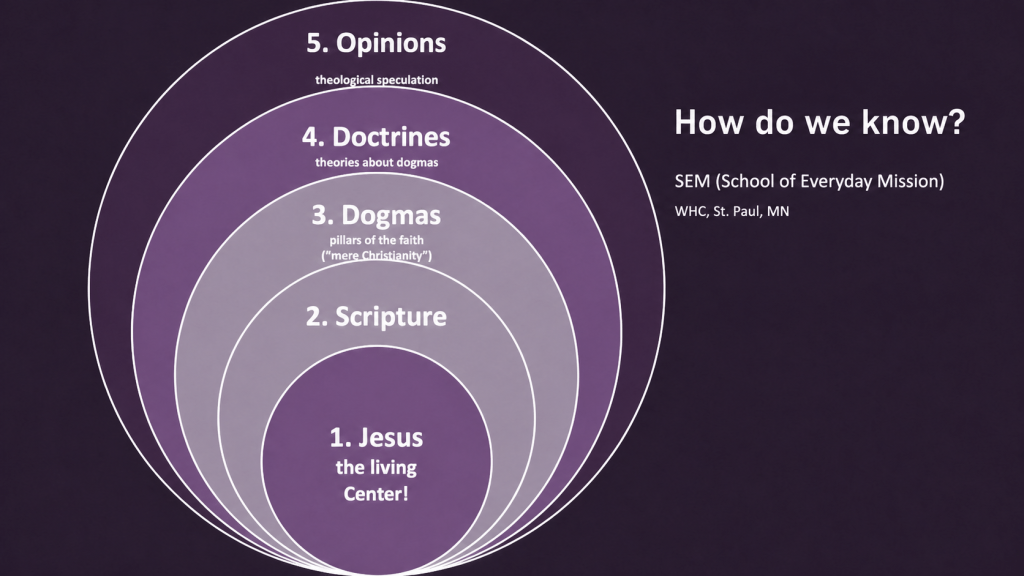
Christian traditions also understand theological authority differently.
Roman Catholicism looks to Scripture and Sacred Tradition as one deposit of faith interpreted by the Magisterium.
Eastern Orthodoxy understands Scripture within the larger life of Holy Tradition.
The Protestant Reformation insisted that Scripture alone is the final, infallible authority, while other authorities remain subordinate to it.
Methodism developed within the Anglican and Protestant world shaped by John Wesley. This is what is now called the Wesleyan Quadrilateral: Scripture remains primary while tradition, reason, and experience help us interpret it.
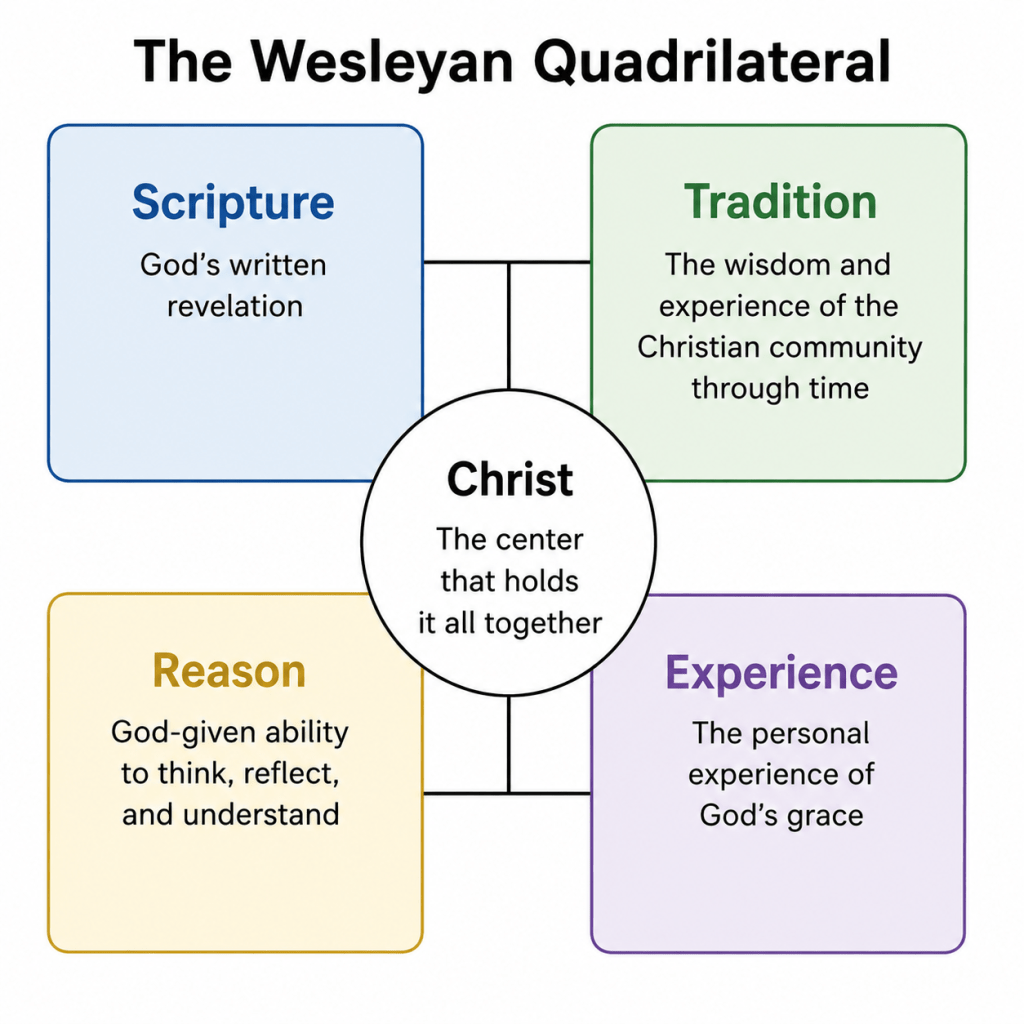
I kind of like this one. It seems the most honest description of how most of us assess our beliefs, whether we admit it or not. I place Jesus at the center because every Christian belief must ultimately be measured against the God revealed in him.
Interpreting Scripture
Whatever our tradition, Scripture is central to how Christians come to know God. The difficult question is usually not whether Scripture is authoritative, but how it should be understood.
Over the past several years, I have come to realize that reading the Bible is not as straightforward as I once assumed. It cannot simply be read as a modern news article, history book, or instruction manual. Scripture was written over many centuries in Hebrew, Aramaic, and Greek for particular communities living in particular times and places. Its authors used poetry, parable, prophecy, wisdom, apocalypse, narrative, law, letters, and other literary forms while assuming scriptural and cultural knowledge that modern readers can easily miss. Jesus and the apostles entered a conversation that had already been unfolding for centuries. Reading Scripture always involves interpretation.
Scripture is also remarkably interconnected. Its authors echo, quote, interpret, and build upon earlier writings. Jesus’ teaching is saturated with the Torah, the Prophets, and the Psalms, while the apostles interpret Jesus through Israel’s story. The New Testament repeatedly assumes that readers will recognize those connections. A passage rarely stands alone; its meaning is shaped by the larger story in which it appears.
This changed the way I approached scripture and in this case the idea of hell. I could no longer begin with a disconnected verse, or few English words and assume that their meaning was obvious. I needed to ask what kind of writing I was reading, what its words meant in their original setting, what earlier Scriptures it echoed, and how Jesus’ first hearers might have understood it.
No one—including me—approaches Scripture without assumptions, traditions, experiences, and questions. Throughout this study, I have tried to recognize those influences, listen across Christian traditions, and let Jesus remain the lens through which I understand Scripture and the character of God.
With these interpretive guardrails in place, I could turn to the next question: What do we actually mean when we use the word hell?
Section 3: What Is Hell?
Or, What the Hell Is Hell?
If Christians have been discussing hell for nearly two thousand years, we should at least agree on what the word means. I assumed we did. As it turns out, we do not.
For most of my Christian life, I assumed there was only one doctrine of hell: God finds a person guilty, and they suffer forever. I simply called it “hell,” though theologians call it Eternal Conscious Torment.
I assumed hell worked like this:
- Definition: An irreversible state where unrepentant sinners endure unending conscious separation and suffering under divine judgment.
- Systemic Logic: Because God is infinitely holy, any rebellion against Him is an infinite offense—demanding an infinite, conscious sentence.
A key distinction began to matter to me. We frequently collapse everything regarding the afterlife into one word—judgment. But God’s judgment actually consists of three distinct stages:
- Judgment — the process of bringing truth to light
- Verdict — the ruling or conclusion
- Sentence — the consequence or punishment that follows
Eternal Conscious Torment belongs to that third category—it is a specific claim about the punishment.
Tracing the Definition to Its Source
If we want to find where this systematic definition actually comes from, we have to trace it back to its originators.
- Was it pagan societies? No. While ancient cultures had various visions of the underworld and divine retribution, none matched the specific mechanics of Eternal Conscious Torment.
- Was it Israel and the Hebrew Scriptures? No. The Old Testament speaks of judgment, national exile, and Sheol (the grave), but contains no doctrine of post-mortem eternal torture.
- Was it Jesus—his words, actions, and warnings? No. Jesus issued urgent warnings using regional imagery like Gehenna and outer darkness, but he provided no systematic formula explaining afterlife mechanics.
- Was it the Apostles and New Testament writings? No. The Apostles warn of severe judgment, destruction, and “the second death,” but they leave us with a tapestry of images, not a unified, systematic definition.
The Disputed Vocabulary of “Hell”
Part of the confusion in the Bible stems from English Bibles. They historically translate several distinct Hebrew and Greek words into a single English word: Hell. When we look at the original languages, a very different linguistic map emerges:
| Biblical term | Language | Basic sense and context |
| Sheol | Hebrew | The grave or realm of the dead; commonly the destination of humanity, not only the wicked. |
| Gehenna / Gehinnam | Hebrew / Aramaic | The Valley of Hinnom outside Jerusalem; associated with idolatry, covenant judgment, destruction, and later expectations of judgment. |
| Hades | Greek | The realm of the dead, broadly corresponding to Sheol; not necessarily the final destination after judgment. |
| Tartarus / tartaroō | Greek | Confinement for rebellious spiritual beings; the verb appears once in the New Testament, in 2 Peter 2:4. |
| Aiōnios | Greek | Pertaining to an age or enduring through an age; often translated eternal, with its force determined by context. |
| Kolasis | Greek | Punishment or chastisement; whether it implies correction in Matthew 25 is disputed. |
When later theology and English translations gathered these distinct terms under one word—hell—it obscured the original Jewish imagery and created the illusion of a single, fully developed system.
Tertullian: The Architect of Endless Flame (c. 155–220 AD)
So where did the systematic definition come from? It emerged centuries later through Latin and Roman Christians who translated dynamic biblical metaphors into a rigid, mechanical system.
Born in Carthage (modern-day Tunisia), Tertullian was a trained legal scholar and the first major Church Father to write extensively in Latin. Known as the “Father of Latin Christianity,” he brought a forensic mindset to theology. Influenced by the Greek philosophical assumption that the human soul possesses inherent immortality, he reasoned that the loss of existence was impossible—making unending suffering the logical consequence for the condemned.
Around 197 AD, Tertullian offered one of the earliest explicit descriptions of the mechanics of Eternal Conscious Torment. In his Apology (Chapter 48), he described a unique, divine fire designed to preserve rather than destroy:
“The mountains retain their feature of burning continuously… Yet, though they burn, they are not consumed. Who will not take these as a proof of the eternal fire… which, while it consumes, restores; and while it destroys, repairs?”
In On the Resurrection of the Flesh (Chapter 35), he made this even clearer:
“The body will be raised up… so that it may endure eternal suffering in the fire… being supplied with an indestructible nature to fit it for an unending punishment.”
Tertullian was not merely repeating a systematic explanation given by Jesus or copied directly from a biblical passage; he was interpreting images and attempting to answer questions those images did not explicitly resolve.
Augustine: The Great Systematizer (354–430 AD)
While Tertullian drafted the early blueprint, Augustine of Hippo fully codified and standardized the doctrine for Western Christianity. As Bishop of Hippo in North Africa, Augustine’s massive work The City of God (De Civitate Dei) served as the definitive theological authority throughout the Middle Ages.
Augustine understood humanity’s rebellion against God as guilt deserving severe divine punishment. In The City of God (Book XXI), he systematically defended the mechanics of Eternal Conscious Torment against critics:
“Why then is it incredible that earthly bodies, which are mortal and corruptible, should endure in eternal fire without being consumed or destroyed?” (Book XXI, Chapter 2)
He insisted that “death” in Scripture when applied to hell did not mean the end of existence, but rather an endless state of dying:
“Their death will be eternal, because the soul will not be able to live without God, nor the body to be freed from torment… The second death is called so because the soul, separated from God, suffers endless pain in union with a body that cannot die.” (Book XXI, Chapter 3)
Through Augustine, Eternal Conscious Torment ceased to be just one interpretation—it became the dominant, orthodox framework of the Western Church.
What Major Traditions Mean by Hell
Because different streams of Christianity emphasized different parts of Scripture, history, and theology, they arrived at fundamentally different answers regarding what follows an adverse verdict:
| Tradition or view[ER1] | What hell or final punishment means |
| Roman Catholic | An eternal and irreversible state of self-exclusion from communion with God; the Catechism also speaks of punishment and eternal fire. |
| Reformed / Calvinist | Everlasting conscious punishment under divine justice and wrath; historic confessions speak explicitly of eternal torment. |
| Lutheran / Evangelical / Baptist | Generally everlasting conscious punishment, variously emphasized as inflicted suffering, exclusion from God’s favor, or both. |
| Wesleyan / Methodist | An eternal adverse destiny, while official sources are often less specific about the mechanics than Reformed or Lutheran confessions. |
| Eastern Orthodox | Final judgment and eternal hell, often described as anguish in God’s unveiled presence rather than divine withdrawal or active torture. |
| Anglican / Anabaptist | Internally diverse; contemporary positions include ECT, Conditional Immortality, and forms of hopeful or restorative judgment. |
| Conditional Immortality | Finite judgment culminating in the second death: permanent destruction and the end of conscious existence. |
| Universal Reconciliation | Severe but remedial judgment directed toward repentance, healing, and the eventual reconciliation of creation. |
| Judaism | No single equivalent to Christian eternal hell; Gehinnom is commonly described as temporary punishment or purification before the World to Come. |
Conclusion: A Human Construction
This comparison reveals that Eternal Conscious Torment is not another name for judgment, nor is it the only Christian understanding of what follows it.
The definition of hell we inherited was not handed down intact on day one. It was constructed across centuries of Roman-Latin theology—borrowing Greek philosophy, formulated by Tertullian, systematized by Augustine, and eventually institutionalized across Western Christianity.
Understanding this history frees us to step back and ask the most important question of all: Does this definition of hell actually reflect the character of God revealed in Jesus?
Section 4: How Did Jesus Grow Up to Become a Rabbi?
The World That Shaped His Understanding
Before asking what Jesus taught about judgment or hell, there is a simpler question we should ask: What had already shaped Jesus’ understanding of these things before he ever began teaching?
Christians confess that Jesus is both fully God and fully human. Luke tells us that he “grew in wisdom and stature, and in favor with God and man” (Luke 2:52). He was not born delivering sermons. He grew up in a family, a village, a synagogue, and a people. He learned the Scriptures of Israel, prayed Israel’s prayers, celebrated Israel’s festivals, and inherited Israel’s hopes.
If we want to understand what Jesus meant when he later spoke about judgment, Gehenna, or the kingdom of God, we should first understand the world that shaped him.
Jesus Becomes a Jewish Rabbi
Jesus did not appear as the founder of a new religion.
But he did take a direct, intentional path into the work of God—a journey rooted in his calling and shaped by the story of his people from the very beginning.
He was born into the covenant people of Israel. He was circumcised according to the Law of Moses, presented at the Temple, and raised in Nazareth. Like every observant Jewish child, he grew up hearing the Torah and the Prophets read in the synagogue. He learned the stories of Abraham, Moses, David, Isaiah, Jeremiah, and the other prophets. He celebrated Passover, Pentecost, and the other great festivals that reminded Israel of God’s faithfulness throughout its history.
Being raised in Nazareth, Jesus was formed in Galilee—a region marked by a vibrant, grassroots devotion to the Scriptures. While the Judean establishment in Jerusalem often looked down on Galileans as provincial, the region was a powerhouse of local Torah literacy. In Galilean villages, children memorized extensive portions of Scripture in synagogue schools, and community life was saturated with the text. It was from this deeply textual, working-class environment—rather than the halls of Judean political power—that Jesus stepped into public life.
By the time Jesus reached about thirty years of age—the traditional milestone for full maturity and spiritual leadership in Jewish culture—he began his public ministry, and people addressed him as Rabbi. Although the formal institutional academies of later Judaism had not yet developed, respected teachers of Torah were widely recognized. They interpreted Scripture, answered difficult questions, debated other teachers, and gathered disciples who learned by living alongside them.
That is precisely how the Gospels portray Jesus.
He taught in synagogues. He interpreted the Scriptures. He debated Pharisees and scribes. Yet unlike conventional teachers who relied solely on citing past traditions, Jesus spoke with a distinct, personal authority that astonished his hearers. He gathered disciples and invited them to follow him—not merely to learn his ideas, but to imitate his way of life. This was the standard path for a rabbi and his students: young men were invited to follow, called to imitate their teacher’s life over years of close immersion, and eventually sent out to carry that yoke forward with disciples of their own.
Jesus challenged many interpretations offered by other teachers, but he never rejected Israel’s Scriptures. Instead, he consistently claimed that God’s promises were reaching their fulfillment in him.
The Story Jesus Grew Up With
The story Jesus inherited began with creation.
God created humanity in his image to live in fellowship with him and to care for his creation. Human beings were made for life, relationship, and flourishing.
When sin entered the world, death, alienation, and violence followed. Yet the biblical story did not become one of abandonment. Instead, it became the story of God’s determination to redeem what had been broken.
- He called Abraham.
- He formed Israel into a covenant people.
- He delivered them from slavery.
- He gave them the Torah as a way of life.
Again and again, Israel experienced both God’s blessing and the painful consequences of abandoning the covenant through idolatry, injustice, and violence. The prophets repeatedly warned that rejecting God’s ways would lead to judgment. Yet those same prophets also proclaimed God’s faithfulness, promising forgiveness, renewal, and restoration beyond judgment.
This was the story every Jewish child knew. It was the story Jesus knew.
Why Jesus’ Words Already Had Meaning
When Jesus later spoke about judgment, Gehenna, the kingdom of God, resurrection, or the age to come, he was not introducing unfamiliar ideas. His hearers had grown up with these words just as he had.
Take Gehenna, for example. Long before Jesus was born, the Valley of Hinnom had become a powerful symbol in Israel’s history. Through the prophet Jeremiah, it represented the devastating consequences of Judah’s idolatry and covenant unfaithfulness. The valley became forever associated with Jerusalem’s destruction and exile—a sobering reminder that turning from God ultimately leads to ruin.
By the first century, Gehenna had also become an image some Jewish teachers used when speaking about God’s final judgment. Whatever nuances existed among different Jewish groups, Jesus’ audience did not hear the word as a blank slate. It already carried centuries of scriptural memory.
The same was true of other expressions Jesus used: Judgment. The Day of the Lord. Resurrection. The Kingdom of God. The Age to Come. These were not new concepts; they were part of the shared language and imagination of first-century Judaism.
The Hope Jesus Shared
The story Jesus inherited did not end with judgment, nor punishment. It ended with hope.
Israel looked forward to the day when God would finally fulfill his promises—when evil would be defeated, the dead would be raised, his people would be restored, and his kingdom would be established over all creation.
Different Jewish groups disagreed about how these promises would unfold, but they shared the conviction that God would ultimately set the world right.
That was the hope Jesus announced when he proclaimed, “The kingdom of God has come near.”
Before we examine what Jesus actually said about judgment and humanity’s final destiny, we should remember that he spoke as a Jewish rabbi to people who shared this story. His words were not spoken into a vacuum. They were spoken into centuries of Scripture, memory, covenant, and hope.
Only by hearing Jesus within that world can we begin to hear him as his first disciples did.
Section 5: What Did Jesus Actually Say?
Warnings, Gehenna, and the Kingdom of God
Earlier, I mentioned that someone confidently told me Jesus talked more about hell than almost anything else. I couldn’t dismiss the claim—but I couldn’t defend it either. I simply didn’t know whether it was true.
That realization sent me back to the Gospels with a much simpler question: Did Jesus ever actually use the word “hell”?
The answer is no.
We cannot separate Jesus’s words from the language he spoke. In Aramaic, Hebrew, and Greek, there was no word for “hell,” because the concept of an eternal post-mortem torture chamber simply did not exist in his world—and it still doesn’t exist in those languages today. Jesus could not talk about “hell” for a very simple reason: neither he nor his hearers had a name, a category, or a concept for it.
If Jesus Didn’t Say “Hell,” What Did He Say, and for What Purpose?
Jesus’s warnings were simple cause-and-effect declarations: “If you stay on this path, you are headed straight for disaster.”
When Jesus referenced Gehenna, he was offering a sobering warning of consequences, not pronouncing a verdict on a sentence of post-mortem punishment. For his first-century audience, the Valley of Hinnom (Gehenna) evoked centuries of prophetic history surrounding national crisis and covenant ruin. This was a sobering real-world warning for any first-century Jew.
He was not establishing a possible sentence within a system of afterlife torture. Like the prophets before him, he was warning his people of the disastrous, real-world end toward which their current path was leading them.
Even in Matthew 25, where many English translations speak of “eternal punishment,” the language requires care. Aiōnios is related to aiōn (“age”), and its precise force must be determined by context; kolasis carries a lexical history rooted in pruning, restraint, or corrective discipline. Neither word, by itself, establishes a doctrine of endless retributive torment.
Jesus’ warnings were real, and they were urgent. But they were always given within the larger context of God’s invitation to repentance and the coming of His Kingdom.
The Center of His Proclamation
When you read the Gospels with fresh eyes, one pattern becomes impossible to ignore: Jesus certainly issued warnings, but when you weigh his words on a scale, the contrast is staggering.
References to Gehenna appear roughly eleven times across all four Gospels. By contrast, Jesus speaks of the Kingdom of God or Kingdom of Heaven over one hundred times. He offers more than thirty distinct parables specifically designed to illustrate what this Kingdom is like—comparing it to a mustard seed, a hidden treasure, a feast, and a father running out to welcome a lost son home.
Jesus did not spend his ministry warning people away from an afterlife torture chamber. He spent his life inviting people into a present reality.
His message was not “Agree to these doctrines so you don’t go to hell.” His message was “The reign of God’s justice, healing, and peace is breaking into the world right now—turn around, step in, and live this way today.”
Everywhere he went, he embodied this invitation:
He sat at dinner tables with tax collectors and outcasts before they changed their behavior.
He touched the untouchable and declared forgiveness freely.
He warned that the greatest tragedy wasn’t being sentenced to an executioner, but standing outside arms-crossed while the feast was already going on inside.
Gehenna as Prophetic Warning: The Catastrophe of AD 70
To understand why Jesus used Gehenna, we must look at a moment that illustrates his heart and his prophetic concern. As Jesus approached Jerusalem for the final time, Luke records that he looked upon the city and wept:
“If you, even you, had only known on this day what would bring you peace—but now it is hidden from your eyes. The days will come upon you when your enemies will build an embankment against you and encircle you and hem you in on every side… because you did not recognize the time of God’s coming to you.” (Luke 19:41–44)
These are not the words of someone delighting in an abstract, eternal sentence. They are the tears of a prophet lamenting an impending historical catastrophe.
Jesus was warning real people living in a real city about a real crisis on the horizon. If Israel continued down the path of violent rebellion against Rome and rejection of God’s way of peace, it would lead to total national ruin.
Within a generation, Jesus’ warning became history. In AD 70, Roman forces under Titus breached Jerusalem, destroyed the city, and burned the Temple to the ground. The devastation transformed Jewish life forever.
As Christianity later moved farther from its Jewish roots and spread into the Greco-Roman world, many Western interpreters began reading these intense historical and prophetic warnings almost exclusively through the lens of individual afterlife destinies. The immediate, real-world setting of Jesus’ warnings—the crisis facing Jerusalem—was slowly forgotten.
So, Where Does That Leave the Hell We Were Taught?
If Jesus proclaimed the Kingdom, embodied restoration, and spoke of Gehenna within the tragic prophetic history of his own people, where does that leave the doctrine we inherited?
Jesus warned people, confronted evil, and spoke of serious consequences. But he never constructed the system that later theology called Eternal Conscious Torment: a God who actively judges, renders verdicts of guilt, and then actively preserves human beings in unending suffering where no correction, healing, or reconciliation can ever occur.
When we measure the doctrine of hell against the character of God revealed in Jesus, the contrast becomes impossible to ignore. Jesus reveals a God who seeks the lost, restores the broken, and overcomes evil with resurrection life.
How that inherited doctrine was gradually built after Jesus—through Latin theology, political empire, medieval institutions, and frontier revivalism—is the story we must turn to next.
Section 6: How Did Christians Come to Believe in Hell—and Why Do So Many Still Believe It?
When I first began asking where the doctrine of hell came from, I approached it much as I had approached the question of what hell actually meant: I expected to find something definitive. Perhaps Jesus had explained it unmistakably and the early church simply passed his teaching down. Perhaps an ecumenical council had debated the alternatives and settled the question. Perhaps Christianity’s historic creeds had clearly established Eternal Conscious Torment as the punishment awaiting the condemned.
I found no single moment like that.
What I found instead was a history. Hell developed slowly, as Christians tried to understand what happened after God’s judgment and what punishment followed an adverse verdict.
Ideas about death, underworlds, divine judgment, punishment, and the continuing existence of the dead existed throughout the ancient world. Christianity did not invent those questions, nor did it simply borrow its answer from one earlier religion.
Jesus and the apostles came from Judaism. Their scriptures told the story of creation and covenant, slavery and liberation, judgment and restoration. Human beings were embodied creatures whose life came from God. Death was an enemy, and the great Jewish hope increasingly became resurrection: God would raise the dead, confront evil, vindicate the righteous, and restore his creation.
As we have already seen, Jesus spoke seriously about God’s judgment. But judgment is not hell. Judgment is the process by which God confronts human beings and evil and renders a verdict. Hell is one particular claim about the punishment following an adverse verdict: that those who are condemned remain conscious under punishment forever.
Jesus never constructed that doctrine.
As the Jesus movement spread beyond its Jewish birthplace, its teaching was interpreted within new philosophical, linguistic, legal, and political settings.
Hell Develops
As Christianity spread into the Greek-speaking world, Christian thinkers increasingly engaged the philosophical traditions around them. Justin Martyr, Clement of Alexandria, Origen, and others drew upon Greek philosophy to varying degrees as they worked out what Christian faith meant for human life, death, judgment, and what came afterward.[R52]
At the center of the developing debate was a simple question: When God sees what is wrong with the world—and our part in it—what does God do about it? Christians agreed that God judges evil: God sees it truthfully, exposes it, confronts it, and acts. The disagreement was about what God’s response was intended to accomplish.
One important tradition in the Greek-speaking church understood God’s actions as ultimately directed toward setting things right. Evil could have severe consequences, and God’s response could involve judgment, discipline, correction, or punishment. But these were not ends in themselves. Their ultimate purpose was to overcome what was evil and restore what had been damaged. Origen of Alexandria, one of the most influential Christian thinkers of the third century, became the best-known early advocate of ultimate restoration, and Gregory of Nyssa would later develop similarly restorative ideas.
Another trajectory, increasingly influential in the Latin West, emphasized guilt, deserved punishment, and retributive justice. Greek philosophy or Roman law did not directly cause ECT; rather, the intellectual and juridical worlds Christians inhabited supplied categories through which some theologians interpreted Scripture and punishment.[R53]
That difference is fundamental. Punishment can be part of setting things right if it protects, corrects, restores, or brings evil to an end. But punishment that continues forever can never arrive at things being set right. The person is never restored, the evil is never healed, and the punishment itself never accomplishes anything further. Suffering becomes the permanent outcome.
One of the earliest and strongest Christian voices moving in this direction was Tertullian.
We can see how far he took this in De Spectaculis. Imagining the great reversal awaiting those who had persecuted Christians, Tertullian pictured rulers “groaning now in the lowest darkness” and persecuting governors suffering in fires fiercer than those they had used against Christians. Then he imagined himself watching: “What there excites my admiration? what my derision? Which sight gives me joy?”
Given what Christians had suffered under Roman persecution, the longing for justice and vindication is understandable. But Tertullian had taken an important step. Punishment was not being imagined primarily as correction or restoration. The continuing suffering of the guilty could itself be understood as justice—and even become part of the vindication enjoyed by the righteous.
Augustine would give this understanding of punishment enormous influence in the Western church.
Augustine and the Western Hell
Augustine did not invent hell. Christians had already proposed different answers to what God ultimately does with evil—destruction, restoration, and continuing punishment. What Augustine did was give Eternal Conscious Torment its most influential systematic theological defense in the Western church.
Augustine’s argument grew from a larger understanding of God, sin, and justice. He understood humanity’s rebellion against God as guilt deserving severe divine punishment. For those finally condemned, punishment was not intended to correct, heal, or restore them. Everlasting conscious punishment was itself a just outcome. It was what their guilt deserved.
Augustine understood the obvious objection. In The City of God, he acknowledged that “eternal punishment seems hard and unjust to human perceptions.” His answer was that human beings failed to comprehend the seriousness of rebellion against God. Humanity was guilty, its punishment was “just and due,” and those not rescued by grace could therefore justly remain under punishment without end.
Augustine believed Scripture confirmed this understanding. Matthew 25:46 became one of his central texts: if the “eternal life” promised to the righteous lasts forever, he reasoned, then the “eternal punishment” of the condemned must last forever as well.
Other Christians disagreed. Origen, Gregory of Nyssa, and others understood God’s actions against evil as ultimately directed toward setting things right, not preserving the guilty under punishment forever. Augustine’s answer was still one among several.
What made Augustine’s answer so consequential was both the breadth of his theology and the historical influence of his writings. As the Western Roman world changed, Latin Christianity preserved and taught his integrated account of sin, grace, salvation, justice, and history. Greek learning became less accessible in much of the Latin West, while Augustine’s authority grew. Centuries later, both Catholic theologians and Protestant Reformers drew deeply from him.[R54]
The Western church inherited Augustine’s answer.
But Christianity did not develop everywhere along the same path. Augustine never acquired comparable authority in the Greek-speaking East. Important streams of Eastern Christianity continued to understand God’s work through healing, transformation, restoration, and theosis—participation in the life of God—rather than through the increasingly juridical categories characteristic of the Latin West.
This distinction matters. We are not tracing something Christianity simply believed everywhere from the beginning. We are tracing how one particular understanding of punishment became dominant within the branch of Christianity that would shape Western Europe and, eventually, much of Protestant Christianity.
And that branch was acquiring something enormously consequential: political power.
In 313, the Edict of Milan legalized Christianity within the Roman Empire. In 380, Emperor Theodosius I went much further, making Nicene Christianity the official imperial orthodoxy. Within less than seventy years, Christianity had moved from a persecuted religion to one backed by the power of the Roman state.
That changed the stakes of theological disagreement. Emperors became involved in Christian disputes, councils defined the boundaries of orthodoxy, bishops acquired increasing political as well as spiritual authority, and theological ideas could now be not merely debated but officially authorized or condemned.
The sixth-century controversies surrounding teachings associated with Origen show how theology and imperial power could intersect. Emperor Justinian opposed several Origenist teachings, including forms of universal restoration, and anti-Origenist condemnations contributed to their marginalization. The relationship between Justinian’s actions and the Fifth Ecumenical Council in 553 is disputed, so it would be too simple to say that the church simply “voted universalism out.”[R55]
Something important had nevertheless changed. Theological conclusions could now be reinforced by imperial and ecclesial institutions, while alternative accounts could be condemned or pushed beyond accepted boundaries.
The range of publicly acceptable answers was narrowing in important parts of imperial Christianity.
ECT was becoming increasingly authoritative in the Latin West.
The next transformation would be even more consequential.
Hell would become a system.
When Hell Became a System
By the time the Fourth Lateran Council met in 1215, the Western church could formally declare that Christ would return to judge humanity, with the wicked receiving perpetual punishment and the righteous everlasting glory.[R56]
Lateran IV did not invent hell. Its importance is that by then everlasting punishment was established enough to sit inside the authoritative doctrinal structure of the Western church.
At this point the story changes, because hell was no longer simply an idea theologians debated. It became part of an increasingly interconnected system governing sin, forgiveness, punishment, death, and the afterlife.
The pieces had developed separately and over centuries. Nobody sat down and designed the entire system. But eventually they functioned together. There was hell for the finally condemned and purgatory for those destined for salvation but still requiring purification. There was confession and absolution, penance, indulgences addressing temporal punishment, and prayers and masses for the dead.
It was quite a system.
The same Lateran council that affirmed perpetual punishment also required Christians to confess their sins to a priest at least annually. For people living within Latin Christendom, questions of sin, forgiveness, punishment, and eternity were now woven deeply into ordinary life.
We need to remember what that ordinary life looked like. Medieval Western Europe was overwhelmingly agrarian and hierarchical, and disease, childbirth, famine, violence, and childhood mortality made death far more immediate than it is for most Western people today. The church was not simply somewhere people went on Sunday. Its bells marked time, its calendar ordered the year, and its clergy baptized children, solemnized marriages, heard confessions, cared for the sick, and buried the dead.
The peasant could see the Last Judgment depicted in the church and hear preaching about the fate of the condemned. The merchant worried about wealth, honesty, restitution, and provisions in his will. The noble worried about violence, political enemies, sexual conduct, and sudden death. The priest could sincerely believe that failing to warn people about eternal punishment endangered their souls. A dying person might wonder whether serious sins remained unconfessed, while a grieving family arranged prayers or masses for someone they loved.
The theology had acquired rituals, images, money, institutions, and authority. Hell had entered the imagination.
Medieval Christianity was far richer than fear. It produced extraordinary charity, scholarship, art, architecture, music, community, and spirituality, and there is no reason to imagine that most clergy were cynically manipulating people with something they did not believe.
That actually reveals the deeper problem. A system does not require malicious people to become coercive. If everlasting conscious punishment is genuinely possible, almost nothing matters more than avoiding it. If the church possesses divinely authorized means of reconciliation with God, its authority becomes enormous. If false belief can contribute to someone’s eternal ruin, suppressing it can even begin to look compassionate.
Fear follows naturally from the stakes.
Measured against the Shalom-Flourishing Framework (SFF) used later in this article, I see parts of medieval Western Christianity displaying characteristics associated with empire: concentrated authority, enforced conformity, control over belonging, fear of punishment, and coercion justified by a supposedly higher good.
The church had begun beneath empire. Increasingly, parts of the church had learned how to behave like one.
The System Breaks, but Hell Survives
Then came the Reformation.
Martin Luther’s challenge to indulgences eventually helped fracture much of the medieval machinery surrounding the afterlife. Protestants rejected papal authority, most rejected purgatory and indulgences, masses for souls in purgatory lost their theological foundation, and sacramental confession ceased to function as it had within Catholic Christianity.[R57]
The system broke, but hell survived.
The Reformers subjected enormous portions of inherited Western Christianity to radical criticism while largely retaining everlasting punishment. John Calvin gave it renewed systematic force. Calvin had studied civil law before becoming the great Reformed theologian, and although it would be too simple to explain his theology through his legal education, he brought extraordinary precision to questions of sovereignty, guilt, election, judgment, verdict, and punishment.
Within Reformed Christianity, hell no longer depended upon the medieval system surrounding it. It did not require purgatory, indulgences, masses for the dead, sacramental confession, or the pope. It could stand on its own as the everlasting punishment believed to follow God’s adverse verdict.
And then hell crossed the Atlantic.
America Makes Hell Portable
Puritan and Reformed Christianity carried strong teachings on eternal punishment into the English colonies, where they became deeply embedded in some preaching about conversion. Jonathan Edwards gave that tradition unforgettable language in Sinners in the Hands of an Angry God, portraying the unconverted as continually exposed to catastrophic divine punishment.[R58]
The Great Awakenings carried this emphasis through traveling evangelists, frontier revivals, and camp meetings, and something important happened to hell in America. It became portable, increasingly binary, and extraordinarily effective at creating urgency.[R59]
The medieval Catholic Christian had inhabited an elaborate sacramental universe. American revivalism could reduce the eternal question to something much simpler: Are you saved? If you died tonight, where would you spend eternity? Heaven or hell?
First came the warning. You are a sinner. God will judge you. Death may come at any time, and an adverse verdict means everlasting punishment. The entirely understandable response is fear: Oh no. That could happen to me.
Then came the remedy. Jesus can save you. Repent, believe, accept Christ, and do it now because tomorrow is not promised.
Years later, I briefly worked for a business leader who liked to say, “Fear is the greatest motivator of human behavior we know of.” His point was about selling: establish a serious danger, make it personal, offer a way to avoid it, and people become strongly motivated to act.
I am not suggesting that revivalists cynically invented a sales technique. Most probably believed exactly what they preached. If you genuinely believe that the person standing before you could die tonight and suffer forever, frightening that person can feel compassionate.
That is part of what makes the method so powerful. Fear creates urgency, urgency demands a decision, and the decision promises escape from the catastrophe. When the catastrophe is infinite, the urgency becomes almost impossible to exceed.
Hell could now travel wherever the evangelist traveled: into fields and tents, churches and auditoriums, printed tracts, radio and television, stadium crusades, and eventually the internet. The elaborate medieval system had largely disappeared, but its most terrifying punishment remained.
More importantly, hell began to reorganize the gospel around itself.
The biblical story had described an enormous human problem—sin, evil, oppression, alienation, violence, death, and the corruption of God’s good creation—and an equally enormous salvation involving liberation, healing, reconciliation, resurrection, Kingdom, and restoration.
Popular revivalism could compress that story into something much smaller: humanity sins, God judges, condemnation is the verdict, hell is the punishment, Jesus provides the escape, and conversion determines the outcome.
To be “saved” increasingly came to mean being saved from hell.
That helps explain why hell became so difficult to question. Once the gospel has been organized around that formula, removing hell appears to remove the problem for which Jesus is the solution. People immediately ask, Then what are we being saved from? Why did Jesus have to die? Why evangelize?
By the time this Christianity reached me, I could say without hesitation, “You have an eternal destiny no matter what. Where do you want to spend it?”
I thought I was summarizing Christianity.
I was actually repeating the final formula of a very long Western Christian story.
Why Do People Still Believe It?
I think the simplest answer is that we inherit worlds.
Parents teach children, pastors teach congregations, seminaries teach traditions, confessions preserve earlier conclusions, hymns give them emotion, and preachers give them urgency. Eventually an inherited interpretation becomes simply “what the Bible says.”
Hell also contains its own enforcement mechanism. Once you have been taught that rejecting the truth can place your eternal destiny at risk, questioning hell itself becomes frightening. What if they’re right? What if questioning this puts me in danger? What if I teach my children differently and they go there?
When the threatened consequence is infinite, even a small uncertainty can exert enormous pressure.
For some readers, these questions are not abstract. Hell teaching may live in the body as dread: fear that a parent or child is suffering forever, terror that an intrusive thought or unconfessed failure has placed one’s own soul at risk, or anxiety that even questioning the doctrine could provoke the punishment it describes. If that is part of your story, I do not want to use your fear as another argument. I simply want to acknowledge the weight you may have carried and make room to examine the doctrine without threat or shame.
Something, however, is changing. Large numbers of Americans have left the religious traditions in which they were raised for many different reasons. The research does not establish that people are leaving Christianity primarily because of hell, and we should not claim that it does. But inherited religious authority has clearly lost much of its ability to prevent people from questioning inherited beliefs.[R510]
Once hell itself becomes subject to examination, it presents Christianity with a profound problem. We teach that God is love, that cruelty is evil, mercy is good, enemies should be loved, and forgiveness is godly. Then we ask people to believe that after rendering an adverse verdict, this same God will preserve some human beings in conscious suffering forever, even after that suffering can no longer correct, restore, reconcile, protect, or heal anything.
Increasing numbers of people are willing to ask whether those two pictures of God belong together.
So am I.
Section 7: One Final Test—Hell and the Logic of Shalom
Contemplating Hell
As I approached the conclusion of this study, two things struck me.
First, during my recent seminary work on spiritual formation, much of our attention focused on how our mental models can deepen or distort our relationship with God. Through contemplative prayer, psychological reflection, and intentional attentiveness, we practiced noticing what was happening within us.
In that posture, I allowed myself to contemplate hell—not as an abstract theological term, but as the everlasting conscious torment of actual human beings.
The images and then words that surfaced were unmistakable: dark, harsh, cruel, traumatic—and ultimately evil. I felt the weight of it physically. I felt awful.
But emotional revulsion alone cannot determine whether something is true. My response might simply have been resistance to an uncomfortable reality.
Second, I was not willing to let that emotional response settle the question. But I already had another test available—one developed independently of this study. It offered a different perspective beyond the scriptural narrative, the history of the doctrine, and my feelings: a disciplined and transparent model of human flourishing.
The Shalom-Flourishing Framework
For several years, I have explored the relationship between modern research into human flourishing and the biblical vision of shalom—right, harmonious, and life-giving relationships with God, neighbor, self, and creation.
For more on this: Flourishing is one of my major life journeys documented in my website – SeePhas: SeePhas: Flourishing Journey
A foundational premise of this work is my conviction that God intends humanity and the whole creation to flourish. In Genesis, God repeatedly declares creation good—and humanity within it very good. God commands living creatures and humanity to be fruitful and multiply. Throughout the rest of scripture, that original fruitfulness expands into the larger vision of shalom: life rightly ordered and flourishing in relationship with God, neighbor, self, and creation.
From this work, I recently developed the Shalom-Flourishing Framework (SFF). It is an assessment tool that evaluates societies, institutions, and ideas across six domains and 16 attributes, backed up by indicators and measurement sources.
The six domains are:
- Body & Vitality: Physical Health; Mental Health; Happiness and Life Satisfaction
- Meaning & Character: Meaning and Purpose; Character and Virtue
- Relationships & Belonging: Close Relationships; Communal Belonging
- Vocation & Agency: Material Sufficiency; Vocation; Agency
- Justice & Society: Justice and Inclusion; Institutional Integrity; Knowledge and Wisdom; Temporal Integrity
- Creation & Spirit: Ecological Embeddedness; Spiritual Groundedness
Each attribute is scored from 1 to 5:
- 1 = Severe contradiction of shalom
- 3 = Mixed or limited impact
- 5 = Structural alignment with shalom
The composite is calculated as an average, but it must be interpreted distributionally. A respectable average cannot erase catastrophic suffering among those at the bottom of a system. The flourishing of one population does not cancel the destruction of another.
A rising ceiling of bliss cannot compensate for an eternal floor of suffering.
Because the framework was designed primarily to evaluate human societies, some attributes must be applied analogically to an eschatological doctrine. Here, they ask whether God’s final order provides the conditions for embodied life, meaningful agency, trustworthy justice, reconciliation, and the healing of creation.
The SFF cannot prove or disprove a metaphysical claim. But it provides a disciplined way to ask what kind of world an idea envisions, what it produces when embodied, and whether its fruit resembles shalom.
What, Exactly, Could I Test?
Throughout this study, I have defined hell by its historically dominant Western formulation: Eternal Conscious Torment, or ECT—the belief that those who receive an adverse divine judgment remain conscious under irreversible punishment forever.
Roman Catholic dogma affirms the existence and eternity of hell, although it does not require belief in the elaborate imagery of underground chambers, demons torturing human beings, or Dante’s circles of punishment. Much of that imaginative world developed around the doctrine through biblical metaphors, Greco-Roman traditions, medieval art and preaching, Dante’s Inferno, and revivalist rhetoric. Major streams of historic Protestantism likewise affirm everlasting punishment through authoritative confessions and statements of faith.
ECT can also become an ideology. A theological doctrine becomes ideological when it begins organizing power, identity, authority, and communal boundaries. Hell functions ideologically whenever the division between the “saved” and the “damned” determines who belongs, which questions are permitted, and what consequences are attached to doubt, disagreement, or departure.
I therefore evaluated hell in two distinct forms:
- Doctrine: As a theological vision of God’s final order.
- Ideology: As an organizing ideology within human communities.
The Results
| SFF Attribute | ECT as Vision | Hell as Ideology |
| Physical Health | 1 | 3 |
| Mental Health | 1 | 1 |
| Happiness and Life Satisfaction | 1 | 2 |
| Meaning and Purpose | 1 | 3 |
| Character and Virtue | 1 | 2 |
| Close Relationships | 1 | 2 |
| Communal Belonging | 1 | 2 |
| Material Sufficiency | 1 | 3 |
| Vocation | 1 | 2 |
| Agency | 1 | 1 |
| Justice and Inclusion | 1 | 1 |
| Institutional Integrity | 1 | 1 |
| Knowledge and Wisdom | 2 | 1 |
| Temporal Integrity | 1 | 2 |
| Ecological Embeddedness | 1 | 3 |
| Spiritual Groundedness | 1 | 2 |
| Composite Score | 1.06 | 1.94 |
Hell as a Theological Vision
The central theological question is straightforward:
Does God’s completed creation establish shalom throughout the cosmos, or does it permanently maintain part of humanity in irreversible suffering, alienation, and ruin?
Under ECT, the floor of human flourishing is locked permanently at the lowest possible level. The condemned remain conscious but are denied forever the possibility of health, joy, restoration, learning, reconciliation, meaningful agency, and communion with God.
This produces a score of 1.06, rounded narratively to 1.1. Fifteen attributes receive the lowest possible score. Knowledge and Wisdom receives a 2 because ECT offers an intelligible retributive order, although its proportionality and coherence with the character of God revealed in Jesus remain deeply fractured.
Defenders of ECT offer serious arguments. Some contend that sin against an infinitely holy God warrants an infinite consequence. Others maintain that the condemned continue rejecting God eternally. Some describe hell as freely chosen separation rather than punishment imposed by God. Another defense holds that justice need not restore; punishment may be just because wrongdoing deserves it.
These arguments deserve to be represented fairly, but they do not resolve the doctrine’s central contradiction under the SFF. An irreversible decision made during a short life shaped by trauma, ignorance, culture, unequal opportunity, distorted teaching, and limited understanding cannot straightforwardly be described as eternally free. The claim that rebellion continues forever assumes that God’s restorative love will never heal or persuade those who resist. Moreover, ECT violates the ancient biblical principle of proportionality—Lex Talionis (“an eye for an eye”)—which was designed to limit retribution so that a penalty never exceeds the offense. By imposing an infinite sentence on finite wrongdoing, ECT abandons proportionality entirely. Retribution may explain why punishment begins, but not why suffering must continue after every protective, corrective, and restorative purpose has disappeared.
Under ECT, suffering is no longer directed toward healing, repentance, protection, or reconciliation. Suffering itself becomes the final outcome.
ECT therefore does not finally eliminate evil and suffering. It preserves their consequences forever within God’s completed creation. The redeemed may flourish, but creation as a whole never becomes whole. Such an outcome contradicts the prophetic vision that runs from Genesis through the Prophets: a faithful Creator who overcomes evil to destroy death and restore creation to wholeness—not preserve its ruin.
Hell as an Organizing Ideology
This assessment requires an important qualification. Christians who affirm ECT have built hospitals, fed hungry people, welcomed strangers, resisted injustice, sacrificed for others, and loved their neighbors deeply. Belief in hell does not automatically make someone cruel, coercive, or psychologically unhealthy.
The question is not whether people who believe in hell can produce good fruit. The question is:
What happens when the logic of hell becomes the controlling principle of a community?
That logic operates through three related claims:
- Humanity is divided into the eternally saved and the eternally damned.
- The consequences of being wrong are infinite.
- Those authorized to interpret God’s requirements therefore acquire extraordinary leverage over the human conscience.
When that logic controls a community, fear of damnation can produce shame, religious scrupulosity, spiritual trauma, and anxiety about one’s salvation or the fate of loved ones. Belonging becomes conditional upon correct belief. Honest inquiry becomes dangerous because reaching the wrong conclusion may carry eternal consequences. Religious authorities can attach those consequences to obedience, disagreement, questioning, or departure.
Hell can also create genuine urgency and purpose. It can motivate evangelism, sacrifice, moral seriousness, and concern for others. That is why several ideological attributes score above 1. But this purpose may be narrowed to rescuing souls from postmortem punishment. The present creation becomes merely a testing ground, and Christian vocation is reduced from participating in God’s healing of the world to securing the correct eternal destination.
The resulting composite is 1.94, rounded narratively to 1.9.
When it becomes controlling, hell generates what the Shalom–Empire Framework identifies as empire logic: domination instead of service, exclusion instead of belonging, coercion instead of agency, retribution instead of restoration, and fear instead of love.
The Weight of the Comparison
The significance of these scores becomes clearer when compared with another system assessed through the same framework. The Third Reich under Nazi rule from 1933 to 1945 received a composite score of 1.38. Hell as an organizing ideology scores 1.94, while ECT considered as God’s final order scores 1.06.
This comparison does not mean that Christians who believe in hell are fascists. It does not equate Christian communities with Nazi Germany or compare a theological belief with the historical magnitude of the Holocaust. These are different units of analysis: an actual historical regime, an institutional religious pattern, and a proposed eternal order.
The comparison reveals something narrower but disturbing. In each system, the suffering or exclusion of one population becomes acceptable within the system’s governing logic. ECT scores even lower as a description of God’s completed creation because every avenue of flourishing for the condemned is permanently closed. There is no further history, restored agency, reconciliation, or redemptive future.
The comparison therefore raises a difficult theological question:
Why would Christians attribute to God’s eternal Kingdom conditions that the framework recognizes as radical contradictions of shalom wherever they appear in human history?
Discernment Over Revulsion
What does this final test demonstrate?
The Shalom-Flourishing Framework cannot independently prove that hell does not exist. If Jesus had unambiguously taught Eternal Conscious Torment, my discomfort would not be sufficient reason to dismiss it.
But this investigation has not revealed an unambiguous teaching of ECT from Jesus. It has revealed Jesus proclaiming the restorative Kingdom of God: confronting evil, warning of judgment, calling people to repentance, restoring excluded people to community, healing the sick, forgiving enemies, and announcing the renewal of creation.
It has also shown that the early church held diverse understandings of final judgment and that ECT became dominant in the Latin West through a long and complicated historical process. The doctrine cannot be reduced to pagan borrowing or political manipulation, but neither can it be treated as though it emerged fully formed from the unambiguous teaching of Jesus and was unanimously believed from the beginning.
The SFF provides one final diagnostic lens. As a theological vision, ECT requires the permanent ruin of human flourishing for part of humanity. As an organizing ideology, it places mental health, authentic agency, honest inquiry, unconditional belonging, and trust in God at profound risk.
I no longer view my revulsion toward hell as necessarily a spiritual defect or a failure of faith. Emotional revulsion alone is not proof. But when tested against the life and character of Jesus, the larger scriptural movement toward reconciliation, the history of the doctrine, and the requirements of shalom, I believe it can be recognized as discernment.
Eternal Conscious Torment does not bring God’s story to a triumphant conclusion. It leaves suffering permanently unhealed, relationships permanently severed, and creation permanently fractured.
Hell does not merely leave shalom incomplete—it makes its completion impossible.
Section 8: Recovering the Story
This whole exploration began with a feeling.
Hell was one of several doctrines I had believed because I thought Christianity required it. But when I stopped treating hell as a theological word and confronted what it actually meant—the everlasting conscious torment of actual human beings—something felt wrong.
So, in my usual way, I set about learning as much as I could.
I studied scripture. I explored the Jewish world in which Jesus was raised. I examined what Jesus said about judgment, Gehenna, destruction, and the age to come. I traced Christian beliefs through the early church, Augustine, imperial Christianity, the medieval church, the Reformation, and American revivalism.
I initially thought I would find a simple answer: Christians had borrowed hell from pagan mythology, and that would settle the question.
It did not.
The history was much more complicated. Hell was not imported wholesale from one pagan religion. Eternal Conscious Torment developed through a long interaction among scripture, Jewish judgment traditions, Greco-Roman ideas, Latin legal thought, theological disagreement, imperial authority, medieval institutions, artistic imagination, Reformation confessions, and revivalist preaching.
The more I studied, the more I learned—but I was still left with uncertainty.
Another part of my seminary formation has involved confronting the myth of certainty: the belief that mature faith means possessing airtight answers to every theological question. I have been learning that doubt is not necessarily the opposite of faith. Sometimes doubt is what remains when we stop pretending to know more than we do. Faithfulness may require living honestly with questions that cannot be completely resolved.
But I still was not satisfied.
This question involved more than the mechanics of the afterlife. It involved the character of God. It involved whether the God revealed in Jesus could create and eternally sustain a place of irreversible suffering. It involved the fear and spiritual trauma produced by that belief. And it involved the story Christians tell the world about who God is.
So here we are.
My questions have not all disappeared, but my doubts about rejecting Eternal Conscious Torment have become much smaller. In fact, I may now be more emphatic about my own beliefs—which is not always an improvement. When I become convinced that I am right, I can become an arrogant pain in the ass.
I do not want to replace one rigid certainty with another. I do not want to leave one theological system only to build a new one in which I possess all the answers and everyone else is wrong.
I hope this is different.
I hope removing hell—defined as Eternal Conscious Torment—from my belief system does not make me more certain of myself. I hope it helps me become more trusting of God.
Perhaps it will help me:
- Trust the God revealed in Jesus’ love.
- See all my neighbors with compassion, rather than as the saved and the damned.
- Seek restoration rather than retribution.
- Understand salvation as healing and reconciliation.
- Address suffering here and now.
- Offer Jesus as an invitation of love, not a threat.
- Hold my beliefs with humility.
And perhaps I can communicate this differently in a way that helps others do the same.
Recovering the Larger Story
For some Christians, hell carries so much theological weight that removing it seems to threaten the entire faith. If there is no Eternal Conscious Torment, why did Jesus come? What are we saved from? Why do sin, repentance, discipleship, or evangelism matter?
Those questions reveal how thoroughly hell has come to organize the Christian story.
The answer is not to replace hell with a religion in which nothing matters, evil is ignored, and everyone simply “gets in.” The answer is to recover the larger story that was there all along.
Christianity does not begin with hell. It begins with creation.
God created the world and called it good. Human beings were created in God’s image and entrusted with the care of creation. The story became distorted by mistrust, violence, domination, and death—but God did not abandon what God had made.
God called Abraham so that all the families of the earth might be blessed. God heard the cries of enslaved people and delivered them from Egypt. God formed Israel to practice justice, mercy, Sabbath, generosity, and care for the vulnerable. The prophets confronted oppression and proclaimed that God would judge evil, restore the people, reconcile the nations, and renew creation.
Judgment was part of that story—but judgment was never its destination.
The destination was shalom.
Jesus entered that story announcing that the Kingdom of God had drawn near. He healed sick bodies, restored excluded people to community, confronted oppressive power, forgave sins, welcomed children, ate with people labeled unworthy, and taught his followers to love their enemies.
Jesus warned of judgment. His warnings were real and severe. But they belonged to his announcement that God was confronting everything opposed to life. Judgment exposed hypocrisy, defended those being harmed, called oppressors to repentance, and warned about the consequences of continuing in violence, greed, exclusion, and domination.
At the cross, Jesus embodied enemy-love when it became costly. In the resurrection, God vindicated Jesus and announced the defeat of sin and death. Resurrection was not an escape from creation. It was the beginning of creation renewed.
This is the gospel: not that God saves us from God, but that God, in Jesus the Messiah, has entered the world to rescue humanity and creation from sin, evil, violence, corruption, and death.
Recovering Judgment and Salvation
Rejecting Eternal Conscious Torment does not require rejecting divine judgment.
A world without judgment would not be a world of love. Love cannot remain indifferent to abuse, exploitation, cruelty, or the suffering of victims. Shalom requires God to confront whatever destroys shalom.
The question is not whether God judges. The question is what God’s judgment is like and what it intends to accomplish.
The judgment revealed in Jesus exposes what is hidden, tells the truth about evil, vindicates those who have been harmed, restrains violence, and confronts those who cause harm. Restorative judgment is not permissive. It requires truth, accountability, repentance, restitution, protection, and transformation. Some things must be stopped. Some powers must be defeated. Some identities, allegiances, and ways of living must die.
But the destruction of evil is not the same as the everlasting destruction of the person trapped within it.
God’s judgment may be more severe than I imagine because divine love refuses to leave us captive to what is destroying us and others. Yet if Jesus is the clearest revelation of God, whatever judgment ultimately means must be consistent with Jesus—with the God who searches for the lost, welcomes the prodigal, forgives enemies, confronts oppressors, heals wounds, and overcomes death with life.
I cannot explain with certainty what every person experiences after death, how long judgment lasts, or how human freedom and God’s restorative purpose are finally reconciled.
But uncertainty about the process does not require uncertainty about God’s character.
Once hell is no longer the center of the story, salvation also becomes larger. Salvation is not merely avoiding punishment after death. It is deliverance from everything preventing us from becoming fully human. It is liberation from sin, shame, violence, fear, corruption, death, and the powers that deform us. It is reconciliation with God, neighbor, self, and creation.
Repentance still matters. But repentance is not groveling before a God eager to punish us. It is turning away from death and toward life.
Following Jesus still matters. But discipleship is not a transaction securing admission to heaven. It is learning to live now as a citizen of God’s Kingdom. As Jesus said, “Follow me.”
Evangelism still matters. But the gospel is not a threat followed by an escape clause. It is the announcement that God has not abandoned the world and that everyone is invited to participate in its healing.
What I Now Believe
I began this journey wanting a definitive answer about hell.
I did not find certainty about every aspect of final judgment. But I found no clear, systematic teaching of Eternal Conscious Torment from Jesus. I found that the earliest Christians proposed more than one outcome following judgment. I found that ECT became dominant gradually rather than emerging as the unanimous belief of Christianity.
And when I tested ECT against the logic of shalom, it failed at the deepest level. It requires suffering, exclusion, hopelessness, and broken relationship to remain permanent features of God’s completed creation.
I no longer believe in Eternal Conscious Torment.
I do believe in judgment. I believe evil will be exposed, confronted, and defeated. I believe those who have been harmed will be vindicated and healed. I believe those who cause harm will face the truth of what they have done. I believe repentance, accountability, restitution, and transformation matter.
And I have come to hope—confidently, even while questions remain—that God’s judgment serves God’s larger purpose of restoration.
That hope is not based on the belief that sin is insignificant. It is based on the belief that God’s love is stronger than sin.
It is not based on the belief that death is unreal. It is based on the resurrection of Jesus.
It is not certainty about every detail of the age to come.
It is trust in the character of the God revealed in Jesus.
The Invitation I Would Offer Now
A decade ago, I found myself repeating the standard revivalist formula:
“You choose. You’re going to spend eternity in one place or another.”
I would not say that today.
If someone asked me why they should consider Christianity, I would begin somewhere else.
I would begin with Jesus.
I would tell them that Jesus shows us what God is like. I would tell them that God has not abandoned the world, that evil and death will not have the final word, and that another kind of life is possible.
I would invite them to follow Jesus—to learn enemy-love, forgiveness, courage, generosity, justice, mercy, and trust.
I would tell them that salvation is not rescue from a God who might otherwise torment them. It is God’s rescue of all of us from everything that is destroying us.
I would tell them that the Kingdom of God has drawn near.
Come and participate in it.
This is the story I thought I might lose when I began questioning hell.
Instead, it is the story I recovered.
The story does not end with part of creation flourishing while another part suffers forever. It ends with death defeated, tears wiped away, creation renewed, and God dwelling with humanity.
It ends not in everlasting torment, but in the fulfillment of God’s purpose.
 SeePhas