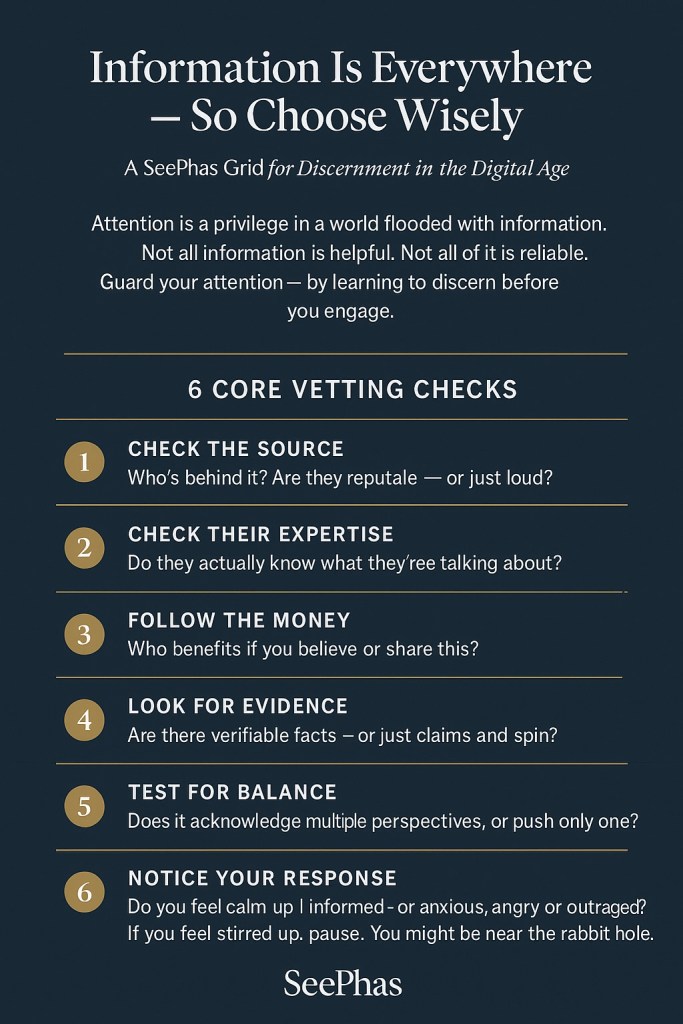
Information Is Everywhere — So Choose Wisely
We live in an age of relentless information.
- More than 1 billion websites have existed.
- At any given time, 200–250 million are active.
- There are trillions of total webpages—both indexed and hidden.
- Social platforms add billions of posts, comments, and videos every day.
- Search engines reveal only 4–10 percent of the entire internet.
In a world this noisy, every request for your attention—a video, article, post, or podcast—is a privilege.
Your time is scarce. Your attention is valuable.
So treat it that way.
Not all information is reliable. Not all of it is helpful.
Some of it is intentionally harmful. Guarding your attention begins with learning to vet what you read, watch, and share.
This discipline is called digital discernment — the ability to make thoughtful, ethical, and informed choices about what you consume, believe, and pass along online.
It blends critical thinking, moral awareness, and ethical reflection in digital spaces.
Over years of work in business and technology—plus teaching, research, mentors, and hard-won common sense—I developed a simple tool to help.
I call it the News & Opinion Vetting Framework.
You’re welcome to use it.
News & Opinion Vetting Framework (Simple Version)
- Check the Source — Who’s behind it? Are they reputable or just loud?
- Check Their Expertise — Do they actually know what they’re talking about?
- Follow the Money — Who benefits if you believe or share this?
- Look for Evidence — Are there verifiable facts, or just opinions and claims?
- Test for Balance — Does it show multiple perspectives, or push only one?
- Notice Your Response — Do you feel grounded and informed—or anxious, angry, or outraged?
If it stirs you up, pause. You may be entering the rabbit hole.
Expanded Framework — For Deeper Analysis
1. Who’s Behind It?
- Are they identifiable? Reputable sources list real names and organizations.
- Is this a recognized outlet or an anonymous account?
- How long have they been active? Longevity and transparency matter.
- Do they have a record of accuracy?
2. What Are Their Credentials?
- Education, training, or professional standing—does it match the topic?
- Relevant expertise? Example: an epidemiologist on vaccines vs. a random blogger.
- Have they published credible work or partnered with reputable institutions?
3. How Close Are They to the Facts?
- Were they direct witnesses or relaying secondhand reports?
- Do they cite sources—documents, data, names?
- Are they independent, or tied to a campaign, cause, or corporation?
4. Reputation & Accountability
- Do they use fact-checkers or issue corrections?
- Are they respected by peers?
- Do they acknowledge bias—or disguise opinion as fact?
5. What’s the Evidence?
- Are claims backed by data or documentation?
- Do multiple reliable outlets confirm it?
- If only obscure sites mention it, that’s a red flag.
6. Fact vs. Opinion
- Facts can be checked.
- Opinions interpret or spin facts.
- Strong opinions with weak evidence = unreliable.
7. Why Now? (Motive & Timing)
- Is this surfacing during a crisis, election, or controversy?
- Who gains if you react emotionally instead of thinking critically?
8. How Do You Feel? (Effect on You)
- Does the content leave you afraid, angry, or frozen?
That’s your nervous system entering survival mode—exactly what many platforms exploit. - When core emotions are triggered, attention becomes profit.
Awareness is your defense.
A Simple Rule of Thumb
I rate sources on a scale of 0 (no credibility) to 5 (high credibility).
If any area scores below 2, it fails my test.
If a post or story fails two or more checks, I don’t believe it—and I definitely don’t share it.
Sharing low-credibility content rewards the wrong people: outrage merchants, attention hackers, and activists who profit from confusion.
Resisting that urge is an act of civic responsibility.
Clarifying the Terms
- Misinformation = false information shared unintentionally.
- Disinformation = false information shared intentionally, often to manipulate opinion or sow division.
In extreme cases, disinformation functions as information warfare.
Closing Thought
Information is abundant. Wisdom is scarce.
Curiosity is free. Attention is costly.
Digital discernment begins with what you spend it on.
 SeePhas