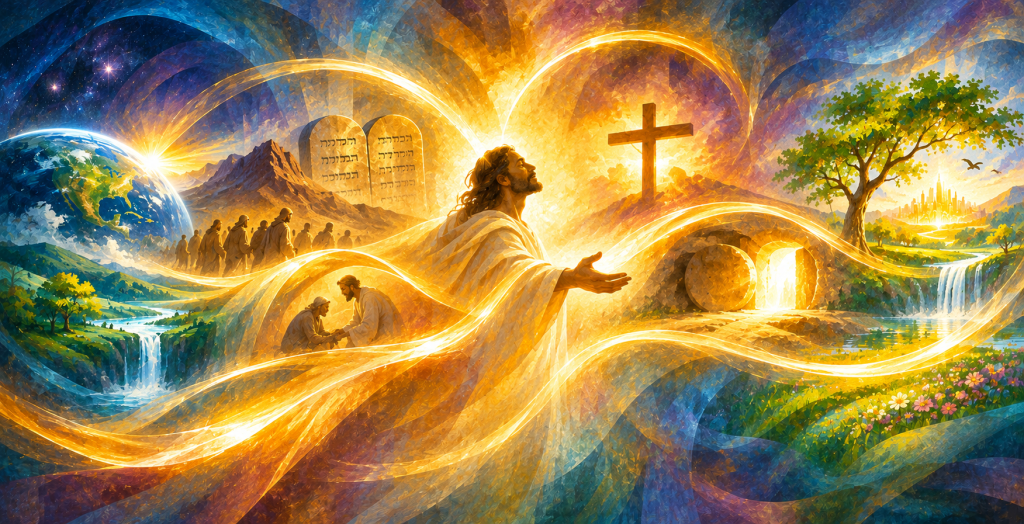
One God. One Love. One Continuous Story.
“God is love.” — 1 John 4:8
The Foundation of Everything
I have come to believe that the most important thing we can know about God is also the simplest: God is love. Everything flows from that.
Love is not simply one of God’s many attributes, nor even merely the greatest of them. Love is the very essence of God’s being—the foundational reality through which everything else about God must be understood.
God’s justice is an expression of love. God’s mercy, holiness, righteousness, faithfulness, and power are expressions of that same divine character. Even God’s judgment must ultimately be understood within the context of love.
These attributes do not compete with one another, as though God sometimes chooses justice instead of love, or wrath instead of mercy. They are different expressions of who God eternally is.
If God is love, God cannot act contrary to love without acting contrary to God’s own nature.
This conviction shapes how I understand God, how I read Scripture, how I understand Jesus, and how I think about humanity’s purpose and destiny.
It also shapes how I understand the biblical story.
I do not see a God whose character changes from one era to another—a God of judgment in the Hebrew Scriptures who somehow becomes a God of love through Jesus.
Nor do I see a series of divine attempts to correct failed plans.
Instead, I see one continuous story in which God’s love is revealed in different ways, through different circumstances, relationships, and events.
The story is not always simple. Scripture contains difficult and sometimes troubling portrayals of God. Human understandings of God develop, and the biblical authors do not always speak with one voice.
But I believe the essential character of God remains unchanged.
God has always been love.
And the biblical story, from creation to restoration, helps us discover what that means.
1. Creation: Love Gives Life
The biblical story begins not with human sin, divine anger, or a need for salvation.
It begins with creation.
“In the beginning God created the heavens and the earth.” — Genesis 1:1
Throughout the creation account, God repeatedly declares creation good. When humanity appears, God declares the whole of creation very good.
Before there was human disobedience, there was goodness. Before alienation, there was relationship. Before redemption became necessary, there was God’s intention for life.
If God’s essential nature is love, creation itself can be understood as an expression of that love.
Why did God create?
Scripture does not fully explain God’s motivation. But I believe God’s character offers an important answer.
God creates because God is love.
Not because God is incomplete, lonely, or in need of something beyond God’s own being. Rather, creation can be understood as the generous expression of divine love—the giving of existence, beauty, possibility, relationship, and life.
Love gives. Love makes room for another. Love seeks the good of the beloved.
Creation, then, is not merely a demonstration of divine power. It is an expression of divine generosity.
Why humanity?
Genesis offers another extraordinary affirmation:
“So God created humankind in his image.” — Genesis 1:27
Humanity is not introduced as fundamentally corrupt, worthless, or deserving of condemnation.
We are created in God’s image and included in God’s declaration that creation is very good.
If God’s nature is love, bearing God’s image carries profound implications.
We are created with the capacity to receive love, give love, live in relationship, and participate in creation’s flourishing.
Why place humanity in this world?
Perhaps because love is not meant to remain an abstraction.
Love becomes tangible through relationships, care, generosity, creativity, responsibility, and freedom. This world provides the setting in which these possibilities can emerge.
Humanity receives a vocation: to cultivate and care for creation, live in relationship with one another, and participate in God’s good purposes.
I do not understand this world primarily as a testing ground to determine who deserves eternal life. I understand it as a world created for life itself.
The biblical language for the fullness of this intended life is shalom—wholeness, right relationship, justice, peace, and flourishing.
Creation reveals a God whose love gives life and invites others to share in its goodness.
Shalom is not God’s backup plan after human failure. It belongs to God’s loving intention from the beginning.
2. Israel and the Hebrew Scriptures: Love Teaches Us How to Live
If creation reveals God’s love through the gift of life, Israel’s story reveals that love through relationship, covenant, and instruction.
God’s love does not disappear when humanity turns away from God’s intention. Nor does God become a different kind of God.
Throughout the Hebrew Scriptures, we encounter divine love in the covenant with Abraham, Israel’s liberation from Egypt, the giving of Torah, the prophets’ demands for justice, and God’s enduring faithfulness despite human failure.
When Moses encounters God’s self-revelation, God is described as:
“Merciful and gracious, slow to anger, and abounding in steadfast love and faithfulness.” — Exodus 34:6
The Hebrew word hesed conveys steadfast, enduring, covenantal love—not fleeting affection, but love expressed through commitment and faithfulness.
This is love that remains present even when relationships become difficult.
Torah: Love Expressed Through Instruction
Central to God’s relationship with Israel is Torah—the Law, or more fully understood, God’s teaching and instruction.
Torah is sometimes portrayed in Christian theology as an impossible standard, intended primarily to demonstrate humanity’s failure and need for salvation.
I do not believe this adequately represents Torah’s purpose within Israel’s covenantal relationship with God.
Torah was given as a gift, not as a stumbling block.
It offered Israel a way of living in right relationship with God, one another, and creation.
Its instructions addressed worship, justice, economic relationships, community responsibilities, care for the vulnerable, and everyday life.
It was an aspirational vision of the good life—a life shaped by God’s character and purposes.
In Deuteronomy 30:15–16, Moses presents Israel with a choice between life and prosperity, death and adversity, calling the people to love God and follow God’s commandments.
And in Deuteronomy 30:11, Moses declares that the commandment is not too difficult or beyond reach.
Torah was not an elaborate trap designed to expose inevitable failure. It was an invitation to embrace life.
The Hebrew Scriptures acknowledge human failure, but failure does not change the gift’s purpose.
The Law expresses God’s love by teaching Israel how to live well.
And following the Law becomes a profound way of loving God in return.
The Shema, Israel’s foundational confession, declares:
“You shall love the LORD your God with all your heart, and with all your soul, and with all your might.” — Deuteronomy 6:5
Obedience, understood this way, is not fearful compliance with an authoritarian ruler. At its best, it is the willing response of love to love.
Torah is love expressed as instruction. Faithfulness to Torah is love expressed in response.
Love Expressed Through Justice
God’s love also extends to the poor, widow, orphan, foreigner, and oppressed.
The Torah provides concrete expressions of this concern.
Gleaning laws require leaving portions of the harvest for the poor and foreigner (Leviticus 19:9–10). Sabbath provides rest for servants, foreigners, and animals (Deuteronomy 5:12–15). Jubilee provisions envision restoration of property and protection against permanent dispossession (Leviticus 25).
These instructions demonstrate that love is not merely a private feeling. It has social, economic, and communal consequences.
This is why the prophets challenge religious practices that coexist with injustice.
God desires people whose lives reflect God’s character.
Judaism continues to carry and interpret this understanding through Torah, prayer, ethical reflection, compassion, and justice.
The Jewish witness to God’s love is not merely a historical prelude to Christianity. It remains a living tradition in its own right.
Israel’s story reveals a God whose love is faithful, whose instruction is directed toward life, and whose justice seeks the flourishing of others.
Christianity emerges from within this Jewish story. It does not begin a new story about a newly loving God.
3. Jesus: Love Becomes Visible
For Christians, Jesus offers an especially clear revelation of the God who has always been love.
Jesus does not introduce a different divine character, persuade God to become merciful, or transform a wrathful God into a loving one.
Jesus reveals what God has been like all along.
We see that love in his compassion for those who suffer, his welcome of the excluded, his healing and forgiveness, and his willingness to challenge religious and political powers that diminish human dignity.
Jesus teaches that the greatest commandments are to love God and love our neighbors.
These are not commandments he invents. They come directly from Deuteronomy 6:5 and Leviticus 19:18.
When Jesus declares that the Law and Prophets depend upon these commandments (Matthew 22:37–40), he identifies love as the organizing principle of faithful living.
The Torah given to Israel was intended to guide people toward life in relationship with God and one another. Jesus illuminates that same intention.
He also teaches love of enemies, extends compassion across social and religious boundaries, challenges domination, and calls his followers to embody self-giving love.
These teachings are not simply ethical instructions.
They reveal something about God’s character.
If God loves even those who oppose God, then divine love cannot be reduced to affection for the obedient or deserving.
If God seeks the restoration of sinners rather than their destruction, then mercy is not an exception to divine justice. It is one of the ways love pursues justice.
And if Jesus refuses to exercise coercive power over others, then God’s power must be understood differently from the domination so common in human affairs.
In John 14:9, Jesus tells Philip:
“Whoever has seen me has seen the Father.”
I understand this as an extraordinary claim.
If we want to understand what God is like, we should look at Jesus.
Not because God has changed, but because Jesus makes God’s character visible in ways that challenge our assumptions about power, holiness, judgment, and love.
For Christians, Jesus becomes a lens through which to interpret the larger biblical story.
Jesus reveals a God whose love crosses boundaries, embraces enemies, confronts injustice, and seeks reconciliation.
The God revealed in Jesus is the God who created, loved Israel, spoke through the prophets, and whose love has never ceased.
4. The Cross and Resurrection: Love Confronts Evil and Death
The clearest expression of God’s love, for Christians, may be found in Jesus’ self-sacrifice.
But what happens at the cross?
One influential Christian explanation emphasizes that God requires punishment for human sin and that Jesus receives that punishment in humanity’s place.
I understand the cross differently.
Jesus enters the full reality of human suffering, violence, injustice, and death—and refuses to respond with the same destructive power.
He confronts the forces that hold humanity captive: political domination, religious coercion, oppression, and what the New Testament describes as cosmic powers of evil and death.
He confronts these powers not by adopting their methods, but through faithful, self-giving love.
Even when that faithfulness leads to his death.
Love Revealed at the Cross
Perhaps the most extraordinary revelation of God’s love comes in Jesus’ words as he is being crucified:
“Father, forgive them; for they do not know what they are doing.” — Luke 23:34
Consider what is happening.
Jesus has been betrayed, abandoned, humiliated, tortured, and condemned to death. The religious and political powers have rejected him. Those responsible for his execution are carrying out an act of profound injustice.
And what does Jesus do?
He asks for their forgiveness.
If Jesus reveals the true character of God, then I believe we can hear something even more profound in those words:
I forgive you.
You do not understand what you are doing. You cannot see the larger picture. You do not recognize the love being offered to you.
You are wounded, afraid, and caught up in the destructive ways of the world around you.
But I have not stopped loving you.
I do not want your destruction. I want your healing and restoration.
Even now, as you reject me and take my life, my invitation remains: come and participate in the Kingdom of God.
This is my interpretation of what Jesus’ words reveal, not a literal quotation.
Jesus does not excuse the injustice or remove responsibility for the harm. But neither does he allow their wrongdoing to become the final word about who they are or what they might become.
At the very moment humanity is doing its worst to Jesus, Jesus reveals a God whose love and forgiveness remain freely offered—even to those who are killing him.
This is enemy-love in its most radical expression. And it reveals the essential character of God.
Love Overcomes Death
And then comes the resurrection.
The resurrection is not simply the miraculous reversal of a tragic execution. It is God’s vindication of Jesus and the way of self-giving love he embodied.
The powers of domination appear victorious at the cross. But the resurrection reveals that their victory is not final.
Hebrews 2:14–15 describes Jesus overcoming the power of death and liberating those enslaved by its fear.
Paul writes:
“The last enemy to be destroyed is death.” — 1 Corinthians 15:26
Death is real. Suffering, grief, violence, and loss are real.
But death’s claim to be the final reality is false.
The illusion is not that death happens. The illusion is that death ultimately wins.
The cross exposes the destructive nature of the powers. The resurrection reveals their ultimate limitation.
God does not defeat death by abandoning love.
God defeats death through love.
The cross and resurrection reveal that divine love does not surrender to evil, imitate evil, or allow death the final word.
5. Restoration: Love Never Abandons Its Purpose
If God’s love gives life, teaches us how to live, becomes visible in Jesus, and confronts evil and death, what does that love ultimately seek?
I believe the answer is consistent with God’s intention from the beginning.
Life. Relationship. Wholeness. Justice. Peace. Flourishing.
Shalom.
Love seeks the good of the beloved.
And if God’s essential nature is love, then God’s ultimate intention must be understood in terms of the good of creation—not its abandonment.
The New Testament describes this hope in sweeping terms.
Colossians 1:20 speaks of God reconciling all things through Christ. In 1 Corinthians 15:28, Paul looks toward God being “all in all.” Revelation 21 portrays renewed creation, where death, mourning, crying, and pain are no more.
These are images not of God abandoning creation as a failed experiment, but of restoration.
The love that gave life in the beginning remains committed to its healing and fulfillment.
This also shapes how I understand salvation.
Salvation is not primarily about persuading God to love us or satisfying a condition before God becomes willing to forgive.
God’s love precedes our response.
Salvation is liberation from sin, alienation, fear, evil, and death—and restoration to right relationship with God, one another, ourselves, and creation.
This does not eliminate repentance, responsibility, or transformation.
Quite the opposite.
If God’s love seeks our good, then that love must also confront what damages us and what we do to harm others.
Divine judgment, understood within the context of love, cannot be reduced to retaliation. It must be considered in relation to God’s justice, the protection of those harmed, and the possibility of restoration.
Reconciliation with God involves learning to participate in God’s love.
We are called to become the people we were created to be.
This also informs my hope concerning humanity’s ultimate destiny.
I cannot claim certainty that everyone will ultimately be reconciled to God. Scripture contains difficult passages concerning judgment, exclusion, and destruction, and I take those seriously.
But I struggle to reconcile eternal, hopeless suffering with a God whose essential nature is love.
I remain hopeful that God’s patient, restorative love may ultimately accomplish more than we can presently imagine.
That hope rests not upon certainty about humanity’s eventual response, but upon confidence in God’s character.
Restoration reveals a God whose love remains committed to life, healing, reconciliation, and the flourishing of creation.
Conclusion: One God, One Love, One Continuous Story
I believe the biblical story is fundamentally a story about God’s enduring love for creation.
Not because every passage is easy to understand, or because every event appears loving from our perspective.
But because I believe God’s essential character provides the foundation for understanding the whole.
Creation reveals love giving life.
Israel’s covenant and Torah reveal love establishing relationship and teaching a way of living.
Jesus reveals love embodied in compassion, forgiveness, enemy-love, and the refusal to dominate.
The cross and resurrection reveal love confronting evil and overcoming death.
And restoration reveals love remaining faithful to the goodness of creation.
These are not separate stories about different versions of God.
They are expressions of the same divine character throughout one continuous story.
The circumstances change. Humanity’s understanding changes. Relationships change. History unfolds through genuine freedom, with all its possibilities and tragedies.
But God’s essential character does not change.
God has always been love.
And that conviction has consequences for how we live.
If we are created in God’s image, and if God’s essential nature is love, then our calling is to reflect that love—not simply through belief or worship, but through how we treat others, care for creation, pursue justice, and participate in our communities.
Perhaps this is also the deepest answer to why God created.
Not to acquire something God lacked.
Not to establish a system of rewards and punishments.
Not to populate heaven with those who pass a test.
But to give life, to share love, and to invite creation into the goodness and flourishing that love makes possible.
God is love. Everything flows from that.
And perhaps the whole story—from creation to restoration—is the unfolding of what that has always meant.

