Faith & Formation
Love ignited faith → Love was obscured → Love was rediscovered → Love now orients everything.
Hope, for me, is remaining oriented toward life when clarity is absent.
My faith did not begin as a set of beliefs. It began as an encounter with love. In my early adult life, I became convinced—captivated, really—by the idea that God is unconditionally loving.
I fell in love with that God.
Faith, since then, has not been a straight line or a settled possession. It ignited brilliantly once, but has been formed and reformed slowly over time—shaped by life, unknowing, spiritual injury, doubt, loss, practice, and return.
There was a season of unlearning—what many now call deconstruction. It was disorienting and costly, marked by questioning and the unraveling of voices that had once claimed authority. At times I felt lost, though even then I sensed that something deeper was holding me.
In this current season I immersed myself again—entering seminary, returning to Scripture, and re-centering on Jesus within the story of the Hebrew Scriptures. What emerged was not a new faith, but a re-integrated one: grounded again in who God truly is, and in the self-giving love that stands at the center of the gospel.
Perhaps I got lost.
Or perhaps I was only rediscovering what had been there all along.
At its heart, faith is learning to live within the love of God.
First, we receive that love ourselves.
Then, in response, we learn to love God, to love our neighbors, to love ourselves rightly—and to care for the creation entrusted to us.
In the end, faith and hope both find their meaning there.
As the apostle Paul wrote:
“And now these three remain: faith, hope and love. But the greatest of these is love.”
— 1 Corinthians 13:13
What follows here is not instruction, but witness.
Faith is not a possession.
Hope is not a conclusion.
Formation is ongoing.
And love is at the center of it all.

Exploring Faith & Hope
My Story
For those who want to understand how this posture of hope and faith was formed, I’ve written more personally about my own journey—where faith began, where it fractured, and how it continues to change.
This is not a testimony of arrival, but of formation over time.

Core Beliefs
These are the convictions I return to when ideas are tested by life.
They are not exhaustive, nor fixed in stone—but they are settled enough to stand on. Formed through faith, experience, and the long work of learning to love well, they orient how I understand God, people, power, and the world we share.
A Jesus-Centered Way Beyond Empire
What does a Jesus-centered life actually look like?
And what does it mean to say Jesus-centered in a world shaped by power, domination, and control?
For me, centering on Jesus has meant learning to see him not as a symbol enlisted by empire, but as a life and way that stands apart from it.
Jesus does not offer an escape from the world, nor a strategy for winning it.
He reveals a different way of being human—marked by humility, enemy-love, non-coercive power, truth-telling, and costly faithfulness.
To follow Jesus, in this sense, is not primarily to defend a belief system, but to be formed into a certain kind of person—one oriented toward life, reconciliation, and faithful presence.
This way has not resolved every question.
But it has given me a center that holds.
He reveals a different way of being human.
Faith, Relearning to Trust
This section sits where faith has been strained, fractured, and slowly reworked.
Some inherited beliefs—about human worth, suffering, judgment, and love—did not simply fail to sustain faith; they distorted it. Naming those distortions became necessary, not to abandon faith, but to allow it to heal.
Some things are clearer now.
Others remain in process.
What is emerging is not certainty, but a faith that can breathe again.

A New Tradition I can Hold onto
Sometimes described as Neo-Anabaptist, this tradition has become a formative way for me—not a destination, but a stepping stone shaping how faith is lived.
Neo-Anabaptism: A New Tradition?
The Meta-Narrative driven by images
It was a formative season.
I entered carrying spiritual injury I did not yet have language for. Learning to see the larger story became part of the healing.
Through deeper engagement with Scripture as a coherent narrative—and shaped by Neo-Anabaptist traditions—I encountered not just a different story, but a way of discerning the ones I had inherited.
I learned that context matters. That doctrines, experiences, and convictions belong within a broader arc—and must be questioned when they distort it.
Learning to process faith this way did not cost me my faith.
It saved it.

Practices that Explore and Shape Faith
Faith is not only shaped by what we believe, but by the practices that help us see, trust, and experience God more deeply.
Some of the reflections here explore how our inner image of God is formed—and how it can be gently reshaped by the self-giving love revealed in Jesus.
Over time, I will add other exercises and practices that have helped deepen trust, renew faith, and orient life more fully toward love.
Image of God – An Exercise
Click on the image below to explore

What image of God lives within you?
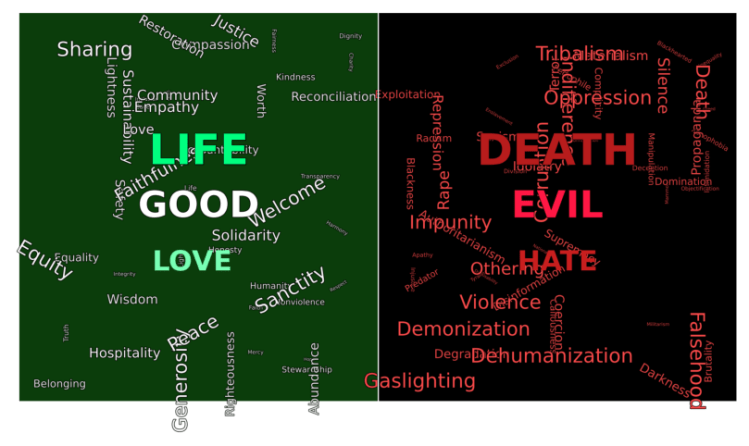
Image of Ultimate Goodness – An Excercise
Click on the image below to explore

We all strive for “goodness” – what is it?
A Guided Meditative Prayer – A Personal Practice
When I did the exercise above – Image of God – the first image of God that popped into my head was the one below.
I felt off-base — actually horrified.
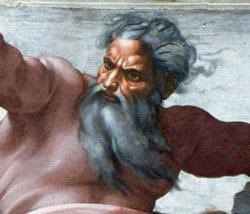
And almost instantly, I went back to being a scared little boy — the part of me that had quietly absorbed the message that God was dangerous. Watching. Condemning. Easily disappointed.
And that was the template living in me.
Yet I proclaim that Jesus is God.
That Jesus is the fullest revelation of God in human history.
That Jesus on the cross most clearly embodies who God is:
- the ultimate of self-giving love in the face of rejection
- absorbing violence rather than inflicting it
- loving and forgiving enemies
- restoring rather than retaliating
My theology said one thing.
My nervous system said another.
In my imagination, the angry old man remained.
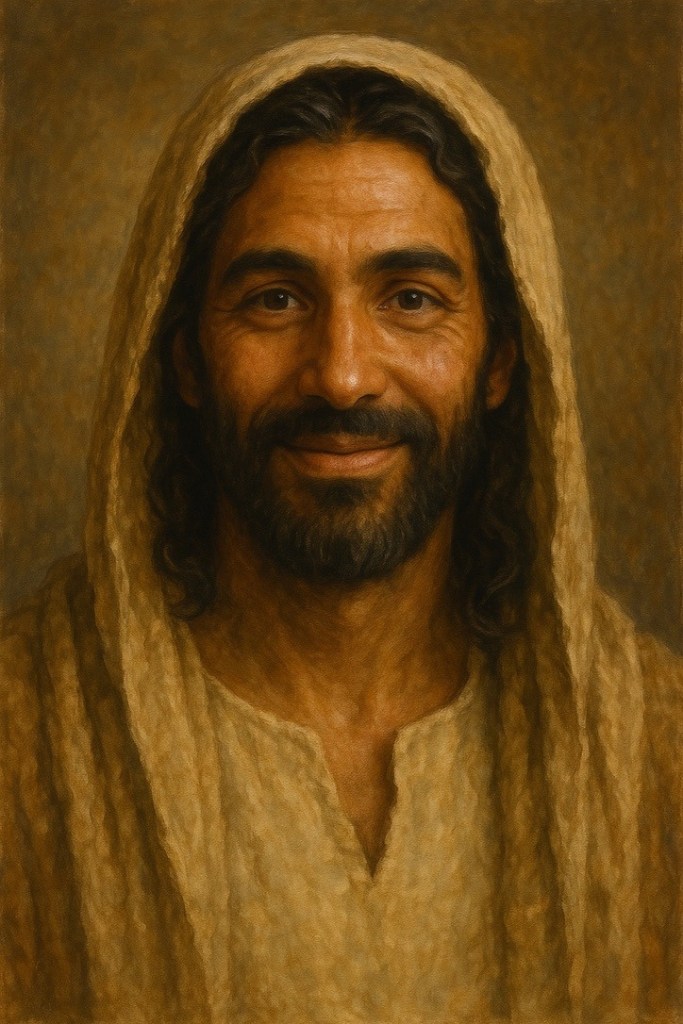
I realized belief alone was not reshaping my inner world. So I created a practice — a imaginative prayer exercise, using guided imagery to gently bring my internal picture of God into alignment with the crucified Christ.
Not to deny what surfaced.
Not to shame the frightened child in me.
But to allow the cross and Jesus through chainging my brain – via neuroplasticity- to become the lens through which I see the Father.
Because what image of God lives in us — beneath our stated beliefs — quietly shapes everything.
Do the Meditation
Click on Jesus below
 SeePhas