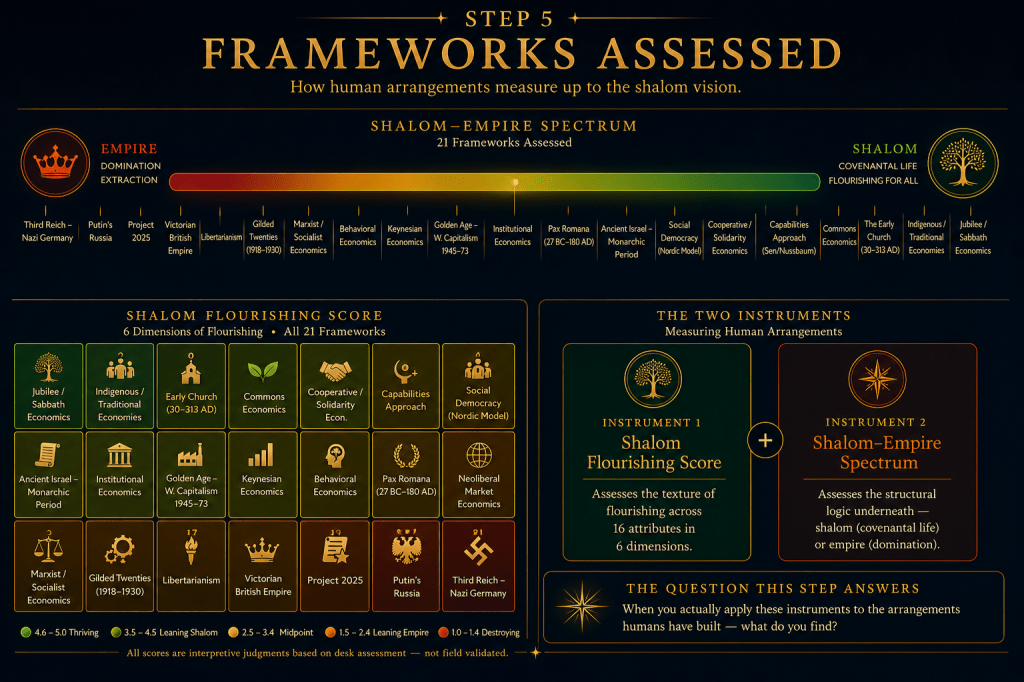
How do the arrangements humans have built measure up against the shalom vision?
From a Question to Insights
Two instruments have been developed for measuring how well society in any human arrangement approximates what God intends for human life:
The Shalom Flourishing Score, which assesses the texture of flourishing across 16 attributes and 6 dimensions; and
Shalom-Empire Spectrum, which assesses the structural logic underneath — whether an arrangement is oriented, at its core, toward domination or toward covenantal life.
The natural next question is the one this step exists to answer:
When you actually apply those instruments to the arrangements humans have built — the economic frameworks, the ideological systems, the historical eras — what do you find?
That question sent me into the historical and contemporary record. Not with a verdict already in hand, but with the instruments and the methodology, and a commitment to follow the evidence wherever it led — including to conclusions that challenged my own prior assumptions.
What I found was instructive. Some arrangements that are widely celebrated score surprisingly low when the whole web is assessed rather than just the included population. Some arrangements that are widely dismissed contain genuine shalom logic worth recovering. And some arrangements — currently operating, right now — score at the empire pole of the spectrum in ways that should trouble anyone who takes the shalom vision seriously.
This step presents those findings. Not as the final word — the framework names its own limitations honestly, and all scores are interpretive judgments rather than strictly empirical measurements. But as a serious attempt to apply a serious standard to the question the students in that Minneapolis classroom first asked:
Is this actually good? And what can we prove?
How to Use This Step
Three Principles
Three principles govern every assessment here, and are worth holding in mind as you read:
— The whole web (all people) — every assessment scores the arrangement for every person it affects, not just the population it most serves. An arrangement that produces genuine flourishing for the included population while systematically destroying it for the excluded will score lower than its prosperity narrative suggests. The Golden Age of Western capitalism is the clearest example.
— The distributional lens — for every dimension, the question is what is happening to the most vulnerable. A rising average that masks a declining floor is not flourishing. It is inequality.
— Direction and trajectory — a snapshot score tells part of the story. The direction of travel tells the rest. Where trend data exists, it is noted. An arrangement scoring 2.1 and moving toward 2.5 is in a different condition than one scoring 2.1 and moving toward 1.7.
This step contains three elements, used together:
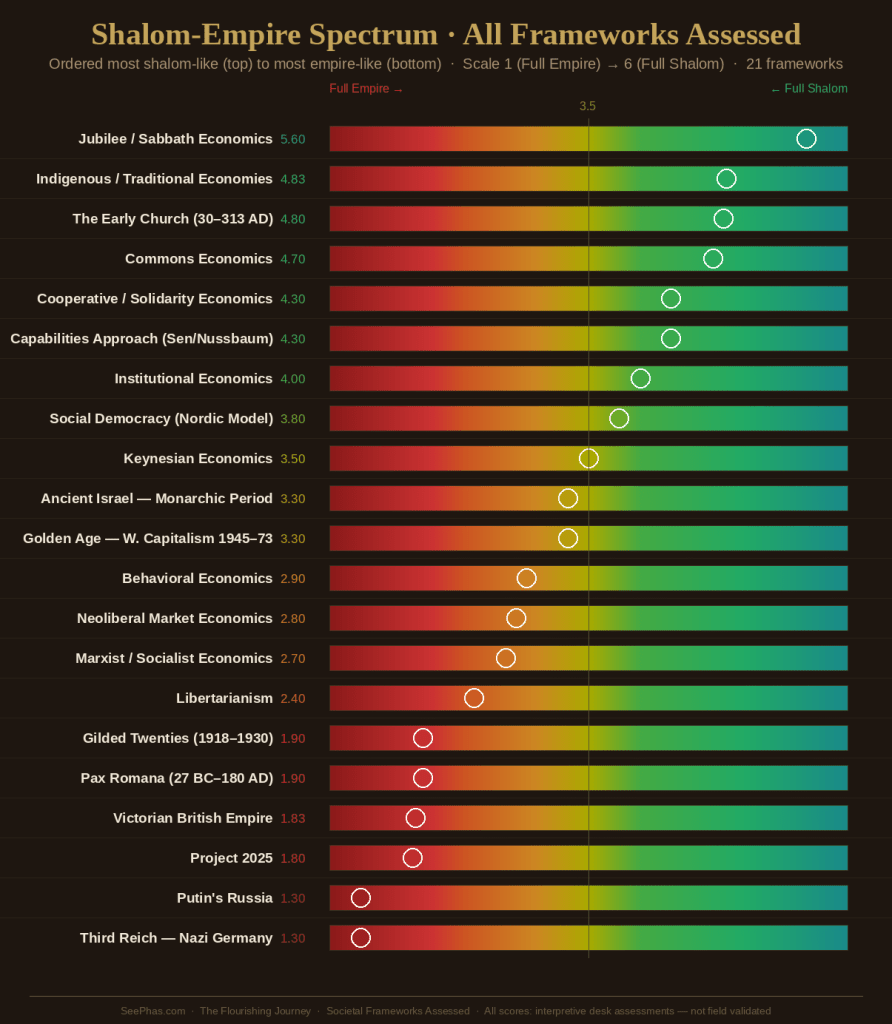
The Shalom-Empire Spectrum graphic — all 21 frameworks on a single gradient bar, ordered from most shalom-like to most empire-like. Read it top to bottom. The vertical line at 3.5 is the midpoint — arrangements above it lean toward shalom’s covenantal logic; below it toward empire’s extractive logic. The dot shows where each arrangement lands.
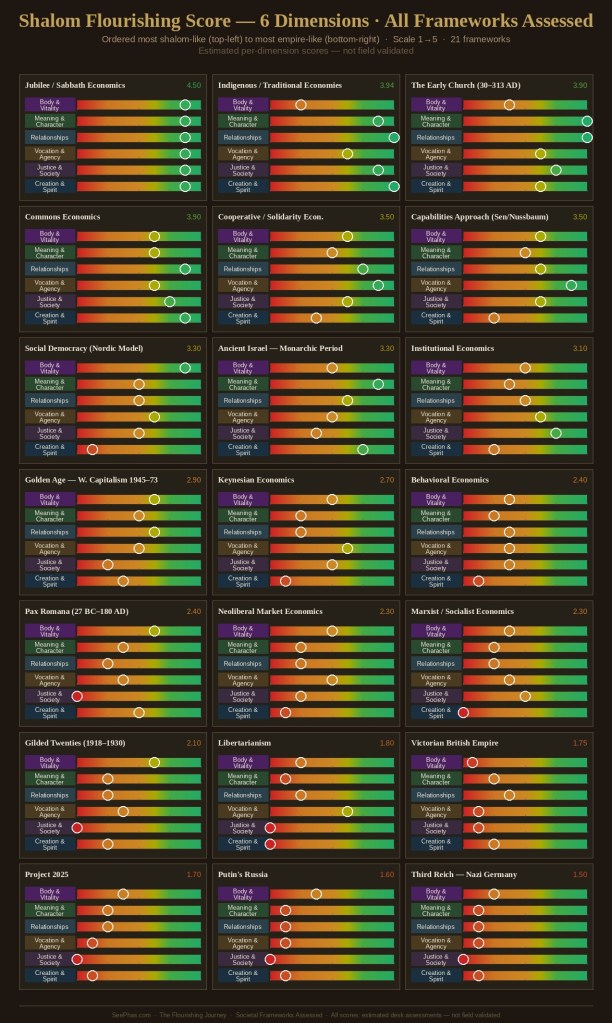
The Shalom Flourishing Score Dimensions graphic — all 21 frameworks as individual cards showing their profile across the 6 dimensions of flourishing. Read the cards top-left to bottom-right, from most to least shalom-like. The color of each bar’s dot tells the story at a glance: green is flourishing, red is destruction. The profile — which dimensions score high, which low — is often more instructive than the composite score alone.
The Framework Descriptions — a written entry for each of the 21 frameworks, in the same order. Each entry covers what the framework is, when and whether it has been enacted, its genuine strengths, its significant weaknesses, the life expectancy its populations experienced, and the reasoning behind both its Shalom Flourishing Score and Shalom-Empire Spectrum scores.ssessing political, economic, and ideological frameworks through the lens of shalom
Most frameworks are evaluated on their own terms — GDP growth judged by growth, democracy judged by procedure. The Shalom Flourishing Framework asks a different question:
What do other frameworks actually produce for human beings — all of them, especially the most vulnerable?
These assessments apply the Shalom Flourishing Framework and the Shalom-Empire Spectrum to specific political ideologies, economic systems, and historical eras. First you will see summaries of all assessments that have been done — a summary based on the 6 shalom dimensions, and the shalom versus empire scale based on an additional 12 attributes.
Then you can do a deep dive on each assessment into the 6 dimensions, 16 attributes, and 96 indicators used to assess each framework — along with explanations of why each attribute was assessed as it was.
They are diagnoses, not verdicts — identifying where each framework most approximates shalom, where it falls short, and what movement toward shalom would require. The gaps are not indictments. They are to be pondered, meditated on, and considered for needed change — nationally, societally, and individually.
This is the site of faithful, humble, constructive work.
Societal Frameworks on the Empire-Shalom Spectrum
Societal Frameworks – How close the Shalom Flourishing?
Framework Descriptions
A Note on Life Expectancy
Life expectancy appears throughout the framework descriptions as a grounding data point — because it was the first metric this journey I ever used. – and it still seems relavant today, e.g., why are the lifespans in Mississippi (70.9 years) so much lower than in Hawaii ((80.0) years)? Back in that Minneapolis classroom, the question was simple: if a technology or arrangement is good, does it help people live longer? It remains a useful anchor.
But it requires an honest caveat.
Life expectancy across human history has been shaped somewhat less by social arrangements than by a small set of transformative health technologies — all deployed within a remarkably compressed window of time:
— Germ theory and sanitation (1860s–1900s) — the discovery that disease is caused by microorganisms, and the resulting revolution in clean water, sewage systems, and hygiene practices
— Vaccination (smallpox eradicated by 1980; polio, measles, and others across the 20th century)
— Antibiotics (penicillin discovered 1928, widely deployed from the 1940s onward)
— Surgical anesthesia and antisepsis (1840s–1860s, allowing safe surgical intervention for the first time)
— Maternal and infant care (dramatic reduction in death during childbirth and in the first year of life across the 20th century)
These technologies, deployed primarily between 1860 and 1970, account for the majority of the increase in global life expectancy from approximately 30–35 years at birth in 1800 to over 70 years today. That is a doubling in roughly 150 years — after tens of thousands of years of near-stagnation.
What this means for the descriptions in this step: when a pre-modern framework shows a life expectancy of 25–35 years, that figure reflects the absence of these technologies — not a verdict on the quality of the social arrangement itself. The Jubilee economy, the Early Church, Indigenous traditional economies, and Ancient Israel all lived in the same pre-germ-theory world. Their low birth expectancies tell us about their era, not about whether their communities were flourishing on the dimensions that matter most.
The exceptions worth noting are modern arrangements that have actively suppressed or denied access to health technologies through war, deliberate neglect, or political dysfunction — Soviet famines, colonial-era India under British rule, contemporary North Korea, and others where life expectancy declined not because of technological limits but because of human choices. In those cases, the life expectancy figure is a direct indictment of the arrangement.
Descriptions of All 21 societal frameworks — what each is, when enacted, strengths, weaknesses, and why the score
Frameworks are ordered from most shalom-like to most empire-like by SFF composite score. Each description covers: what the framework is, whether and when it has been enacted, its genuine strengths, its significant weaknesses, and the reasoning behind its SFF and SES scores. All scores are interpretive desk assessments — not field validated.
1. Jubilee / Sabbath Economics Shalom Flourishing Score 4.5 · Shalom-Empire Spectrum 5.6
WHAT IT IS
A theological-economic framework drawn directly from the Hebrew Bible’s social architecture. Built around the weekly Sabbath (rest and renewal), the Sabbatical year (debt release, land rest every 7 years), and the Jubilee (full reset of land ownership and release of enslaved persons every 50 years). Not a policy proposal but a divinely ordained structural system designed to prevent the permanent concentration of wealth and power across generations.
ENACTED
Enacted as the covenantal law of ancient Israel, though scholars debate how fully the Jubilee was implemented in practice. Elements have influenced later traditions — Medieval European sabbatical practices, liberation theology, the modern debt jubilee movement, and the Jubilee 2000 campaign that secured $100 billion in debt relief for developing nations.
STRENGTHS
— Life expectancy: Life expectancy context (not enacted): Ancient Israel (1000–586 BC) — approximately 25–30 years at birth; adults surviving childhood could expect 45–50 years. Pre-modern figures reflect infant and child mortality, not adult health quality. The framework’s design precedes modern medicine by three millennia.
— The only framework in the assessment explicitly designed around intergenerational equity — the 50-year reset prevents permanent dynastic wealth accumulation
— Integrates ecological rest (the land itself rests) with economic justice — the only framework to do so structurally
— Grounds distributive justice in covenant obligation rather than charity or state redistribution — making it genuinely binding rather than merely advisable
— Treats the vulnerable (the poor, the debt-slave, the landless) as primary beneficiaries of structural design, not afterthoughts
WEAKNESSES
— Never fully implemented even in ancient Israel — the prophetic literature suggests consistent violation of Jubilee obligations
— Designed for an agrarian economy; translation to industrial and post-industrial economies requires significant reinterpretation
— No contemporary nation-state equivalent exists — the framework remains largely aspirational and theological
— Implementation would require a degree of social trust and covenant commitment that contemporary secular societies do not possess
WHY THIS SCORE
Scores highest of all frameworks assessed on both instruments. On the Shalom Flourishing Score, it is the only framework to score above 4.0 — because it is the only one explicitly designed around every dimension of shalom simultaneously. On the Shalom-Empire Spectrum, its structural logic is the most comprehensively covenantal: power distributed, resources recirculated to the floor, identity constituted by covenant inclusion, the vulnerable protected first. Its weakness — that it was never fully implemented — is acknowledged but does not affect the score, which assesses the framework’s design logic, not its historical track record.
2. Indigenous / Traditional Economies
Shalom Flourishing Score 3.94 · Shalom-Empire Spectrum 4.83
WHAT IT IS
The economic and social arrangements practiced by Indigenous peoples across North America, Africa, the Pacific, and elsewhere — predating Western economic frameworks by millennia and existing largely outside their frame entirely. Not a single unified system but a family of frameworks sharing structural features: communal stewardship of land rather than private ownership, reciprocity as the organizing principle of exchange rather than accumulation, decision-making accountable to ancestors and to seven generations forward, and deep embeddedness in creation rather than extraction from it. Key traditions include the Haudenosaunee (Iroquois) Confederacy’s Great Law of Peace and its seven-generation principle; the Māori concept of kaitiakitanga (guardianship — the reciprocal, intergenerational stewardship of land and water); Ubuntu philosophy in southern Africa (“I am because we are” — individual identity and prosperity constituted through communal relationship); and the potlatch economies of the Pacific Northwest, in which status was gained by giving rather than accumulating.
ENACTED
Enacted across thousands of distinct cultures over tens of thousands of years — making this by far the most widely and durably practiced framework in the assessment. The Haudenosaunee Confederacy has governed continuously for at least 600 years; Swiss alpine commons operating under similar principles have functioned since the 13th century. Many Indigenous economic practices persist today. The Māori concept of kaitiakitanga is now embedded in New Zealand law (Resource Management Act 1991). Ubuntu philosophy influenced the post-apartheid South African constitution. Indigenous land stewardship practices are increasingly recognized in international climate agreements. In most cases, these frameworks were not replaced by Western economies — they were destroyed by colonization, forced displacement, and the deliberate dismantling of communal land tenure.
STRENGTHS
— Life expectancy: Life expectancy (enacted, pre-colonial): approximately 20–35 years at birth across most Indigenous populations globally, driven by high infant and child mortality, not adult health failure. Adults who survived childhood commonly lived to 50–65 years. Samuel de Champlain recorded Mi’kmaq and Huron communities with life expectancy approaching 60 years. Contemporary Indigenous peoples in colonized countries live 5–10 years below national averages, reflecting dispossession rather than traditional economics.
— The highest Temporal Integrity score of any framework assessed — the seven-generation principle is the most structurally rigorous account of intergenerational obligation in the entire assessment, exceeding even the Jubilee
— The highest Ecological Embeddedness score of any framework — stewardship is not an add-on or a policy position but the foundational structure of the relationship between people and land
— Communal Belonging scores 5 — identity constituted through genealogy, land, and covenant community rather than through constitutive enemies or market participation
— Spiritual Groundedness scores 5 — spirituality is not compartmentalized but integrated into land, work, governance, and community life as a single coherent whole
— Meaning & Purpose scores exceptionally high — vocation is participation in creation’s ongoing cultivation, grounded in ancestral identity and cosmic responsibility rather than self-constructed purpose
— Commons Economics — the framework most celebrated in contemporary economics for sustainable resource governance — is in many ways a secular theorization of what Indigenous communities have practiced for millennia
WEAKNESSES
— Body & Vitality scores 2.0 — the Shalom Flourishing Score measures Physical Health using life expectancy at birth (20–35 years for pre-modern Indigenous populations), access to healthcare, and community health infrastructure. By these empirical measures the score must be low: no germ theory, no surgery, no vaccination, no sanitation systems. This is not a judgment that Indigenous adults were unhealthy by the standards of their time — adults who survived childhood often lived into their 50s and 60s, with strong functional health. It is a recognition that the Shalom Flourishing Score’s measurement framework is calibrated to modern empirical standards, and on those standards Body & Vitality cannot score highly for any pre-modern arrangement
— Agency varied significantly — women’s roles, treatment of outsiders, and individual freedom within community obligation differed widely across traditions; some were more coercive than others
— Inter-community conflict was real — the circle of covenantal obligation often extended to the community or nation but not consistently to outsiders; war between groups was practiced across most traditions
— Not a single framework — assessing “Indigenous economies” as a category risks homogenizing thousands of distinct traditions; this entry represents common structural features, not a uniform system
— Scalability is contested — the framework’s strengths are most evident at the community and regional scale; how its principles translate to national or global economic governance remains an open question
WHY THIS SCORE
Indigenous / Traditional Economies score second only to Jubilee / Sabbath Economics on both instruments — and on several individual dimensions (Temporal Integrity, Ecological Embeddedness, Communal Belonging, Spiritual Groundedness) they score higher than any other framework assessed, including Jubilee Economics. The Shalom Flourishing composite (3.94) is pulled down by Body & Vitality, which scores 2.0. The Shalom Flourishing Score measures Physical Health using life expectancy at birth, access to healthcare, and community health infrastructure — empirical standards calibrated to modern conditions. By those measures, pre-modern Indigenous arrangements score low: life expectancy at birth of 20–35 years, no access to modern medicine, no germ theory, no surgical intervention. This is an important methodological honesty: the Shalom Flourishing Score’s measurement framework is modern, and any pre-modern arrangement — including the Early Church, Ancient Israel, and the Jubilee itself — faces the same constraint on this dimension. It does not mean Indigenous adults lived poorly — those who survived childhood often lived into their 50s and 60s with strong functional health and rich relational lives. But the Shalom Flourishing Score measures what it measures, and intellectual honesty requires accepting that. The Shalom-Empire Spectrum score (4.83) is the second highest of all frameworks, reflecting that the structural logic of Indigenous economies is overwhelmingly covenantal: resources distributed for sufficiency, power distributed through elder councils and community accountability, identity constituted through belonging rather than opposition, time horizon extending seven generations forward, and spirituality integrated rather than co-opted. The one dimension preventing a higher Shalom-Empire Spectrum score is Violence and Peace — inter-community conflict was real and widespread, preventing a score of 6 on that dimension. This framework’s inclusion corrects the most significant blind spot in the original 20 assessments: every other framework in this document is either Western or defined in relation to Western capitalism. Indigenous economies predate that frame entirely — and in several dimensions, they exceed it.
3. The Early Church (30–313 AD)
Shalom Flourishing Score 3.9 · Shalom-Empire Spectrum 4.8
WHAT IT IS
The social and economic practices of the Christian community from Pentecost through the Edict of Milan, before Christianity became the religion of the Roman Empire. Characterized by radical sharing of resources (Acts 2:42–47, Acts 4:32–35), care for widows and orphans, the erasure of social distinctions (Galatians 3:28), and a counter-cultural identity organized around covenant community rather than Roman imperial loyalty.
ENACTED
Historically enacted across the Roman Empire from approximately 30–313 AD. The practices described in Acts — common purse, breaking of bread, care for the vulnerable — were not universal or uniform, but sufficiently consistent to attract both admiration and suspicion from Roman observers.
STRENGTHS
— Life expectancy: Life expectancy (enacted, Roman Empire 30–313 AD): approximately 25–35 years at birth; adults surviving childhood could expect 45–55 years. Christians lived under the same conditions as the broader Roman population. Community mutual aid may have marginally improved survival rates for the most vulnerable.
— The strongest relational and communal belonging scores of any framework assessed — covenant community practiced rather than theorized
— Radical economic sharing that functioned as a genuine alternative to both Roman patronage and market exchange
— Identity constituted entirely through covenant inclusion — the most consistent Shalom-Empire Spectrum score on Identity Formation
— Prophetic independence from imperial power — the martyrs’ refusal of the imperial cult is the archetypal shalom pole on Loyalty vs. Covenant
WEAKNESSES
— Body & Vitality scored lower — the early church often idealized poverty and suffering rather than addressing systemic health conditions
— The practices of Acts 2–4 appear to have been short-lived even in Jerusalem — the later epistles suggest significant departure from radical sharing
— No institutional framework for scaling — what worked in small covenant communities proved difficult to sustain as the movement grew
— After 313 AD the church’s absorption into imperial power reversed many of its most shalom-oriented features almost entirely
WHY THIS SCORE
Second highest Shalom Flourishing Score and highest Shalom-Empire Spectrum score of any enacted historical arrangement. The early church’s structural logic was genuinely covenantal across most Shalom-Empire Spectrum dimensions — which is why the co-option of Christianity by empire after 313 AD represents such a dramatic reversal. The Shalom Flourishing Score is tempered by the Body & Vitality dimension, where the framework had no structural response to disease, poverty, or physical suffering beyond mutual aid.
4. Commons Economics
Shalom Flourishing Score 3.9 · Shalom-Empire Spectrum 4.7
WHAT IT IS
An economic framework centered on the collective stewardship of shared resources — natural commons (land, water, fisheries, forests, atmosphere), digital commons (open-source software, Wikipedia, academic knowledge), and social commons (public health infrastructure, education). Most rigorously theorized by Nobel laureate Elinor Ostrom, who demonstrated that communities can govern shared resources sustainably without either privatization or state control, through self-organized institutions with clear rules, monitoring, and graduated sanctions.
ENACTED
Partially enacted in multiple forms across history and geography. Medieval European commons sustained communities for centuries before enclosure. Contemporary examples include open-source software ecosystems, community land trusts, fishing cooperatives in Japan and Maine, Swiss alpine grazing commons (some operating continuously since the 13th century), and Alaska’s Permanent Fund dividend. No nation-state has implemented a comprehensive commons economics framework.
STRENGTHS
— Ostrom’s empirical research demonstrated that commons governance actually works — not a utopian theory but a documented practice across cultures and centuries
— Life expectancy: Life expectancy context: Historical commons communities (medieval Europe, 13th–18th century) averaged 30–40 years at birth. Modern partial enactments operate within surrounding national healthcare systems with life expectancies of 80–83 years. The framework itself does not determine health outcomes — surrounding systems do.
— The strongest ecological scores of any secular framework — the commons logic builds stewardship into the ownership structure itself
— Community governance generates genuine belonging and mutual obligation — stronger on Relationships than most economic frameworks
— Polycentric governance distributes power effectively — strong on Power Architecture in the Shalom-Empire Spectrum
WEAKNESSES
— Difficult to scale beyond local communities — Ostrom’s case studies were predominantly small-scale and place-based
— Requires high levels of social trust and shared identity that contemporary mobile, anonymous societies often lack
— No comprehensive theory of macroeconomic management — the commons framework addresses resource governance but not monetary policy, investment, or trade
— Spiritual Groundedness is not part of the framework’s account — it is secular in its theoretical foundations
WHY THIS SCORE
Scores nearly as high as the Early Church on the Shalom Flourishing Score because its structural logic — distributed stewardship, community governance, intergenerational responsibility — aligns closely with shalom’s vision of creation care and mutual obligation. The Shalom-Empire Spectrum score reflects its genuinely covenantal logic on most dimensions. It scores below Jubilee/Sabbath Economics because it lacks a transcendent ground for its obligations and has limited application at the macro scale.
5. Cooperative / Solidarity Economics
Shalom Flourishing Score 3.5 · Shalom-Empire Spectrum 4.3
WHAT IT IS
An economic framework organizing production and exchange through worker-owned cooperatives, credit unions, mutual aid societies, community development financial institutions, and solidarity networks. Centers on democratic ownership of enterprises, profit-sharing among workers, and economic relationships organized around mutual benefit rather than extraction. The Mondragon Corporation in the Basque Country is the most studied large-scale example.
ENACTED
Partially enacted globally. The cooperative sector includes over 3 million cooperatives worldwide with 1 billion members. Mondragon (founded 1956) employs 80,000 people in worker-owned enterprises spanning manufacturing, retail, and finance. The Emilia-Romagna region of Italy — where cooperatives generate 40% of GDP — is the most comprehensive regional example. No nation has implemented cooperative economics as its primary economic framework.
STRENGTHS
— Life expectancy: Life expectancy context (partially enacted): Modern cooperative economies (Mondragon region, Emilia-Romagna, Nordic countries) average 80–83 years, consistent with surrounding welfare-state healthcare systems. No distinctive cooperative health effect has been isolated from national context.
— Worker ownership structurally eliminates the extraction logic of conventional capitalism — workers cannot be treated as inputs when they are the owners
— Demonstrated resilience during economic crises — Mondragon did not lay off workers during the 2008 financial crisis, instead redeploying them across enterprises
— Strong on Vocation — cooperative work is structurally more likely to generate meaningful contribution and skill development
— Democratic governance distributes power within enterprises — strong on Power Architecture
WEAKNESSES
— Competitive pressure from conventional capitalist enterprises often forces cooperatives to adopt similar cost-cutting logic over time
— Scaling cooperatives to compete with multinational corporations remains an unsolved problem
— Weak on Spiritual Groundedness — the framework is secular and makes no claim about the transcendent basis of its values
— Creation & Spirit scores lower — ecological stewardship is not built into the cooperative structure itself
WHY THIS SCORE
Scores at the midpoint of the upper half of the Shalom Flourishing Score because it structurally addresses the most critical shalom violation in conventional economics — the instrumentalization of workers. The Shalom-Empire Spectrum score reflects genuinely covenantal economic logic. It scores below Commons Economics because it operates within the competitive market framework rather than replacing it, and has not demonstrated the capacity to govern an entire economy.
6. Capabilities Approach (Sen/Nussbaum)
Shalom Flourishing Score 3.5 · Shalom-Empire Spectrum 4.3
WHAT IT IS
A philosophical framework for assessing human development and justice developed by economist Amartya Sen and philosopher Martha Nussbaum. Shifts the question from ‘how much does a person have?’ to ‘what is a person actually able to do and be?’ Defines development as the expansion of real freedoms — capabilities to achieve valued functionings — rather than income growth. Nussbaum’s version specifies a list of central human capabilities that any just society must protect above a threshold level.
ENACTED
Highly influential in policy but not implemented as a comprehensive framework anywhere. The UN Human Development Index (HDI), which replaced GDP-per-capita as the standard development measure for 193 countries, is directly derived from Sen’s work. Nussbaum’s capabilities list has influenced disability law, women’s rights frameworks, and constitutional design in several countries.
STRENGTHS
— Life expectancy: Life expectancy context (not enacted as comprehensive framework): Countries most influenced by the Human Development Index and capabilities approach show strong correlation between HDI score and life expectancy. High-HDI countries average 78–83 years; low-HDI countries 55–65 years — empirically validating the framework’s core claim.
— The most rigorous secular account of what real freedom requires — moves beyond formal rights to actual conditions
— Directly parallels Sen’s central insight: that development is the expansion of substantive freedoms, not income accumulation
— Strong on Agency — the framework is specifically designed to measure and protect the conditions for genuine human choice
— Cross-cultural applicability — has been applied in over 100 countries through the HDI and related measures
WEAKNESSES
— Cannot answer why capabilities matter — the framework describes what flourishing requires without being able to ground the obligation to provide it
— Spiritual Groundedness scores low — the framework is explicitly secular and has no account of transcendent meaning or divine intention
— The capabilities list is contested — who decides which capabilities are central and at what threshold?
— Weak on Communal Belonging and Temporal Integrity — the framework focuses on individual capabilities rather than community health or intergenerational obligation
WHY THIS SCORE
Scores identically to Cooperative Economics on both instruments for different reasons. The Capabilities Approach is the secular framework that comes closest to shalom’s vision of substantive freedom — it is precisely what Sen calls development and what shalom calls agency. But it hits the ceiling of secular frameworks sharply: it can describe the shape of flourishing without being able to name its ground or make its obligations genuinely binding.
7. Social Democracy (Nordic Model) Shalom Flourishing Score 3.3 · Shalom-Empire Spectrum 3.8
WHAT IT IS
A political-economic framework combining capitalist markets with extensive redistributive institutions — universal healthcare, free education through university, generous unemployment insurance, strong labor protections, and high levels of public investment. Implemented most comprehensively in the Nordic countries (Sweden, Denmark, Norway, Finland, Iceland) and to varying degrees across Western Europe. Accepts the market as the primary economic mechanism while using democratic institutions to redistribute its outputs and correct its failures.
ENACTED
The most comprehensively enacted framework in the upper half of this assessment. Sweden, Denmark, Norway, Finland, and Iceland have maintained social democratic systems since the mid-20th century. These countries consistently lead global rankings on human development, happiness, and social trust.
STRENGTHS
— Life expectancy: Life expectancy (enacted, contemporary Nordic countries, 2023): Norway 83.2, Sweden 83.1, Denmark 81.6, Finland 81.9, Iceland 83.1 years — among the highest in the world. The Nordic model’s universal healthcare, strong social safety nets, and low inequality produce measurably superior health outcomes across the whole population.
— The strongest Body & Vitality scores of any fully implemented framework — universal healthcare and strong social protection produce measurable health outcomes
— High social trust — Nordic societies consistently rank highest globally on interpersonal trust and institutional confidence
— Genuine material sufficiency for most of the population — poverty rates among the lowest in the world
— Strong institutional integrity — low corruption, effective rule of law, genuine checks on power
WEAKNESSES
— Weak on Spiritual Groundedness — the Nordic model is built on secular social democratic values with no transcendent account of human dignity
— Creation & Spirit scores lower — while Nordic countries have good environmental records, ecological stewardship is not built into the framework’s core logic
— Immigration and demographic change are straining the high-trust social fabric that makes the model work
— The model’s success depends on a degree of cultural homogeneity and social capital that may not be replicable elsewhere
— Colonial history — Nordic wealth was partly built through colonial extraction that the framework does not account for
WHY THIS SCORE
The highest-scoring fully implemented contemporary framework. Scores well because it genuinely delivers flourishing across most Shalom Flourishing dimensions for the population it serves. The Shalom-Empire Spectrum score (3.8, Shalom-leaning) reflects that its structural logic is more covenantal than most — but it remains on the near side of the midpoint because it lacks transcendent grounding, its ecological logic is incomplete, and its success depends partly on circumstances it cannot reproduce or export.
8. Ancient Israel — Monarchic Period
Shalom Flourishing Score 3.3 · Shalom-Empire Spectrum 3.3
WHAT IT IS
The social and economic arrangements of ancient Israel under the monarchy (approximately 1050–586 BC, from Saul through the Babylonian exile). A theocratic monarchy in which covenant law — Torah, prophetic accountability, Sabbath and Jubilee obligations — was the formal standard but frequently violated. The prophetic literature (Amos, Isaiah, Micah, Jeremiah) constitutes an extended internal critique of the gap between covenant obligation and monarchic practice.
ENACTED
Historically enacted. The monarchic period produced genuine institutional achievements — a functioning legal system, prophetic accountability mechanisms, covenant memory — alongside systematic covenant violation, economic exploitation of the poor, and political corruption extensively documented in both the historical books and the prophets.
STRENGTHS
— Life expectancy: Life expectancy (enacted, Iron Age Levant, 1050–586 BC): approximately 25–35 years at birth; adults surviving childhood could expect 40–50 years. Comparable to regional contemporaries. The prophetic literature’s sustained concern for the poor reflects the reality that material deprivation measurably shortened lives.
— The strongest Meaning & Purpose scores of any historical arrangement — a people constituted by a coherent theological narrative with genuine telos
— Prophetic accountability tradition — the existence of Amos, Isaiah, and Micah as recognized voices represents a unique institutional check on power
— Covenant law provided structural protection for the vulnerable (gleaning rights, Jubilee obligations, prohibition of interest) even when violated
— Strong temporal integrity in design — Sabbath and Sabbatical year built intergenerational responsibility into the social architecture
WEAKNESSES
— The prophets’ consistent indictment reveals systematic violation of the covenant obligations that gave the framework its shalom logic
— The monarchy itself was a concession to empire logic — Samuel’s warning (1 Samuel 8) proved accurate as kings accumulated wives, horses, and wealth
— Slavery was practiced and regulated rather than abolished
— Women’s agency was severely constrained relative to the shalom vision
WHY THIS SCORE
Scores at the same Shalom Flourishing Score level as Social Democracy but for different reasons — strong on theological dimensions (Meaning, Temporal Integrity) but weaker on Justice & Agency due to systematic covenant violation. The Shalom-Empire Spectrum score (3.3, Empire-leaning) reflects the tension between the covenantal design of the Torah and the empire-leaning practice of the monarchy. A framework that knew what shalom required and consistently chose less.
9. Institutional Economics
Shalom Flourishing Score 3.1 · Shalom-Empire Spectrum 4.0
WHAT IT IS
An economic framework emphasizing that markets are embedded in institutions — rules, norms, organizations, and enforcement mechanisms — that shape economic behavior and outcomes. Associated with Thorstein Veblen, John Kenneth Galbraith, Douglass North (Nobel 1993), and Daron Acemoglu. Argues that economic development depends not on geography or culture alone but on the quality of institutions — property rights, contract enforcement, checks on extractive power, and inclusive political and economic arrangements.
ENACTED
Highly influential in development economics and policy. The World Bank’s governance indicators and the IMF’s institutional reform programs draw heavily on institutional economics. Acemoglu and Robinson’s ‘Why Nations Fail’ (2012) brought the framework to wide public attention. No nation has implemented institutional economics as a comprehensive framework — it is more a theory of what enables markets to work well than an alternative to them.
STRENGTHS
— The strongest account of why institutions matter for flourishing — directly grounded in empirical evidence across countries and centuries
— Life expectancy: Life expectancy context (not enacted as comprehensive framework): Countries with strong institutional quality (WJP Rule of Law Index above 0.75) average 79–83 years; countries with weak institutional quality (below 0.45) average 55–68 years — empirically validating the framework’s central claim.
— Strong on Institutional Integrity — the framework’s core claim is that inclusive institutions are the primary driver of long-term flourishing
— Explains the persistence of poverty and inequality without resorting to cultural determinism
— Directly relevant to the Shalom Flourishing Score’s concern with accountable structures that distribute power
WEAKNESSES
— Primarily a theory of economic development rather than a comprehensive account of human flourishing
— Silent on spiritual groundedness, ecological stewardship, and the transcendent basis of institutional obligation
— The ‘inclusive institutions’ concept is empirically powerful but ethically underspecified — it can describe what works without explaining why it matters
— Reform recommendations often focus on formal institutions while underestimating the role of culture, trust, and shared narrative
WHY THIS SCORE
Scores higher on the Shalom-Empire Spectrum (4.0, Shalom-leaning) than the Shalom Flourishing Score (3.1) because its structural logic — distributed power, accountable institutions, inclusive political and economic arrangements — aligns well with shalom’s covenantal vision of governance, even though its account of flourishing is narrower than the Shalom Flourishing Score requires. The Shalom Flourishing Score is limited by its silence on meaning, relationships, ecology, and spirit.
10. Golden Age — Western Capitalism (1945–73)
Shalom Flourishing Score 2.9 · Shalom-Empire Spectrum 3.3
WHAT IT IS
The post-World War II period of sustained economic growth, rising wages, expanding middle class, and improving social indicators across Western Europe and North America. Built on Bretton Woods institutions (IMF, World Bank, fixed exchange rates), the Marshall Plan, Keynesian demand management, strong labor unions, and expanding welfare states. Produced the largest reduction in poverty and expansion of the middle class in Western history up to that point.
ENACTED
Fully enacted across Western Europe and North America from approximately 1945–1973. Ended with the oil shocks of 1973, the breakdown of Bretton Woods, and the rise of neoliberal economics in the late 1970s.
STRENGTHS
— Life expectancy: Life expectancy (enacted, 1945–73): United States rose from 68.2 years (1950) to 70.8 (1970). UK rose from 69.2 to 72.0. Western Europe broadly rose from ~67 to ~72 years. Significant racial disparity persisted: Black American life expectancy ran 7–8 years below white American throughout — the whole-web problem in a single number.
— Genuine material flourishing for the included population — rising real wages, expanding homeownership, growing access to education and healthcare
— Strong institutional integrity — functioning democratic institutions, high public trust, effective governance
— The most successful period of poverty reduction in Western history for those included
— Keynesian demand management produced stable growth with low unemployment for three decades
WEAKNESSES
— The ‘whole web’ problem: the prosperity was built partly through continued colonial extraction from the Global South, systematic exclusion of Black Americans and women, and cheap resource consumption that deferred ecological costs onto future generations
— The Shalom-Empire Spectrum score (3.3, Empire-leaning) reflects that the structural logic remained extractive for the excluded majority even as it was covenantal for the included minority
— The model could not sustain itself — its internal contradictions (inflation, stagflation, dollar overextension) produced its own collapse
— Spiritual Groundedness and Ecological Embeddedness were neglected — the era’s materialism had no transcendent account of its own purposes
WHY THIS SCORE
The most instructive arrangement for understanding the Shalom Flourishing Score’s ‘whole web’ principle. Scores 2.9 on the Shalom Flourishing Score — higher than most — because it genuinely produced flourishing for a large included population. But the Shalom-Empire Spectrum score (3.3, barely Empire-leaning) reveals that the structural logic underneath was still predominantly extractive. Real flourishing for the included; empire logic for the rest.
11. Keynesian Economics Shalom Flourishing Score 2.7 · Shalom-Empire Spectrum 3.5
WHAT IT IS
An economic framework developed by John Maynard Keynes in response to the Great Depression, arguing that market economies are inherently prone to demand shortfalls and that government spending, tax policy, and monetary management must actively maintain full employment and economic stability. Rejects the classical assumption that markets self-correct and insists on the state’s role as economic manager of last resort.
ENACTED
Enacted most comprehensively during the Golden Age (1945–73) and partially revived after the 2008 financial crisis (stimulus packages, quantitative easing). The New Deal (1933–39) was a precursor. Contemporary ‘New Keynesian’ economics is the dominant framework in central banking and most mainstream economic policy.
STRENGTHS
— Demonstrated effectiveness at preventing economic collapse and reducing unemployment — the post-WWII prosperity was substantially Keynesian in its policy framework
— Life expectancy: Life expectancy (enacted, 1945–80): US rose from 68.2 years (1950) to 73.7 (1980) during the period of Keynesian dominance — the fastest sustained gain in US history. Cannot be fully separated from simultaneous advances in medicine, but full employment and expanding healthcare access were structural contributors.
— The only major mainstream economic framework that explicitly prioritizes full employment as a policy goal
— Government investment in infrastructure, education, and research produces genuine public goods
— More attentive to distribution than classical economics — recognizes that aggregate demand depends on the spending of ordinary people, not just investors
WEAKNESSES
— Primarily a macroeconomic management framework — silent on meaning, relationships, ecology, and spirit
— The framework’s focus on aggregate demand can be satisfied by any spending, regardless of its human value
— Has no account of distributive justice — it manages the level of economic activity without addressing how its benefits are distributed
— Ecological Embeddedness scores low — Keynesian growth logic is structurally indifferent to ecological limits
WHY THIS SCORE
Scores at the Shalom-Empire Spectrum midpoint (3.5, exactly) — the furthest point secular economic management frameworks have reached toward shalom. The Shalom Flourishing Score (2.7) reflects that Keynesian economics genuinely improves on laissez-faire capitalism across several dimensions (Agency, Material Sufficiency, Institutional Integrity) while remaining silent on the dimensions that matter most to shalom — meaning, relationships, ecology, and spirit.
12. Behavioral Economics
Shalom Flourishing Score 2.4 · Shalom-Empire Spectrum 2.9
WHAT IT IS
An economic framework integrating psychological research on human decision-making into economic theory. Challenges the classical assumption of rational self-interest by documenting systematic cognitive biases (loss aversion, present bias, status quo bias, anchoring) that cause people to make decisions against their own stated interests. Associated with Daniel Kahneman (Nobel 2002), Richard Thaler (Nobel 2017), and Cass Sunstein. Policy application: ‘nudge’ theory, which uses choice architecture to steer people toward better decisions without restricting freedom.
ENACTED
Partially enacted through nudge units in the UK (Behavioural Insights Team, founded 2010), US (Social and Behavioral Sciences Team), and 60+ governments globally. Influences pension enrollment design, organ donation policy, energy conservation programs, and public health campaigns.
STRENGTHS
— Life expectancy: Life expectancy context (partially enacted): No distinctive life expectancy pattern is attributable to behavioral economics interventions, which operate at the margin of existing systems rather than as a comprehensive framework.
— Empirically grounded — built on decades of rigorous experimental research rather than theoretical assumptions
— Practical effectiveness — nudge interventions have demonstrably improved retirement savings, organ donation rates, and energy conservation
— More honest about human nature than classical economics — takes seriously that people are not perfectly rational self-interested actors
— Low-cost policy tool that doesn’t require coercion or large government expenditure
WEAKNESSES
— Accepts the existing distribution of preferences rather than asking what preferences people should have — no account of genuine human good
— Paternalistic in practice — experts decide what behavior to nudge toward without democratic deliberation about what flourishing requires
— Remains within the individualist framework of mainstream economics — no account of communal flourishing, shared meaning, or covenant obligation
— Silent on the structural causes of poor decisions — nudges address symptoms without addressing the conditions that produce them
WHY THIS SCORE
Scores in the middle of the Empire-leaning zone on both instruments. Better than classical economics at accounting for how people actually behave, but it uses that knowledge to manage behavior within existing structures rather than to transform them. It describes the shape of poor decision-making without asking what a genuinely good human life requires.
13. Pax Romana (27 BC–180 AD) Shalom Flourishing Score 2.4 · Shalom-Empire Spectrum 1.9
WHAT IT IS
The period of relative peace and Roman imperial expansion from Augustus through Marcus Aurelius, governing approximately 50–70 million people across the Mediterranean world. A sophisticated imperial system combining military dominance, legal standardization, infrastructure investment (roads, aqueducts, forums), and a patronage economy that produced genuine urban flourishing for Roman citizens and the incorporated elite while systematically extracting resources from conquered peoples.
ENACTED
Fully enacted as the governing arrangement of the Roman Empire from 27 BC to approximately 180 AD.
STRENGTHS
— Life expectancy: Life expectancy (enacted, 27 BC–180 AD): approximately 25–35 years at birth across the whole population. Roman elite: evidence of individuals reaching 60–80. Enslaved population: significantly lower. The distribution was extremely unequal by class, legal status, and geography.
— Genuine infrastructure investment — Roman roads, aqueducts, and legal systems produced real improvements in connectivity and civic life
— Legal standardization across a vast territory provided a degree of procedural justice for Roman citizens
— Long period of relative peace reduced the most acute forms of violent death for the included population
— Cultural and intellectual achievements of genuine value — Stoic philosophy, Roman law, engineering
WEAKNESSES
— The pax was enforced peace — maintained by the constant threat and frequent use of extreme violence
— Slavery was foundational to the economy — perhaps 30% of the Italian population were enslaved
— Resource extraction from the periphery to Rome was systematic and total
— No accountability mechanisms for conquered peoples — governed by appointment with no representation
— The peace benefited Roman citizens; the provinces experienced extraction, not flourishing
WHY THIS SCORE
Scores 2.4 on the Shalom Flourishing Score — similar to Behavioral Economics — but for very different reasons and with a dramatically lower Shalom-Empire Spectrum score (1.9, Full Empire). The Shalom Flourishing Score reflects genuine flourishing for Roman citizens alongside the systematic destruction of flourishing for conquered peoples and the enslaved. The Shalom-Empire Spectrum score reflects that the structural logic is openly imperial — no pretense of benevolence, pure domination and extraction. Rome is distinguished from the Victorian Empire by its honesty: it did not claim to be doing its subjects a favor.
14. Neoliberal Market Economics (1980–2008)
Shalom Flourishing Score 2.3 · Shalom-Empire Spectrum 2.8
WHAT IT IS
An economic framework prioritizing free markets, private property, minimal government intervention, deregulation, trade liberalization, and the reduction of public spending. Associated with Friedrich Hayek, Milton Friedman, and the Chicago School, and implemented politically through Thatcherism in the UK and Reaganism in the US from the late 1970s. Became the dominant global economic framework from approximately 1980–2008, institutionalized through the IMF, World Bank, and WTO.
ENACTED
Comprehensively enacted across the English-speaking world from approximately 1980 onward, and exported through IMF structural adjustment programs to much of the Global South. Dominant global economic framework for four decades.
STRENGTHS
— Life expectancy: Life expectancy (enacted, 1980–present): US peaked at 78.8 years (2018) then declined to 76.4 (2023) — the longest sustained decline since World War II. The UK stalled at approximately 81 years from 2011 onward. The neoliberal era coincided with the first sustained life expectancy decline in modern Western history for the bottom income quintile, driven by ‘deaths of despair’.
— Demonstrably effective at generating aggregate economic growth and reducing prices for consumers
— Trade liberalization lifted hundreds of millions out of poverty in Asia, particularly China and India
— Respect for individual economic freedom — people can make their own economic choices without state interference
— Deregulation enabled entrepreneurial innovation and technological development
WEAKNESSES
— Produced dramatic increases in economic inequality — the gains of the neoliberal era went predominantly to the top 1%
— Structural adjustment programs imposed on developing countries destroyed public health and education systems
— Hollow on every Shalom Flourishing dimension beyond Material Sufficiency for the included population — no account of meaning, relationships, justice, or spirit
— The 2008 financial crisis revealed the systemic instability of deregulated financial markets
— Treats human beings as economic actors rather than image-bearers — the framework’s anthropology is its deepest flaw
WHY THIS SCORE
Scores near the bottom of the assessed frameworks on the Shalom Flourishing Score — ahead only of the Gilded Twenties and the openly authoritarian arrangements — because it actively undermines most Shalom Flourishing dimensions for the majority of people while improving material conditions for some. The Shalom-Empire Spectrum score (2.8, Empire-leaning) reflects that its structural logic is extractive even when its defenders claim otherwise: resources flow toward the center, power concentrates, the vulnerable bear the costs of market failures.
15. Marxist / Socialist Economics
Shalom Flourishing Score 2.3 · Shalom-Empire Spectrum 2.7
WHAT IT IS
An economic and political framework analyzing capitalism as a system of class exploitation — the extraction of surplus value from workers by capital owners — and proposing collective ownership of the means of production as the alternative. Karl Marx’s historical materialism argued that economic structures determine social and political life, and that capitalism contains the contradictions that will produce its own supersession. In practice, Marxist economic frameworks have ranged from Soviet command economies to Scandinavian social democracy.
ENACTED
Enacted in multiple forms across the 20th century. The Soviet Union (1917–1991), Maoist China (1949–1978), Cuba (1959–present), and numerous other states implemented Marxist-Leninist command economies. None produced the classless, stateless society Marx envisioned. Social democratic parties in Europe enacted partial elements without the revolutionary transformation.
STRENGTHS
— Life expectancy: Life expectancy (enacted, varies by implementation): Soviet Union rose from ~47 years (1926) to a peak of 70.1 (1987), then collapsed to 64.5 (1994). Cuba (2023): 78.8 years — a genuine public health achievement. Maoist China rose from ~35 years (1949) to ~65 (1978), though the Great Leap Forward famine killed 30–45 million. No consistent pattern across implementations.
— The most rigorous critique of capitalism’s exploitation logic available — Marx’s analysis of how surplus value is extracted from workers remains analytically powerful
— Genuine concern for the material conditions of the working class — addresses Material Sufficiency and Vocation more directly than most frameworks
— Communal ownership eliminates the extraction logic of private capital in theory
— The analysis of ideology — how power justifies itself — remains the most useful tool for the Shalom Flourishing Score’s empire-vs-shalom analysis
WEAKNESSES
— Every large-scale implementation produced totalitarian outcomes — the concentration of economic power in the state created exactly the empire logic Marx claimed to oppose
— Materialist anthropology — the framework reduces human beings to economic actors shaped by material conditions, with no account of meaning, spirit, or transcendence
— The dictatorship of the proletariat in practice became the dictatorship of the party over the proletariat
— Atheist foundation eliminates Spiritual Groundedness entirely
— Ecological record of Soviet-style socialism was catastrophic
WHY THIS SCORE
Scores identically to Neoliberalism on the Shalom Flourishing Score but slightly lower on the Shalom-Empire Spectrum. The identical Shalom Flourishing Score reflects that both frameworks fail across similar dimensions — both are materialist, both produce inequality (differently distributed), both are silent on meaning and spirit. The slightly lower Shalom-Empire Spectrum score reflects that Marxist implementation has more consistently produced totalitarian power concentration than neoliberalism has. The diagnosis (capitalism is exploitative) is more accurate than the cure (state ownership of everything) turned out to be.
16. Gilded Twenties (1918–1930)
Shalom Flourishing Score 2.1 · Shalom-Empire Spectrum 1.9
WHAT IT IS
The period of dramatic economic inequality, financial speculation, cultural excess, and political isolationism between World War I and the Great Depression. Characterized by laissez-faire economics, the dismantling of wartime labor protections, rampant financial speculation, dramatic concentration of wealth, the Red Scare and suppression of labor organizing, Prohibition, and the beginnings of mass consumer culture. Ended catastrophically with the stock market crash of October 1929.
ENACTED
Fully enacted across Western industrial economies, most severely in the United States, from approximately 1918–1930.
STRENGTHS
— Life expectancy: Life expectancy (enacted, 1918–30): United States 1920: 53.6 years (male), 54.6 (female) — depressed by the 1918 Spanish flu pandemic immediately preceding the era. By 1929: approximately 57 years. Stark racial disparity: Black Americans 45–48 years versus white Americans 58–60 years — a gap of 12–15 years.
— Technological innovation — the 1920s saw the widespread adoption of the automobile, radio, and electrical appliances that genuinely improved daily life for the middle class
— Cultural creativity — jazz, literature, and art produced genuine human flourishing for those with access
— Economic growth at the aggregate level — GDP grew substantially, though the benefits were narrowly distributed
WEAKNESSES
— Wealth concentration at extremes not seen since the Gilded Age of the 1890s — the top 1% held approximately 40% of national wealth
— Systematic exclusion of Black Americans, immigrants, and women from the era’s prosperity
— Financial speculation completely untethered from productive economic activity — the era’s growth was built on a bubble
— Political isolationism after WWI rejected the possibility of cooperative international institutions
— The era’s contradictions made the Depression almost inevitable — a case study in temporal dishonesty
WHY THIS SCORE
Scores near the bottom of the assessment on both instruments. The Shalom Flourishing Score (2.1) reflects genuine material improvement for a narrow included population alongside systematic exclusion and exploitation for the majority. The Shalom-Empire Spectrum score (1.9, Full Empire) reflects the era’s structural logic: wealth extracted upward, power concentrated in financial elites, redemptive violence (the Red Scare, labor suppression) as the tool of social order, identity constituted through fear of immigrants and communists.
17. Libertarianism Shalom Flourishing Score 1.8 · Shalom-Empire Spectrum 2.4
WHAT IT IS
A political philosophy prioritizing individual liberty above all other values — specifically the liberty to do anything that does not directly harm others. Argues that the only legitimate function of government is the protection of individual rights (life, liberty, property) through law enforcement and national defense. Opposes taxation beyond the minimal state, all forms of economic redistribution, and most regulation. Associated with Robert Nozick, Friedrich Hayek, and Murray Rothbard. The Libertarian Party in the US is the third-largest political party.
ENACTED
Never comprehensively enacted. Elements appear in American political culture — low tax rates, weak labor regulation, limited welfare state — but no polity has implemented libertarianism as its governing framework. Approximated most closely in failed states where government capacity has collapsed, which is instructive about what pure libertarianism produces in practice.
STRENGTHS
— Life expectancy: Life expectancy context (not enacted): The closest approximations — minimal government in weak or failed states — produce life expectancies of 45–60 years. The United States, the most libertarian-leaning wealthy democracy, has the lowest life expectancy (76.4 years) among peer nations, with the gap widening as social spending has declined.
— The most rigorous philosophical defense of individual agency and freedom from coercion
— Correct that excessive state power is a genuine threat to human flourishing
— Consistent — applies its principles across the political spectrum (opposing both the drug war and economic regulation)
— Vocation scores relatively higher — the framework strongly protects individual economic choice and entrepreneurial activity
WEAKNESSES
— Justice & Inclusion scores 1 — the framework has no account of structural injustice, historical exploitation, or the obligation to protect the vulnerable
— Material Sufficiency — the framework explicitly rejects redistribution, leaving the floor of material provision to charity alone
— No account of communal belonging, covenant obligation, or anything beyond contractual relationships between individuals
— Spiritual Groundedness is absent — the framework’s anthropology is the isolated rational individual with no account of what humans are for
— The framework’s idealized freedom is formal, not substantive — it protects the right to starve as much as the right to thrive
WHY THIS SCORE
Scores second-lowest among non-totalitarian frameworks. The Shalom Flourishing Score (1.8) reflects that libertarianism genuinely protects some dimensions of flourishing (agency, some vocation) while actively undermining the rest. The Shalom-Empire Spectrum score (2.4, Empire-leaning) is higher than the openly authoritarian frameworks because libertarianism at least does not concentrate power in the state — but its structural logic produces private concentrations of power that can be equally extractive.
18. Victorian British Empire (1837–1901)
Shalom Flourishing Score 1.75 · Shalom-Empire Spectrum 1.83
WHAT IT IS
The imperial system of the United Kingdom under Queen Victoria (1837–1901), governing approximately a quarter of the world’s population and land surface at its peak. Combined genuine domestic institutional development (parliamentary democracy, free press, expanding franchise, reform movements) with systematic colonial extraction, engineered famines, forced deindustrialization, and the suppression of self-governance across Africa, Asia, and the Americas. Justified through the ‘civilizing mission’ — the ideology that British rule was a gift to inferior peoples.
ENACTED
Fully enacted from 1837–1901 and extending beyond Victoria’s death until the decolonization movements of the 1940s–1960s.
STRENGTHS
— Life expectancy: Life expectancy (enacted, 1837–1901): United Kingdom domestic population: approximately 41 years at birth (1840), rising to 50 years (1901) — driven by sanitation reform. India under British rule: fell from approximately 32 years (1870s) to 27 years (1910s) — a 20% decline during peak empire. The contrast between domestic improvement and colonial decline is the most stark disparity in the assessment.
— Genuine domestic institutional development — parliamentary government, independent judiciary, free press, and authentic reform movements (abolition, labor rights, women’s suffrage) represent real achievements
— The abolition movement produced one of history’s most significant moral reversals — the empire that built its wealth on slavery eventually outlawed it
— Close Relationships scored highest of any dimension — family and community bonds were genuinely strong across British society
— Victorian intellectual and cultural output was extraordinary — Darwin, Dickens, Mill, Eliot
WEAKNESSES
— Engineered famines killed an estimated 30–60 million people in India alone
— Extracted approximately $45 trillion (today’s value) from India between 1765–1938
— The ‘civilizing mission’ was religion co-opted by imperial ideology — the most insidious form of spiritual register failure
— Agency and Justice & Inclusion score 1 — the majority of people governed by the empire had no political agency and no protection from its extractive logic
WHY THIS SCORE
The most instructive arrangement for understanding the difference between the Shalom Flourishing Score and Shalom-Empire Spectrum instruments. The Shalom Flourishing Score (1.75) is slightly higher than the Shalom-Empire Spectrum (1.83 — lower on the 1–6 scale) because genuine domestic flourishing for the included population pulls the Shalom Flourishing Score upward, while the structural logic is clearly Full Empire. Distinguished from the Third Reich by its authentic reform tradition and the abolitionists — and from the Pax Romana by the sophistication of its self-justifying ideology.
19. Project 2025 (2017-2020, 2025-Current)
Shalom Flourishing Score 1.7 · Shalom-Empire Spectrum 1.8
WHAT IT IS
A comprehensive governing blueprint produced by the Heritage Foundation and aligned conservative organizations in 2023, intended to guide a second Trump administration. Proposes the dismantling of the administrative state, concentration of executive power, elimination of independent agencies, deployment of federal authority to enforce conservative social policy, withdrawal from international climate agreements, and removal of civil service protections to replace career federal employees with political loyalists. A governing framework, not an economic theory — its logic is the concentration and exercise of executive power.
ENACTED
Partially enacted from January 2025 onward under the second Trump administration. Key elements — mass firings of civil servants, elimination of the Department of Education, withdrawal from international agreements, use of federal agencies for political purposes — are being implemented as of the assessment date.
STRENGTHS
— Life expectancy: Life expectancy context (being implemented from 2025): US baseline 76.4 years (2023), down from 78.8 (2018). Early policy indicators — Medicaid restrictions, EPA rollbacks, reduced public health infrastructure — are projected by health economists to further reduce life expectancy for the bottom income quintile. No enacted outcome data yet.
— Responds to genuine frustration with administrative overreach and unaccountable bureaucracy — the concern about concentrated administrative power is legitimate even when the proposed solution is not
— Argues for clear democratic accountability over administrative agencies — a principle with genuine merit in the abstract
WEAKNESSES
— Justice & Inclusion scores 1 — the framework explicitly removes protections for vulnerable populations (LGBTQ+, immigrants, low-income healthcare recipients)
— Institutional Integrity is actively undermined — the replacement of career civil servants with political loyalists is the definition of institutional corruption
— Concentration of executive power is the empire pole of Power Architecture — the framework does not distribute power, it concentrates it in the presidency
— Truth and Narrative — the framework operates in an information environment characterized by systematic rejection of empirical consensus (climate, health, economics)
— Spiritual Register — religious language is extensively deployed in service of political power, the precise pattern the Shalom Flourishing Score identifies as spiritual groundedness failure
WHY THIS SCORE
Among the lowest-scoring contemporary arrangements on both instruments. The Shalom Flourishing Score (1.7) reflects the framework’s active dismantling of the institutions and protections that enable flourishing for vulnerable populations. The Shalom-Empire Spectrum score (1.8, Full Empire) reflects that the structural logic — concentrated executive power, loyalty replacing accountability, vulnerable populations bearing costs — is the empire pole across most Shalom-Empire Spectrum dimensions. Lower than the Victorian British Empire on the Shalom Flourishing Score because it lacks the Victorian era’s authentic reform tradition.
20. Putin’s Russia (2000 – Current)
Shalom Flourishing Score 1.6 · Shalom-Empire Spectrum 1.3
WHAT IT IS
The political and economic arrangement of the Russian Federation under Vladimir Putin (2000–present). A kleptocratic authoritarian system in which formal democratic institutions exist as facades over a system of concentrated personal power, state-directed resource extraction, suppression of political opposition, systematic corruption, and aggressive nationalism. The economy is predominantly extractive — oil and gas revenues fund the state and the oligarchic class, while the majority of Russians have limited economic mobility.
ENACTED
Fully enacted since Putin’s first election in 2000, intensifying after 2012 and dramatically after the invasion of Ukraine in 2022.
STRENGTHS
— Life expectancy: Life expectancy (enacted, Russia 2023): approximately 73.4 years overall; male life expectancy approximately 68.5 years — among the lowest in Europe. Life expectancy collapsed from ~70 years (1990) to 64.5 (1994) following Soviet dissolution, recovered partially, then declined again with Ukraine war mortality and international isolation.
— Strong nationalist identity provides a degree of social cohesion and a meaningful narrative for those who accept it
— Body & Vitality scores slightly higher than the lowest frameworks because Russian state provision of basic services (healthcare, education) still partially functions
WEAKNESSES
— Justice & Inclusion scores 1 — political opponents are imprisoned, assassinated, or exiled; ethnic minorities, LGBTQ+ persons, and dissenters face systematic persecution
— Institutional Integrity scores 1 — the entire institutional apparatus exists to protect concentrated power, not to constrain it
— Truth and Narrative scores 1 — the state information apparatus produces systematic disinformation as a governing tool
— The invasion of Ukraine represents a category-level Shalom-Empire Spectrum failure across Violence and Peace, Resource Distribution, and Justice
— Spiritual Register: the Russian Orthodox Church has been largely absorbed into state ideology — a near-complete spiritual register failure
WHY THIS SCORE
Second-lowest Shalom Flourishing Score and second-lowest Shalom-Empire Spectrum score of all arrangements assessed. The Shalom-Empire Spectrum score (1.3) reflects that Putin’s Russia scores at or near the empire pole on virtually every dimension — the only thing preventing a score of 1.0 is the residual functioning of some public services and the fact that the arrangement does not pursue the total ideological control of the Third Reich.
21. Third Reich — Nazi Germany (1933–45)
Shalom Flourishing Score 1.5 · Shalom-Empire Spectrum 1.3
WHAT IT IS
The totalitarian system of National Socialist Germany under Adolf Hitler, 1933–1945. A racial-nationalist state combining absolute personal dictatorship, total ideological control, genocide as state policy, aggressive territorial expansion, and an economic system that combined state direction, private enterprise, and slave labor in service of militarization and racial domination. The Holocaust — the systematic murder of 6 million Jews and millions of others — is the defining feature of the arrangement’s moral logic.
ENACTED
Fully enacted from Hitler’s appointment as Chancellor in January 1933 through Germany’s defeat in May 1945.
STRENGTHS
— Life expectancy: Life expectancy (enacted, 1933–45): Germany (Aryan population as defined by regime, 1933–1939): approximately 61 years — rising from 56 in 1930. Jewish population: driven systematically toward zero through genocide. Enslaved laborers in camps: average survival measured in months. The most extreme distribution in the entire assessment.
— On narrow measures, early economic recovery from the Depression was real — unemployment fell dramatically from 1933–1936
— The included Aryan population experienced genuine material improvement in the short term — full employment, infrastructure investment, social programs for the defined in-group
— These apparent strengths are inseparable from their method: the recovery was built on rearmament, slave labor, and the systematic theft of Jewish and other minority property
WEAKNESSES
— Anthropology scores 1 — the framework is built on the explicit denial that all human beings bear equal dignity. This is the foundational Shalom-Empire Spectrum failure from which all others flow
— Justice & Inclusion scores 1 — genocide is the ultimate empire pole on this dimension
— Spiritual Register scores 1 — the Deutsche Christen movement represents the most comprehensive co-option of Christianity by state power in modern history
— Truth and Narrative scores 1 — the regime’s information apparatus was a total propaganda system
— Every Shalom-Empire Spectrum dimension scores at or near 1 — the Third Reich is the closest to a fully realized empire logic of any arrangement assessed
WHY THIS SCORE
Lowest Shalom Flourishing Score of all arrangements assessed. The score of 1.5 rather than 1.0 reflects the narrow reality that the included population experienced some genuine material improvement in the early years — the Shalom Flourishing Scores the whole web, but the whole web included some people who experienced real benefits before the arrangement destroyed itself and the world around it. The Shalom-Empire Spectrum score (1.3) is the lowest possible while acknowledging that the arrangement functioned as a state rather than pure chaos. The Third Reich is the benchmark for the empire pole across virtually every dimension of both instruments.
SeePhas.com · The Flourishing Journey · Societal Frameworks Assessed · All scores: interpretive desk assessments — not field validated

