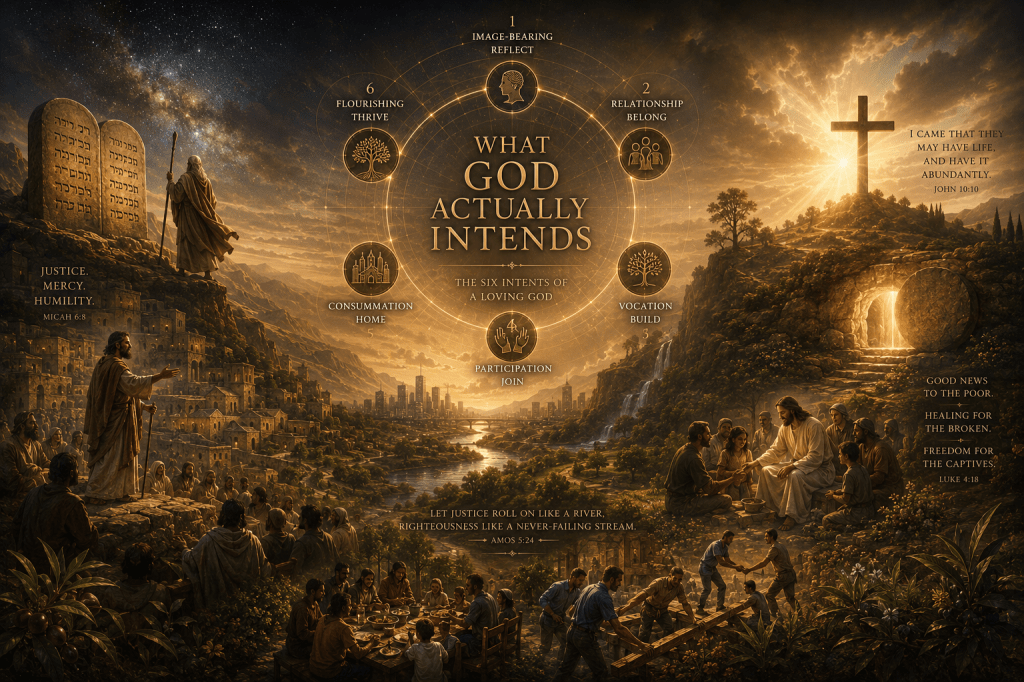
What God Actually Intends
How I Got Here
Since the beginning of time, people have been trying to discern the intent of God.
When the Hebrew people arrived on the stage of history, this discernment became especially intense. Prophets began to appear — Abraham, Moses, Isaiah, Jeremiah, Amos, Micah. The Hebrews were not merely interested in God as a concept. They were intent on hearing God’s voice and following it. The Torah, the prophets, and the wisdom literature were given as instruments of this discernment — a centuries-long, sometimes agonizing attempt to understand what God actually wants for human life and for creation.
Then Jesus came. He didn’t dismiss what came before. He reinforced it and deepened it. “You have heard it said… but I say to you.” The Sermon on the Mount is not a rejection of the Hebrew vision. It is its fulfillment — the deepest and clearest articulation of what God has been intending all along.
For the last 2,000 years, humans have continued this quest. Theologians, mystics, activists, ordinary believers — all wrestling with the same fundamental question: what does God actually want for us? For the world? For creation?
So have I.
As I describe in My Story, there came a moment when a single word began to matter in a new way: flourishing. It emerged out of illness. Out of watching students wrestle with technology. Out of the persistent gap I kept seeing between what human life could be and what it so often is. The question that formed was not economic or philosophical. It felt theological.
What does God actually intend for human life?
Not as abstract doctrine — but as a lived, measurable, embodied reality. What does it look like when humans are truly flourishing? And why, when we clearly have the means, do we so consistently choose less than that?
I began to pursue this direction. The research grew. The framework took shape. And at the center of it was a conviction: that God’s deepest intent for human life is flourishing — not bare survival, not merely avoiding sin, not passive endurance, but genuine, whole, abundant life.
What follows is my attempt to build that case from the ground up — from what Scripture actually says about God’s nature and intent, grounded in the Hebrew tradition, fulfilled in Jesus, and lived out in the early church.
The Foundation: God Is Love
Before anything else — before the framework, before the attributes, before any assessment of any human system — there is a single statement that changes everything:
“God is love.” — 1 John 4:8
Not: God acts lovingly. Not: God is loving when he chooses to be. But: God is love. Love is not something God does. It is what God is.
This is the foundation. And it matters more than anything else on this site.
The nature of love — genuine love, the kind the Greek New Testament calls agape — is that it moves toward the full aliveness of its object. Love does not want the beloved to suffer. Love does not want the beloved to merely survive. Love wants the beloved to flourish — to be fully, wholly, completely alive.
Before the intents, there is the nature. Before the design, there is the desire. Before the plan, there is the Person.
If God is love — and love moves toward the full aliveness of its object — then everything God intends for humanity flows from that single source. The question “what does God intend for human life?” has its answer already embedded in the answer to “what is God?”
The Six Intents of a Loving God
When we trace this vision through Scripture — from creation through the Hebrew prophets through Jesus and the early church — six distinct intents emerge. Each one is an expression of what agape wants for its beloved. Together they form the integrated vision we call shalom.
1. Image-Bearing — Reflect
Agape gives the beloved dignity.
Humans are created in the image of God — imago Dei. This is not a metaphor. It is a statement about ontology: every person carries within them something of the divine nature, which means every person has irreducible worth. The first intent of God is that this dignity would be honored and expressed in every human being and every community.
A system that treats people as instruments rather than image-bearers is, by this measure, failing God’s first intent.
2. Relationship — Belong
Agape moves toward the beloved.
The God of Scripture is not a distant deity. From the beginning, the human story is relational: made for relationship with God, with each other, and with creation. The rupture of those relationships is the definition of the fall. Their restoration is the definition of redemption. God’s intent is that humans would belong — genuinely, deeply, in communities of mutual commitment and shared life.
3. Vocation — Build
Agape gives the beloved meaningful purpose.
The first humans are given work before the fall — to tend and keep the garden, to name the creatures, to be stewards of creation. Work is not a consequence of sin. It is a gift of love. God is a creator, and humans made in God’s image are creators too. The third intent is that humans would find meaningful vocation — work that connects their gifts to the common good.
4. Participation — Join
Agape invites the beloved into its own work.
God does not accomplish redemption and restoration alone. God invites humans to participate — to be co-creators, co-laborers, fellow workers in the Kingdom (1 Corinthians 3:9). Agency — real freedom backed by real conditions, not merely formal permission — is not incidental to God’s intent. It is central to it.
5. Consummation — Home
Agape will not stop until it has brought its beloved home.
The biblical story has a direction. It moves toward the restoration of all things, the renewal of creation, the new Jerusalem where God dwells with humanity and “every tear will be wiped away” (Revelation 21:4). History has a destination, and that destination is shalom fully realized. What we do now matters because it participates in a trajectory that leads somewhere real.
6. Flourishing — Thrive
Agape’s goal is the full aliveness of its beloved.
All five previous intents find their integration here. Image-bearing, belonging, vocation, participation, consummation — these are not separate programs. They are dimensions of a single vision: that human beings and all of creation would be fully, wholly, completely alive.
The sixth intent is not one item among equals. It is the integrating vision. The biblical word for it is shalom. And shalom is what God has been intending since before the first morning.
The Hebrew Vision: Shalom as Social Order
The Torah is not primarily a set of religious rules. It is a blueprint for a society organized around shalom — where the vulnerable are protected, the land is stewarded, wealth does not concentrate permanently, and every person has enough.
The Jubilee — the fiftieth year in which debts are cancelled, land is restored, and slaves are freed — is perhaps the most radical economic instruction in human history. It exists precisely because God will not accept a permanent underclass. The covenant demand is this: no one should be permanently excluded from flourishing.
The prophets return to this vision relentlessly. When Israel fails to embody it, they name the failure as covenant violation — not merely social injustice but theological betrayal.
“Let justice roll on like a river, righteousness like a never-failing stream.” — Amos 5:24
“What does the Lord require of you? To act justly, to love mercy, and to walk humbly with your God.” — Micah 6:8
Isaiah describes God’s preferred fast — not religious ceremony but the liberation of the oppressed, food for the hungry, shelter for the poor (Isaiah 58:6–7). The vision is always the same: God wants human life to flourish, and the measure of faithfulness is whether the most vulnerable are flourishing too.
Jesus: The Fullness of the Vision
Jesus does not introduce a new intent. He embodies and fulfills the one that was always there.
Look at what he actually does.
He turns water into wine at a wedding — not water into suffering. He feeds five thousand people who are hungry. He heals the sick, gives sight to the blind, restores lepers to community, raises the dead. He welcomes children when the disciples turn them away. He eats and drinks with such regularity that his enemies call him a glutton and a drunkard. He describes the Kingdom of God as a feast, a banquet, a celebration to which everyone is invited.
When he stands in the synagogue at Nazareth and reads from Isaiah — “The Spirit of the Lord is on me, because he has anointed me to proclaim good news to the poor” (Luke 4:18) — he is not announcing a political program. He is announcing the arrival of the shalom God always intended.
His healings are shalom acts. When he heals a leper, he restores not just skin but belonging. When he raises the widow’s son, he restores not just life but her economic survival and social standing. The Kingdom of God that Jesus announces is shalom becoming visible in a first-century occupied territory.
And then the most direct statement in the entire Gospel:
“I came that they may have life, and have it abundantly.” — John 10:10
Abundantly. The Greek word is perissos — overflowing, exceeding what is expected, beyond the ordinary measure. Not barely surviving. Not enduring. Not merely being forgiven. Abundant life.
The early church understood this. In Acts 2, they lived it:
“All the believers were together and had everything in common. They sold property and possessions to give to anyone who had need… they broke bread in their homes and ate together with glad and sincere hearts.” — Acts 2:44–46
Glad hearts. Everything in common. No one needy. This is not a description of a community organized around suffering. It is a description of shalom — the Shalom Flourishing Framework in practice.
Addressing the Objection
At this point a genuine challenge arises, and it deserves a direct answer.
The claim: Jesus’ life espoused the exact opposite of human flourishing. He called his followers to self-denial, to take up their cross, to lose their lives. Paul speaks of sharing in Christ’s sufferings. The martyrs died. Suffering, on this reading, is not incidental to the Christian life — it is the point of it.
Here is the response.
Suffering in the New Testament is almost always the cost of faithfulness in a world organized against shalom — not the goal of faithfulness. The distinction is everything.
Bonhoeffer died in a Nazi prison. But he did not die because God’s intent was for him to suffer. He died because he was faithful to God’s intent for human dignity in a world that violently resisted that intent. The suffering was the cost of the witness — not the point of the witness.
The prophets suffered because they named what empire didn’t want named. Jesus was crucified because the Kingdom he embodied was a direct threat to the powers organized around domination rather than shalom. The cross is not a celebration of suffering. It is what happens when the full intent of God collides with a world organized against it.
Self-denial in Jesus’ teaching is not self-destruction. It is the willingness to release the grasping, accumulating, status-protecting self — in order to become fully human. “For whoever wants to save their life will lose it, but whoever loses their life for me will find it.” (Matthew 16:25) The loss is in service of the finding. The death is in service of the life.
A community following Jesus that is characterized primarily by suffering and deprivation is not following the Jesus of the Gospels. It may be following a theology of suffering grafted onto his name. The Jesus of the Gospels healed people, fed people, celebrated with people, restored people to community, and said he came to bring abundant life.
That is the Jesus who matters here.
The Standard Is Revealed, Not Constructed
This is why the Shalom Flourishing Framework begins here — not with social science, not with economics, not with political philosophy, but with the nature of God.
Most flourishing frameworks are constructed by humans — built from utility, preference, productivity, or rights. They measure what humans decide matters. This framework is different. It begins with a claim: the standard for human flourishing is not constructed by humans. It is revealed — by a God whose nature is love, whose intent for human life has been made known through creation, through the Hebrew prophets, through Jesus, and through the long witness of those who have tried to embody shalom in a world that keeps choosing empire.
The sixteen attributes of the Shalom Flourishing Framework are not arbitrary. Each one traces back to this vision. Each one is a dimension of what God intends when love creates, redeems, and restores.
The gap between what God intends and what human systems produce is not an indictment. It is an invitation. It is the space where the calling of shalom begins.
— Peter

