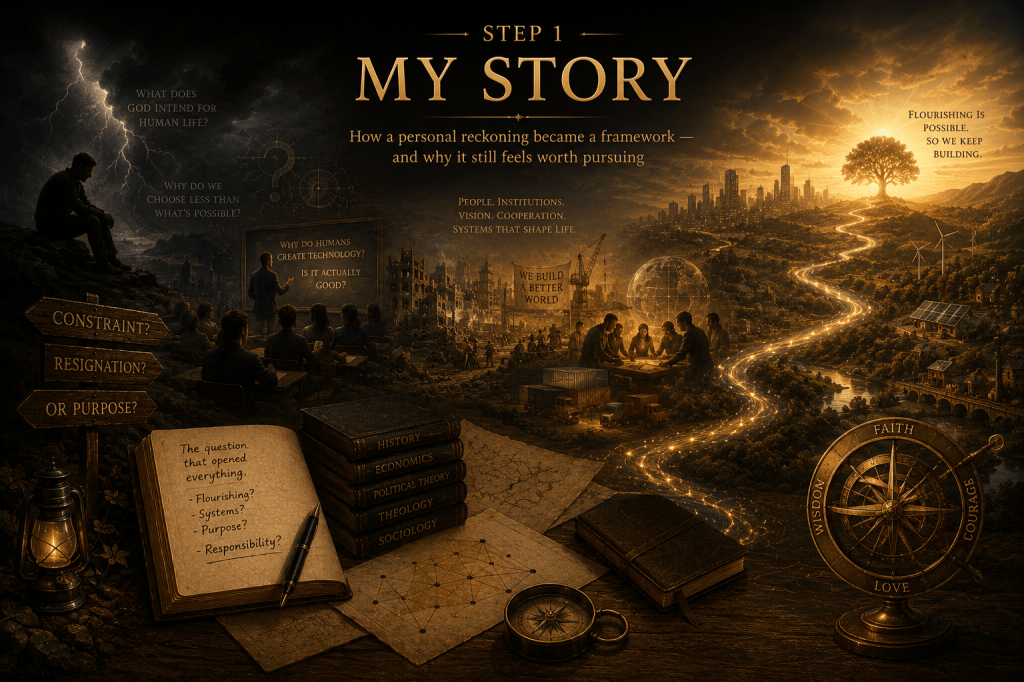
Inside the Machine
I grew up knowing I was going to follow my father’s footsteps to be a lawyer — according to him, one of only three legitimate professions, the others being medicine and theology. But after finishing college with an undergraduate in finance, he and others encouraged me to work for a while, then go back to law school. In fact, they said, get into this newfangled business hot in the Twin Cities at that time — computers. So, I did.
I learned two things — the law seemed boring in comparison to technology. And I could still go back to school, get an MBA and focus it on information technology. So, I did exactly that, and when I graduated, I went into consulting — global systems consulting. So much for the law.
For most of my adult life, I worked inside large organizations and large systems — global businesses, global transformations, global scale. I helped organizations rethink how they operated at enormous size. Supply chains. Data architecture. Process design across industries that touched billions of people’s lives.
The largest of these projects was Transora — a project that turned into a company. An ambitious attempt to transform the consumer goods industry from the inside. Backed by more than 100 of the world’s largest consumer goods companies and roughly $250 million in investment, it sought to reinvent the global supply chain, systemizing the then-nascent internet — the system would eventually contain more than $15 trillion in annual economic activity. Had it fully succeeded, it might have opened global supply networks more effectively to underserved communities, lowered costs for those with the fewest resources, and dramatically reduced waste across the system.


I believed then — and still believe — that large systems can be redesigned. That human coordination at scale is possible. That when humans of good will, and guided by a higher power – God – good can happen. That when institutions, incentives, resources, technology and imagination align, the world can change for the better.
“Go big, or go home,” we used to say to each other in those days.
Another thing about who I was then: I was politically, a Republican. Specifically, a fiscally conservative Republican. I believed in markets, in scale, in the power of well-run systems to create broad prosperity. As for people and the least of these — I didn’t lack compassion exactly. I just considered them unfortunate. People who needed to pull themselves up by their bootstraps and make something of themselves. Just like I had.
The question that was coming — waiting for me — was so far outside my political and personal frame that some family members still describe the coming illness as having made me “switch teams.” They’re not entirely wrong. But it’s more complicated than that.
That belief, and that indifference, would eventually collide with everything else in this story.
The Illness
In 2009, something was seriously wrong with me — and for months, nobody could tell me what. It started with back pain. Pain so severe I had been prescribed bed rest. What nobody knew yet was that the pain wasn’t muscular — Multiple Myeloma, a blood cancer that lives in the bone marrow, had begun dissolving bone, causing lesions. My spine was not simply sore. It was under attack.

The bed rest that was supposed to help me recover instead left me invalided. I couldn’t get up and walk without help. And somewhere in that period I contracted pneumonia — which, as I would only learn later, is one of the leading causes of death in myeloma patients. The disease I didn’t yet know I had was making it nearly impossible to fight the disease that was visible.
For a lengthy stretch of time, my world narrowed to a recliner in a dim room. A sliding stand held my laptop — I was still working, because stopping wasn’t something I could imagine. My phone and headphones stayed plugged in beside me. Fear, pain, sleeplessness — with some moments I can only describe as hallucinatory. Days were spent simply enduring.
I thought I was dying. And I didn’t even know what was killing me.
It wasn’t until months later that I was finally diagnosed: Multiple Myeloma. I’m in remission now and have been for the better part of fifteen years.
But in that recliner, in the unnamed dark of it, at some point I surrendered. Not dramatically. Not with any ritual or prayer. Just a quiet letting go of the outcome. Whatever came next was God’s to decide. I was done fighting the uncertainty.
And in that surrender, a question arrived. Not a vision. Not a voice. Just a thought that lodged itself somewhere I couldn’t reach to remove it:
Why do we accept that the least of us don’t flourish?
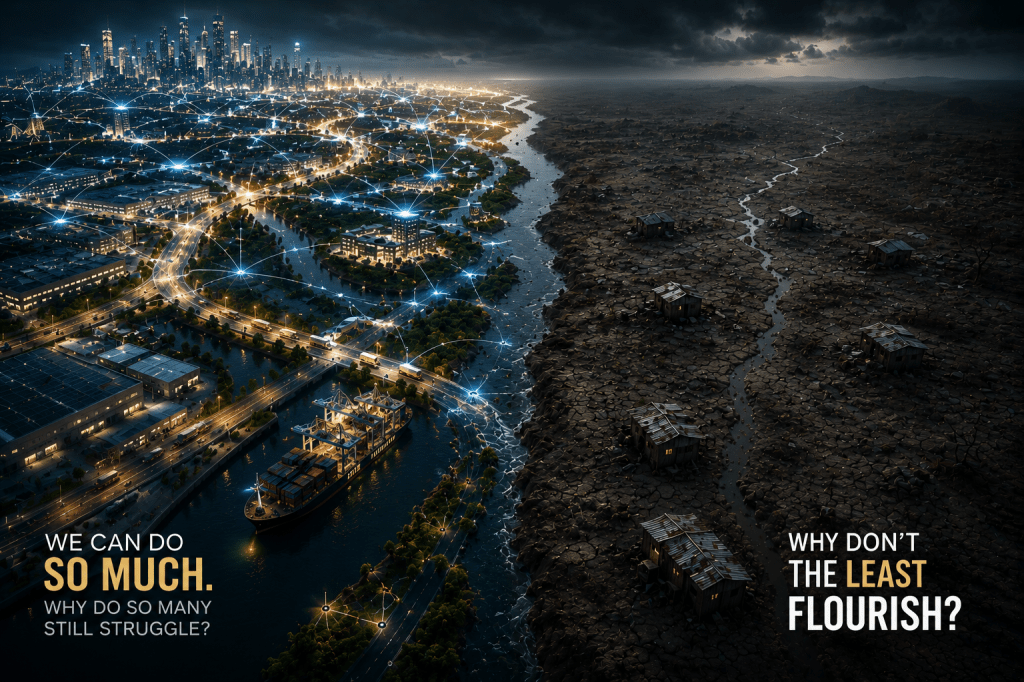
I used to tell this part of my story by saying I suddenly grew a compassion gene. That’s how it felt — random, inexplicable, almost funny in its lack of drama. No trigger I could identify. Just a thought, arriving uninvited, that refused to leave.
It wasn’t until years later — sitting in seminary, learning that the Holy Spirit moves in ways that don’t announce themselves — that I understood what had probably happened in that recliner.
I had surrendered to God. And God had spoken back. And the question God left me with wasn’t will you survive?
It was why are you here?
Fear Is the Greatest Motivator
But I never stopped working. Through the illness and the recovery I took only a few weeks off — I was at a large global software company at the time and stayed there for a time, then went into another global executive role with another software provider. From there to smaller consulting firms, my own gig, and finally what I can only call the Boston-astrophy.
It looked like a re-entry into something with real momentum — a small, Boston-based boutique with a hot cost-cutting model and genuine energy. I was ready to get back in the game.
I knew on the first day it was a mistake.
The opening line of the first management meeting — spoken by the CEO, without irony — was: “We all know fear is the greatest motivator of humans.”
I stayed six months. One of my best friends told me at the three-month mark to get the hell out. He was right. I wasn’t ready to hear it yet.
The men running the firm were also, loudly, men of Jesus. The prosperity gospel variety: Christianity as personal brand, worn on the sleeve, untethered from anything that looked like the actual teachings of Jesus. I didn’t have the theological vocabulary for it then. I do now.
I quit-fired at six months. I left knowing something I hadn’t been able to fully name before: I was done helping enrich a few wealthy executives when technology and scale could serve so many more. Why was I here?
The question from the recliner wasn’t going anywhere. And the career I’d built — for all its genuine ambition, for all its real possibility — had never quite asked it.
It was time to find somewhere that would.
The Classroom
Around that time, a Christian K-12 school in one of the most diverse and economically challenged neighborhoods in the country asked me to help build a technology program. They came to me because of my involvement helping a nonprofit do similar work. I was hired to implement it. But I decided I’d teach too.
“What will you teach?” they asked.
“Technology,” I said. “But not just how to use it. Look at the bigger questions — what it is, why humans create it, how it shapes us, and whether it actually makes life better.”
They seemed unsure the students would go for it. Honestly, so was I.
Nobody wakes up hoping to hear a middle-aged man lecture about stone tools, the wheel, or the history of innovation. You probably felt your eyes starting to glaze over just reading that sentence.
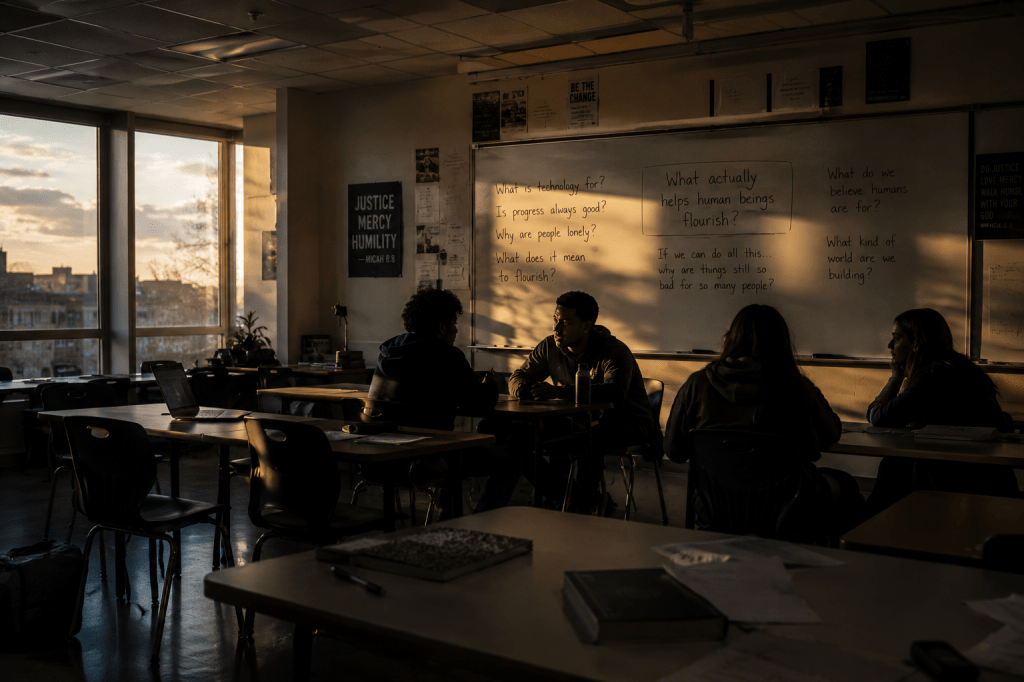
But then something unexpected happened. The students started asking real questions.
Why do humans keep creating technology? Why are we never satisfied? Why does every new tool solve problems but also seem to create new ones?
And eventually, the biggest question emerged:
Can technology actually be good?
I remember one classroom discussion where the energy suddenly shifted. We had moved beyond devices and inventions and were talking instead about loneliness, wealth, power, anxiety, inequality, social media, war, and what kind of world we were building together.
And then a student asked a version of a question I still cannot shake:
“If we can do all this — why are things still so bad for so many people?”
That landed harder than the students probably realized. Because it was the question I’d been carrying since the recliner. And now it had company.
Beneath the technology questions was something hiding in plain sight: Why do human beings exist — what are we here for?
I started researching. How did we know? What was life success? Could we start with just lifespan? I found the discipline around these questions was called human flourishing.
And I couldn’t put it down.
Seminary and SEM
The school where I taught was evangelical and Calvinist. The first year I was caught up in building something new — the program, the curriculum, the energy in the classroom. It was working. And then, somewhere in the second year, threads I had never examined started pulling loose.
The theology I was surrounded by raised questions I couldn’t put back:
If God made us in his image, how can we be so utterly depraved?
If God is love and sovereign over all things, how could evil and suffering be part of that plan?
If God is love, how could God choose for people to go to hell?
And if God is love, how can we treat some people well while being so openly hateful toward others?
I left the school after three years and spent the next year reading and studying furiously. The human flourishing research was sitting there — where it was. But it was floating without a foundation — I was missing the meta-narrative, the frame that could hold it all together.
In a kind of desperation, I entered the School of Everyday Mission (SEM), part of Woodland Hills Church — Greg Boyd’s place. I was theologically in trauma. I needed to find out what could be true.
SEM began restoring what the school had broken. God is love — not sovereignty first, not wrath first. God is Jesus — the clearest picture of who God is in human history. And underneath everything, a framework for understanding why the world is so broken: good and evil as genuine forces in history, kingdom versus empire, two opposed ways of organizing human life in permanent conflict.
Three rivers began running through my mind — my faith, now being rebuilt on firmer ground; the human flourishing research, growing deeper; and something ancient I hadn’t yet fully named. In year two of SEM, they began to converge.
Alongside SEM, I went deeper — independently — into the Hebrew Bible. Through resources like The Bible Project, which explores the literary and theological themes of Scripture, and BEMA, a podcast bent on recovering the Hebrew context that Western Christianity largely lost, something came into focus.
This is how God has always intended things. From the Garden of Eden and abundance with human caretakers. To Abraham’s Promised Land. To Israel’s salvation from slavery and return to the promised land. God has persisted through all of human history, drawing creation back toward the way it ought to be. And with Jesus, still is.
That way has a name.
It’s called shalom.
And when I set that ancient vision alongside the human flourishing research I’d been building since the classroom — the convergence was real. Shalom wasn’t a synonym for flourishing. It was its ground.
The framework that would become the Shalom Flourishing Framework had found its foundation.
The Challenge
One of SEM’s core convictions is that faith is inherently political — it always has been. The kingdom of God and the kingdom of empire operate in the same world — from entirely different places. One rooted in evil, the other in God’s intent. They are not separate spheres. They are at war. That conviction was present in every class discussion. And by winter 2025, with a new presidential administration and the world feeling increasingly unstable, it was impossible to ignore.
We were deep in the theology of spiritual warfare — kingdom versus empire, good and evil as genuine forces in human history. I was making an argument I believed completely:
Evil is real. Empire is real. And the faithful response is that we can resist at scale. We can build at scale. The evidence is undeniable — worldwide lifespans up, diseases tamed, maternal and infant mortality down sharply, abject poverty falling from over half the world’s population to under 10%. The overall arc of human wellbeing, measured honestly, bends upward. The post-WWII era alone proves what coordinated human effort can achieve. There isn’t a movement yet that has fully named and aimed at shalom. But there could be.
The theological architect of the School of Everyday Mission looked into the Zoom camera and said, in front of the class:
“Why do you worry about things that won’t matter when you’re dead?”
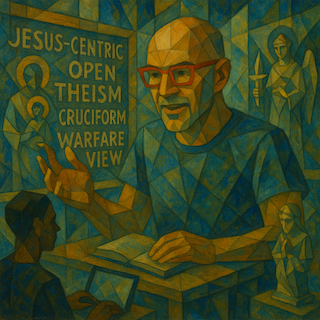
I acknowledged it. Then silence. I had no idea what to say. What it even meant.
What I heard underneath it was: think smaller. Your family. Your community. Your legacy in the world you can touch. The forces of evil are too pervasive, too co-optive. Don’t put your faith in large-scale human systems or progress.
It was a serious theological argument. From someone whose theology I had come to deeply respect. And it landed like a question I hadn’t expected to have to answer.
Is all of this worth it?
I sat with that.
The Question That Wouldn’t Leave
I tried to embrace the challenge. Genuinely.
Think smaller. What would that mean? What would I focus on? What would I start doing, stop doing, do differently? I sat with it. I turned it over. I tried to find the shape of that life that still felt faithful to me.
I couldn’t find it.
Not because the small things don’t matter — they do. Family. Community. The people directly in front of you. Those are real and they are not nothing. But something kept pulling me back to a question I couldn’t set down:
When in history have humans come together and done real good at scale?
The post-WWII era kept presenting itself as an answer. Good people, wanting to stop bad things — never another depression, never another world war — built the Marshall Plan, Bretton Woods, the United Nations. In a single generation, global life expectancy rose from 46 years to nearly 60. Extreme poverty began its long decline. Real wages rose broadly.
But the framework would later show that even that era carried empire logic underneath the prosperity — colonialism still operating, racial exclusion built in, Cold War domination across three continents. The flourishing was real. It was also incomplete.
That was the point I kept returning to: even a flawed, empire-leaning attempt at large-scale coordination produced genuine good. What would a genuinely shalom-oriented effort produce?
That question wouldn’t leave me alone. So I kept building.
Then the world outside the class exploded.
Operation Metro Surge came to the Twin Cities — federal immigration enforcement that felt less like law and more like occupation. Renee Good, a 37-year-old mother of three and U.S. citizen, was shot and killed by an ICE agent on a residential street in south Minneapolis. Two weeks later, Alex Petri, a neighbor who intervened to help a woman being attacked by agents, was beaten, found to be legally armed, and shot ten times in the back. He died in the street. People in the class were enraged, grieved, overwhelmed. They were sending money, providing food, shelter, and showing up.
The libertarian thread that had been running through the class since the 2024 election had a response: quit paying taxes. What?
The year wound down into its final sessions — Jesus parables, a healing journey. What does God intend for us, for me? What did Jesus mean, to the people of his time and to us today?
In the middle of that discussion, I pushed back on how parables were being interpreted. And from that came a challenge I hadn’t seen coming:
God doesn’t intend for humans to flourish in this life.
If flourishing is only eschatological — pertaining to the end times — building a framework to measure it in history is a fool’s errand. Leave the big systems to the empire builders. Tend your garden. Wait for the kingdom to come.
But I was deep enough into the Hebrew Bible by then to have an answer. Shalom isn’t only eschatological. It is God’s persistent intent for creation — from the garden, through Abraham, through the Exodus, through the prophets, through Jesus. God has always been drawing the world back toward the way it ought to be. Not only at the end. Now. Imperfectly. Partially. But genuinely. And perhaps God is waiting for us to get it more right than wrong, then returns?
My answer didn’t just respond to the challenge. It locked something into place.
The human flourishing science and the shalom vision — two threads I had been pulling separately — finally met. And they meshed. The empirical research on what makes human life go well, and the ancient Hebrew vision of what God intends for creation, were pointing at the same reality from entirely different starting points.
The Shalom Flourishing Framework came into being.
So, I pushed on.
The Finding
The first surprise was the convergence itself.
I had expected overlap. What I found was something closer to identity. The human flourishing science — Harvard’s empirical framework, Gallup’s research, the decades of work on what makes human life go well — and the ancient Hebrew vision of shalom were not merely pointing in the same direction. They were describing the same thing. Different languages. Different starting points. The same reality.
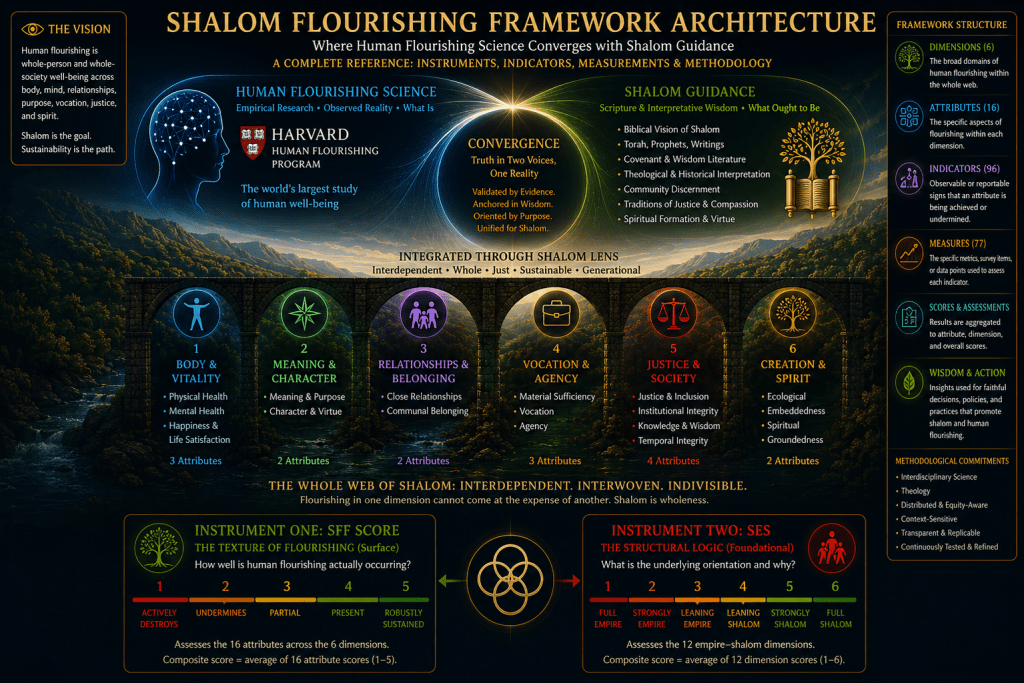
That convergence made something possible I hadn’t anticipated: an actual instrument — a way of scoring any social arrangement, any ideology, any historical era against a standard that was both empirically grounded and theologically rooted. Sixteen attributes across six dimensions, 96 indicators, 77 measures. A companion instrument that mapped the structural logic underneath — empire or shalom. And individual and community assessments asking where we stand personally within it.
The second surprise came when I started scoring.
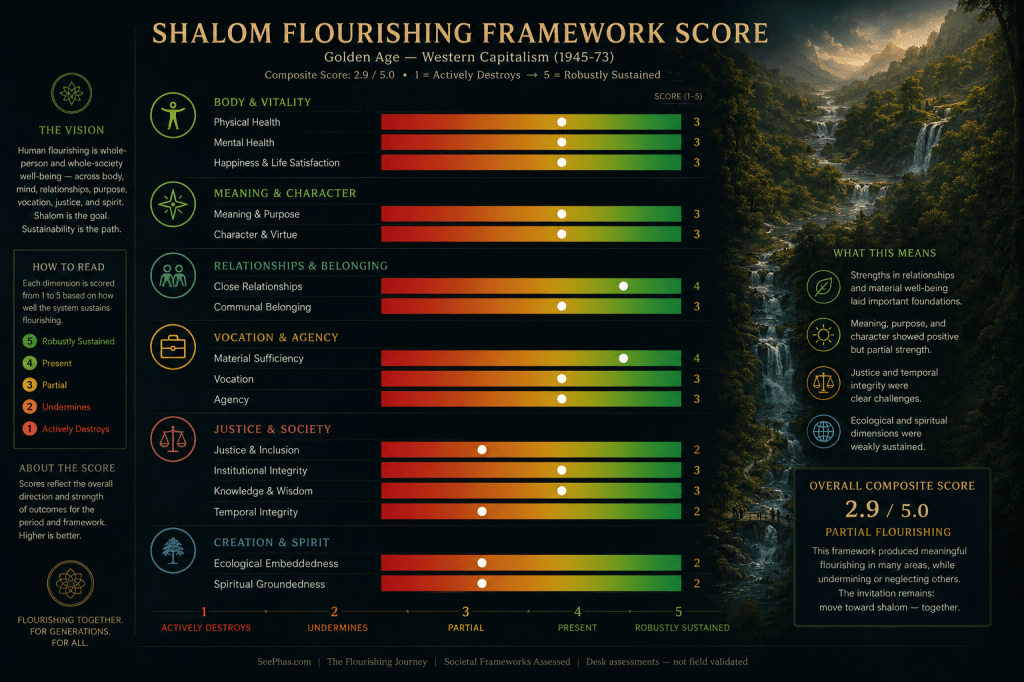
The post-WWII era — my test case — came back middling. 2.9 out of 5. Real flourishing for a significant portion of humanity. And empire logic running underneath. The framework hadn’t vindicated my argument. It had given me an honest answer. And that, I realized, was exactly what it was supposed to do.
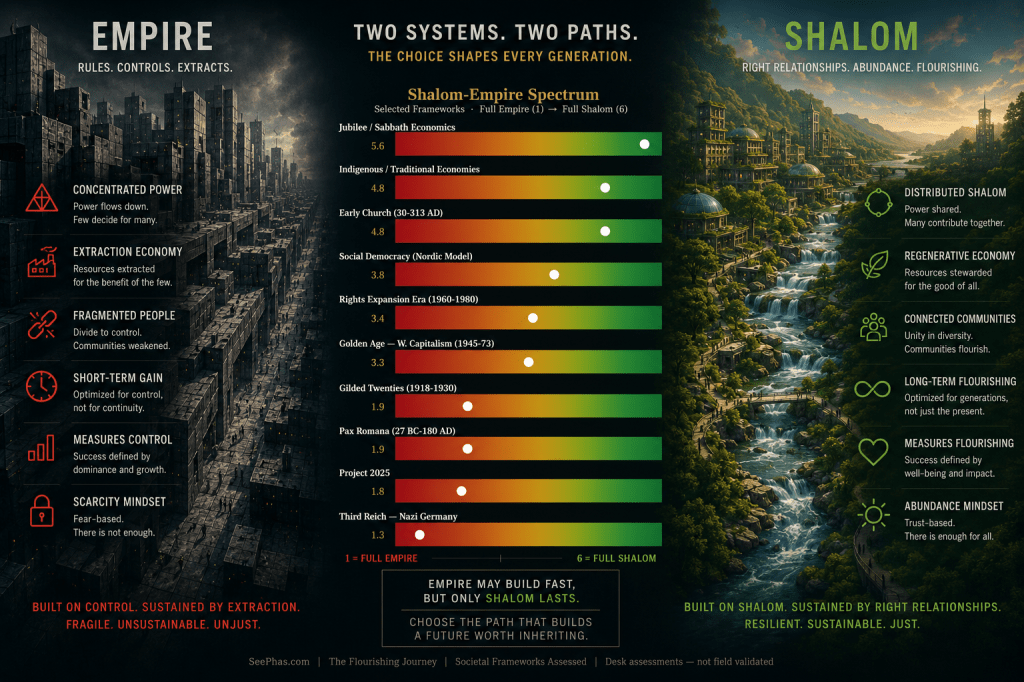
The shalom standard doesn’t bend to make any era look good. The standard is fixed. What changes is how closely any arrangement approximates it — and in which dimensions it most succeeds and most fails.
That’s what makes it useful. The question isn’t whether large-scale human flourishing is possible. The question is whether we’re willing to name the standard, measure honestly against it, and do the work.
The Walls and the Road

Now I want to be honest about what this is up against.
The first wall is political tribe. Everything gets filtered through partisan identity before it gets evaluated on its merits. The framework scores some arrangements much lower than their supporters want to hear — and in a climate where the score is all anyone sees, the evidence behind it never gets examined.
The second wall is the language itself. Shalom opens doors for some people and closes them for others — before the conversation even begins. For the theologically serious it unlocks the vision. For secular policy people it might sound like church. For theologically conservative Christians, like progressive politics in biblical clothing. The same word does different things to different people.
The third wall is weight. This is not a light framework. People are tired. The news is relentless. Who has time to examine a 16-attribute assessment of human flourishing?
I name these walls not to discourage but because pretending they don’t exist would be dishonest. And because the people who will find this useful are precisely the people willing to walk through them anyway.
So here is who I am speaking to:
To the American confessing church and SEM students — you already have the theological language. Most already believe God intends shalom. This is an invitation to connect that conviction to the empirical reality of where we actually are.
To the politically minded — left, right, or exhausted by both — this is an invitation to name what wholeness would actually look like, measure honestly against it, and find a basis for conversation that isn’t just tribal loyalty dressed as principle, or complaining, or worst an invitation to burn it down.
To the disenfranchised, the burned-out, the ones who’ve given up or checked out — the world has gotten better. Not enough. Not fast enough. Not for everyone. But better. That is not naive optimism. It is the testimony of history, measured honestly. Don’t you want to join in?
The question that arrived in that recliner — why are you here? — still doesn’t have a complete answer. But this journey is part of it.
You’ve read my story. Now step into the framework.
The next step asks the question that started everything: does God intend for creation to flourish? Not just at the end. Now. The answer is older than any framework, and more demanding than any political program.
It’s called God’s Intent. And it’s where this journey begins.
 SeePhas