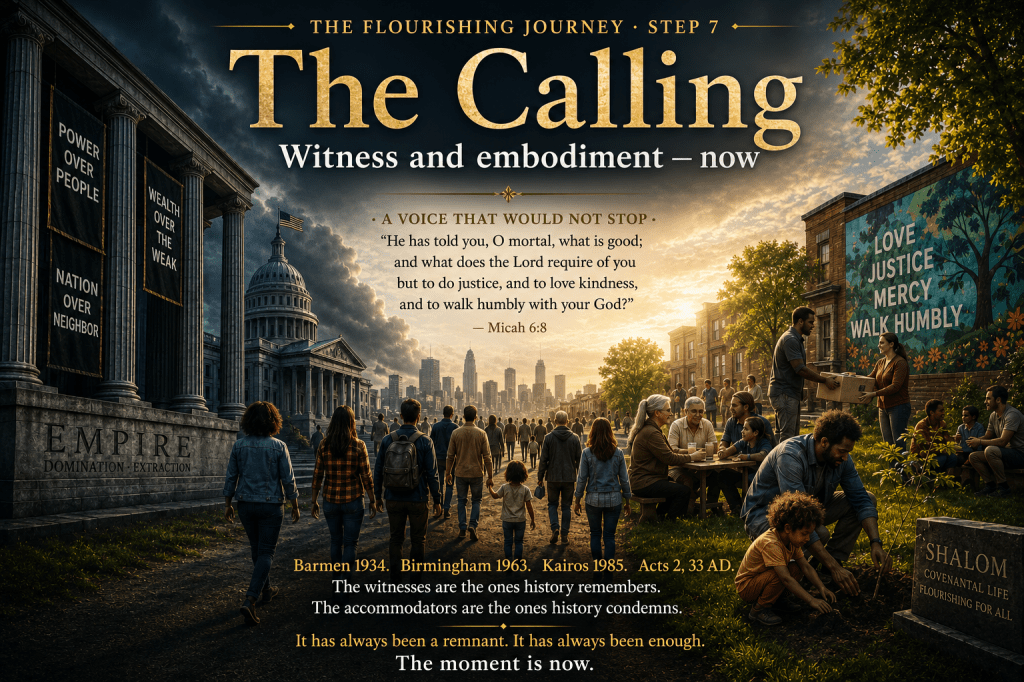
A voice that would not stop
This journey started on what felt, at the time, like it could have been my deathbed. Something in my nephesh — the Hebrew word that holds together our soul, our entire being — was disturbed. The disturbance was in two places prophets have never stopped naming: mishpat, restorative justice, and tzedakah, righteousness — right-with-ness, or in other words loving others.
The question that would not leave me alone was simple. Devastating, but simple:
Why do we skimp?
Why does the wealthiest nation in the history of humankind — a country that actually has the resources — choose not to care for its poor, its oppressed, its widows, its orphans, its immigrants, its mothers and its children? We could. The math works. But we choose not to.
And in this time — 2026 — we are choosing to double down on that. We are eroding what little safety net still exists. We are stripping out what public good the government provides and refocusing on the ability to wage war. We are allowing power and wealth to concentrate at the very top — all the while being told to enjoy our greatness, be more grateful, and to trust them more.
· The Numbers ·
Since 1980 — what actually happened
Since the Reagan revolution, we have systematically stripped out safety nets and reduced taxes — especially on the wealthy. The data tells the story plainly. Real GDP has averaged roughly 2.5% annual growth since 1980 — the economy quadrupled in real terms between 1989 and 2022 (CBO). Our wealthiest have gotten dramatically wealthier. The top 1% held 22.8% of national wealth in 1989. Today that figure has risen to 31.7% — a new all-time record, according to the Federal Reserve. The top 1% now collectively hold approximately $55 trillion. The bottom 50% of Americans hold just 2.5%.
The billionaire class has expanded beyond anything in our history. In 2024 alone, just 19 households added $1 trillion to their net worth — an amount larger than Switzerland’s entire economy (Gabriel Zucman, UC Berkeley / Federal Reserve data).
So the wealth has gone up. The wealthy, especially the top 1%, have gotten dramatically wealthier. The economy has grown.
And yet.
5.7 years White–Black life expectancy gap — widened during COVID — not recovered (CDC 2023)
#1 Maternal death rate in the developed world — highest among wealthy nations — by far
3.5% Bottom quintile share of national income — flat or declining since 1980 — while the top 1% share nearly tripled
18% US poverty rate (OECD measure) — second highest among all 38 OECD nations — behind only Costa Rica
#1 Child poverty rate in the developed world — per OECD — Black and Hispanic child poverty above 20%
Our poverty rate — measured by the OECD’s independent standard, not our own suppressed threshold — stands at 18%. Second highest among wealthy nations. In countries like Denmark, Finland, and Czechia, poverty affects 5–7% of the population. We have the resources. We make different choices.
How is it that Black Americans live on average nearly six years less than white Americans? How is it that we have the highest maternal death rate in the developed world? How is it that we have managed to divide people — mainly by race and by geography, rural versus urban — and convince large numbers of Americans that they are being taken from by “them”? Starting with their rights. Ending with their pocketbooks.
In this time we have an administration running a playbook — Project 2025 — that is further eroding what government provides for the public good, consolidating power and wealth at the very top, attacking the press, projecting dominance rather than partnership in the world, and targeting the most vulnerable. The Shalom Flourishing Framework scores this arrangement at 1.7 out of 5 — the third lowest of the 21 frameworks assessed. The Shalom-Empire Spectrum scores it at 1.8 out of 6, also third most “empire-like” amongst the 21.
That places it squarely in the company of Putin’s Russia and the Gilded Twenties — and yes, on the structural logic measure, close to the Third Reich — the lowest Shalom Flourishing Score and most empire-like of 21, which includes the Roman Empire and Victorian United Kingdom.
That is not hyperbole. That is what the framework shows.
· The Church ·
Where is the church in all of this?
The church in America claims to hold the standard. The Sermon on the Mount. The prophets — Micah, Amos, Isaiah. The Jubilee. Acts 2. Matthew 25: whatever you do for the least of these, you do for me.
It has in its hands the most complete account of human flourishing ever articulated. 62–69% of Americans identify as Christian. 200 million people. More infrastructure, more weekly gatherings, more existing relationships than any other institution in American civic life.
If the church were applying its own standard, it would be the most powerful force for shalom in America. That is the measure of what is being lost.
63% Of all Christians who voted for the Project 2025 framework in 2024 — Pew Research
81% White Evangelicals — the highest of any Christian group
13% Black Protestants — the most shalom-aligned Christian bloc in America
20% Weekly church attendance — down from 32% in 2000 — institution shrinking as witness is needed most
Sixty-three percent of professing Christians in the United States voted for this in the last election. Eighty-one percent of evangelicals. Those Christians who didn’t support it are now the minority. And most are not speaking out. Is silence complicity?
The gap between what the church confesses and what it supports is not a political disagreement. It is a theological crisis.
Christian nationalism is not a political problem. It is a heresy. It must be named as such — not as bad politics but as false doctrine. The merger of the gospel with nationalist identity is what the church has done before and it has led to disaster for the church and for humanity every single time.
But there is something else that must be said.
The American church is largely preoccupied with itself. Two hundred million Christians, and the average church spends approximately 50% of its budget on professional staff, another 20–25% on facilities — the air-conditioned auditoriums, the professional-grade sound systems, the lights. What remains for the poor, the widow, the immigrant, the incarcerated? Studies consistently find that direct benevolence — actual material help to people in need — accounts for 1–3% of the average church budget (ECCU Ministry Advisory Panel; Lake Institute National Study of Congregations).
1–3%. In a nation with 43.7 million people in poverty.
The church talks charity. It talks service. It talks “meeting the needs of the least of these.” And then it spends 95 cents of every dollar on itself — on its programs, its staff, its buildings, its brand. This is not a political critique. It is a Matthew 25 critique. It is the church failing its own test.
Witness without embodiment is just better politics. Embodiment without witness is just a nice community. Together they are the calling of shalom.
· The Pattern ·
This is not the first time — 900 years of the same pattern
Every time, across nine centuries, the pattern is identical: the majority of the church accommodated power. A remnant witnessed against it. History vindicated the remnant every single time.
1095–1291 Crusades · Pope’s War
✗ Pope Urban II launched the Crusades. The massacre of Jews and Muslims in Jerusalem was celebrated as divine victory.
✓ Bernard of Clairvaux, Francis of Assisi challenged the logic. Almost no one listened.
1492–1600s Conquest of the Americas
✗ The church provided theological architecture for genocide across an entire hemisphere.
✓ Bartolomé de las Casas named the atrocity. Almost no one listened.
1619–1865 American Slavery · Slaveholder Theology
✗ Most Protestant and Catholic denominations provided systematic theological justification for slavery. Scripture deployed in service of empire.
✓ Abolitionists. Frederick Douglass, Harriet Tubman, the AME Church. The prophetic remnant was mostly Black.
1877–1965 Jim Crow · Segregation Church
✗ White churches silent or actively complicit. Civil rights activism condemned as “political prostitution of the church.”
✓ The Black church. King’s Letter from Birmingham Jail was written to white moderate clergy.
1933–1945 Nazi Germany · The Reich Church
✗ The established Protestant church absorbed into Nazi ideology. Blessed the state. Silenced the prophetic. Bonhoeffer called it “cheap grace.”
✓ Confessing Church — Barmen 1934: “Jesus Christ is Lord, not the Führer.” Bonhoeffer. Niemöller. Barth.
1948–1994 South Africa · Apartheid Church
✗ The Dutch Reformed Church provided official theological justification for apartheid.
✓ Kairos Document 1985: “The church cannot collaborate with tyranny.” Tutu. Boesak. Beyers Naudé.
1865–1965 The KKK · Christian Terror
✗ Explicitly Protestant Christian. Burning cross, hymns, church membership required. 3–6 million members at peak. Ministers recruited from pulpits.
✓ The Black church. A small number of white ministers who condemned it — some were killed for it.
1994 Rwanda · The Silent Church
✗ 90% Christian nation. Church leaders largely passive during the genocide of 1 million Tutsi. Some clergy participated directly.
✓ A small number of pastors hid Tutsi at personal risk. The majority did not.
The majority accommodated. The remnant witnessed. History has always vindicated the witness. Same pattern. Different century. Every time.
Has a remnant formed in America — like the Confessing Church of Nazi Germany — that is all that remains of the church that is against empire in our time?
Maybe?
· The Distinction ·
The Confessing Church versus the Accommodation Church
In 1934, a group of German pastors gathered at Barmen and issued a declaration. Its meaning was simple and cost them everything: Jesus Christ is Lord. Not the Führer. The same distinction exists in America today. It is not a political distinction. It is a theological one.
The Accommodation Church — The theological structure of accommodation
✗ Blesses the state and its leader — theological cover for power
✗ Deploys Scripture in service of nationalism
✗ Targets the vulnerable — the opposite of Matthew 25
✗ Merges Christian identity with political identity
✗ Silences prophetic witness as political interference
The Confessing Church — The theological structure of witness
✓ Names Jesus as Lord — not the nation, not the party, not the flag
✓ Applies Shalom Flourishing to every system — including its own
✓ Protects the vulnerable as the primary test of faithfulness
✓ Refuses the merger of gospel and nationalism
✓ Pays the cost of prophetic witness — and pays it anyway
· The Remnant ·
Is there a Confessing Church in America today?
Yes. Scattered, multiracial, theologically serious, not yet named as such. The remnant is larger than it feels. 30% of Americans wholly reject Christian nationalism (PRRI 2024).
Black Church Tradition
The most historically consistent prophetic voice in America. Has been the confessing church all along — while the white church accommodated. The remnant has largely been here the whole time.
Poor People’s Campaign
Rev. William Barber and Rev. Liz Theoharis — explicitly theological, multi-racial, grounded in the prophetic tradition. Fusion politics rooted in the gospel.
Progressive Evangelical Movement
Jemar Tisby, Kristin Du Mez, Diana Butler Bass — naming Christian nationalism as heresy from inside the evangelical tradition.
Sanctuary Movement
Congregations actively protecting immigrants and refugees. Matthew 25 made concrete. Not a political gesture — a covenantal act.
Creation Care Communities
Churches taking ecological stewardship seriously as theological obligation, not political preference. The creation mandate as covenant.
30% of Americans
Wholly reject Christian nationalism (PRRI 2024). Scattered across every tradition, every city. Is the remnant is larger than it feels?
It has always been a remnant. It has always been enough. The question is whether it will find itself and act together.
· Where Do We Begin? ·
Prophetic imagination — Walter Brueggemann
So this is where we start. Not with a program. Not with a strategy. With what the prophets always did first.
“Prophetic imagination proceeds through three basic steps: it refuses denial and penetrates despair with honest cries over pain and loss that result from social injustices; it overcomes amnesia by drawing on ancient, artistic traditions that energize the community to imagine and live into a more just order; and it ends in hope and gratitude for the surprising gift of an emancipated future.” — Walter Brueggemann
1 Refuse denial. Cry honestly.
Name the pain. Name the loss. Don’t let the numbness of empire stand. Lament is not weakness — it is the first act of faithfulness.
2 Overcome amnesia. Remember.
The community remembers what empire wants forgotten. Jubilee. Exodus. Acts 2. The tradition is not antiquarian — it is subversive. It energizes imagination toward a different order.
3 End in hope. Receive the gift.
Not naive optimism. The surprising, unearned gift of an emancipated future. The prophets always ended here — not because they had a plan, but because they trusted the One who does.
· The Calling ·
Witness and embodiment — what we are called to do
From the prophetic imagination flows a double calling that has characterized every confessing community in every empire. It is not a strategy. It is a description of what faithfulness looks like when the majority has accommodated.
Witness — say it publicly, at cost
1. Name Jesus as Lord — publicly, specifically, politically
Not the nation. Not the market. Not the party. Not the flag. The confession of the early church was not private — it was public and it cost them their lives. Kyrios Iesous, not Kyrios Kaisar.
2. Name Christian nationalism as heresy
Not bad politics. Not a different opinion. False doctrine. The merger of the gospel with nationalist identity is what the church has done before and been condemned for every single time.
3. Name the gap between confession and support
The church that confesses Matthew 25 and voted for a framework the flourishing framework scores at 1/5 on Justice and Inclusion. Name that. Not as judgment. As truthtelling. The prophetic function is to say what is true.
4. Speak for the least of these — publicly, persistently, at cost
The immigrant. The poor. The incarcerated. The excluded. Not as a political position. As the theological test that has always determined whether the church is faithful.
Witness is not the same as resistance. Witness is saying who is Lord — and letting the consequences follow.
Embodiment — live it visibly, concretely
1. Be the Acts 2 community
Practice shalom economics in congregational life. Share resources. Cancel debts. Redistribute materially. This is not a metaphor. The early church did it. It’s what made empire’s logic insufficient.
2. Apply the Matthew 25 test to every decision
Every budget, every program, every building use, every political alignment — ask first what it does for the most vulnerable. Apply it to your own congregation before applying it anywhere else.
3. Score your own congregation with the flourishing framework
This framework is not for pointing outward. It is for asking: are we actually practicing what shalom requires? Where are we failing? Start there.
4. Build the alternative so visibly that empire’s logic becomes obviously insufficient
The Confessing Church did not just resist — it formed communities of practice ordered around a different Lord. That is the calling. Not protest. Not resistance. The visible Kingdom.
5. Vote — every election, every level
There is a temptation in confessing communities to treat withdrawal as holiness. It is not. When the Black church led the campaign for the Voting Rights Act, they didn’t stop voting. They organized, they marched, they registered, they showed up — and they changed the law of the land. Local elections shape schools, housing, policing, and the safety net. Federal elections shape everything else. A democracy teetering on the edge of authoritarian oligarchy does not need a church that has retreated into its own purity. Not voting is not neutrality. It is a choice for the status quo, or worse.
6. Learn — know what is actually happening
Empire depends on a population that is confused, exhausted, or tuned out. The confessing church is called to wisdom — to understand how power works, who it serves, and who it harms. Read. Seek out sources that hold power accountable. Reject the algorithm that feeds you rage and calls it information.
7. Organize — find the remnant and act together
The confessing church is scattered. It needs to find itself. Join coalitions across denominational lines. Connect with the Black church, the sanctuary movement, the Poor People’s Campaign. The remnant that acts together is the church the moment requires.
8. Advocate — use your voice where it can be heard
Call your representatives. Show up at town halls. Write letters. Support organizations doing the work. The prophets spoke to power publicly and at cost. That is not a historical curiosity. It is a model.
9. Resist economic complicity
Where you bank, where you shop, where you invest — these are not neutral choices. The confessing church practices shalom economics, which means asking whether our economic participation funds the extraction or the common good.
The early church did not withdraw from Rome. They built an alternative so compelling that Rome eventually had to reckon with it. Civic engagement is not a compromise of the gospel. In a democracy, it is one of the forms the gospel takes.
The early church was not killed for their nice community. They were killed because the Kingdom they embodied made Caesar’s kingdom look small.
· The Vision ·
A confessing church is forming in America
Scattered but present in every tradition and every city.
Multiracial — with the Black church as its most faithful and most historically consistent voice.
Theologically serious — grounded in Scripture and the full revealed standard.
Not a political movement — the Kingdom of God becoming visible.
Will pay a cost — it always has.
The question is not whether we will be political. We already are. Every silence is political. Every budget is political. Every decision about whose needs come first is political. The question is which Lord we serve — and whether our life together makes the answer visible.
“He has told you, O mortal, what is good; and what does the Lord require of you but to do justice, and to love kindness, and to walk humbly with your God?” — Micah 6:8
· · ·
Barmen 1934. Birmingham 1963. Kairos 1985. Acts 2, 33 AD.
The witnesses are the ones history remembers.
The accommodators are the ones history condemns.
It has always been a remnant. It has always been enough.
The moment is now.

