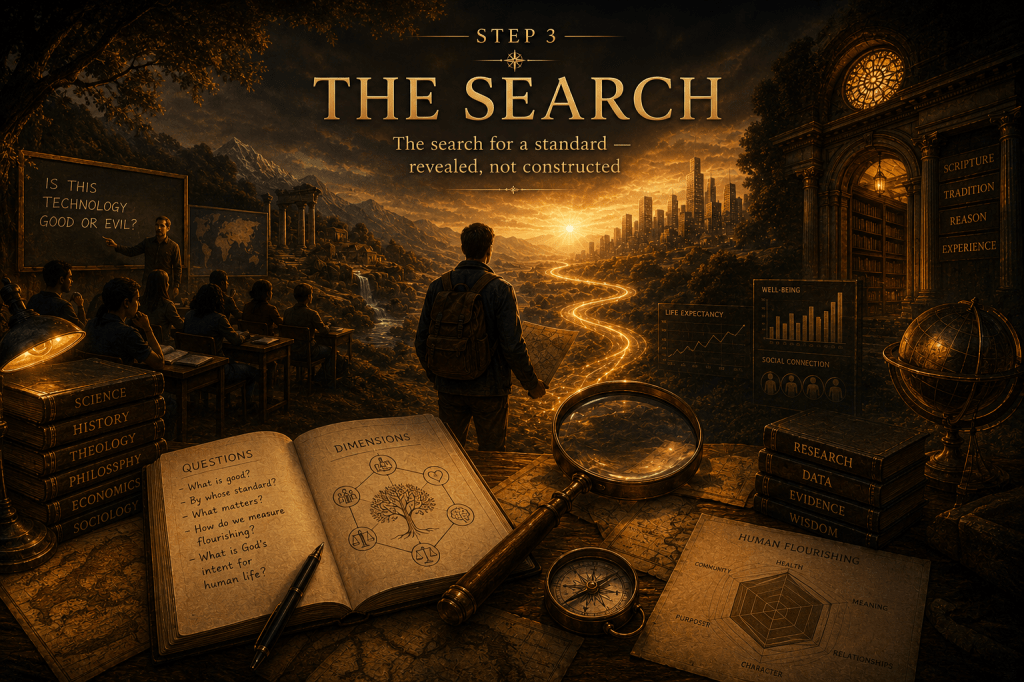
The Search
The search for a standard — revealed, not constructed
Nine Waypoints · The Story of How This Framework Came to Be
Each waypoint below is a step in the journey from a classroom question to a complete framework. Click any heading to follow the path.
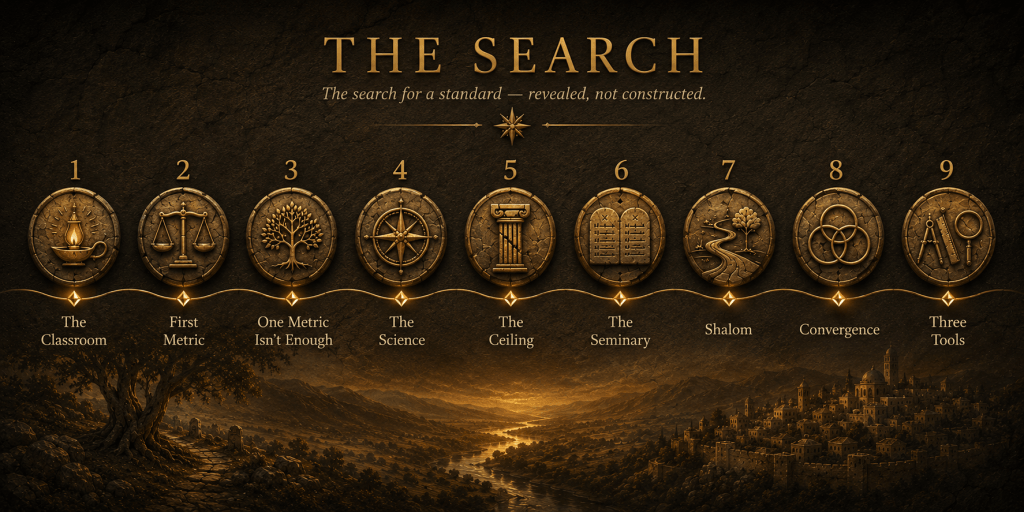
From Questions to a Method
Step 1 ended with a conviction — that the question of what God intends for human life is worth pursuing carefully, honestly, and at scale. Step 2 named the answer the biblical tradition gives: shalom. The whole web of relationships in right order.
But a conviction is not yet a framework. And a word — even a rich theological word like shalom — is not yet a standard. The question that opens The Search is the one that turns vision into something you can actually use:
How do you measure something revealed rather than constructed? How do you know flourishing when you see it — or when it’s absent?
The answer didn’t arrive all at once. It arrived through a classroom.
WAYPOINT 1 · THE QUESTION IN THE CLASSROOM
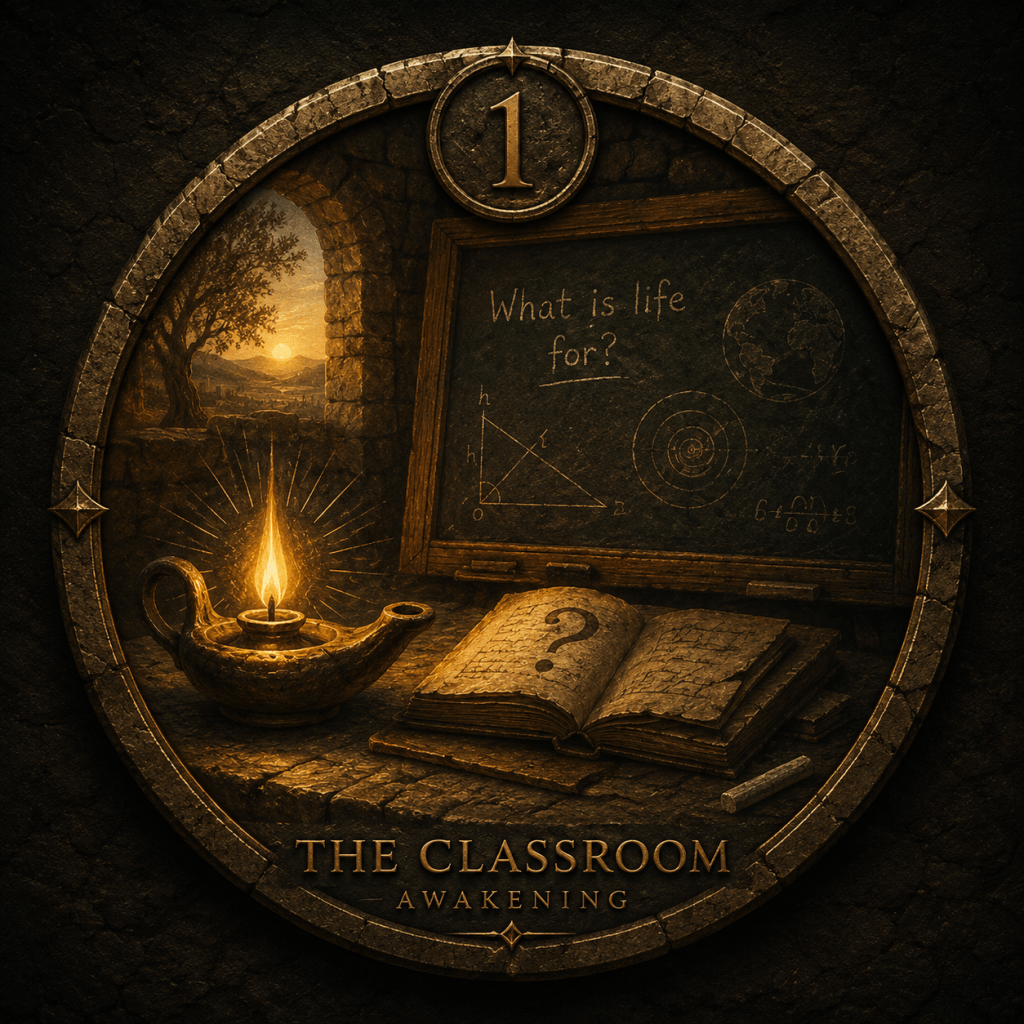
Is This Technology Good or Evil?
◆
In 2020, teaching ninth and tenth graders about technology at a Christian school in inner-city Minneapolis, two questions caught fire in the room. The first: why do humans create technology at all? The second — harder, and more interesting — was this:
When we create technology, is it actually good?
That wasn’t a rhetorical question. The students took it seriously. So did I. And immediately we ran into the problem that anyone serious about that question runs into: good by whose standard? Good measured how?
You can’t evaluate something without a metric. And we didn’t have one yet.
THE WAYPOINT
◆ You can’t evaluate something without a metric. And we didn’t have one yet.
WAYPOINT 2 · THE FIRST METRIC
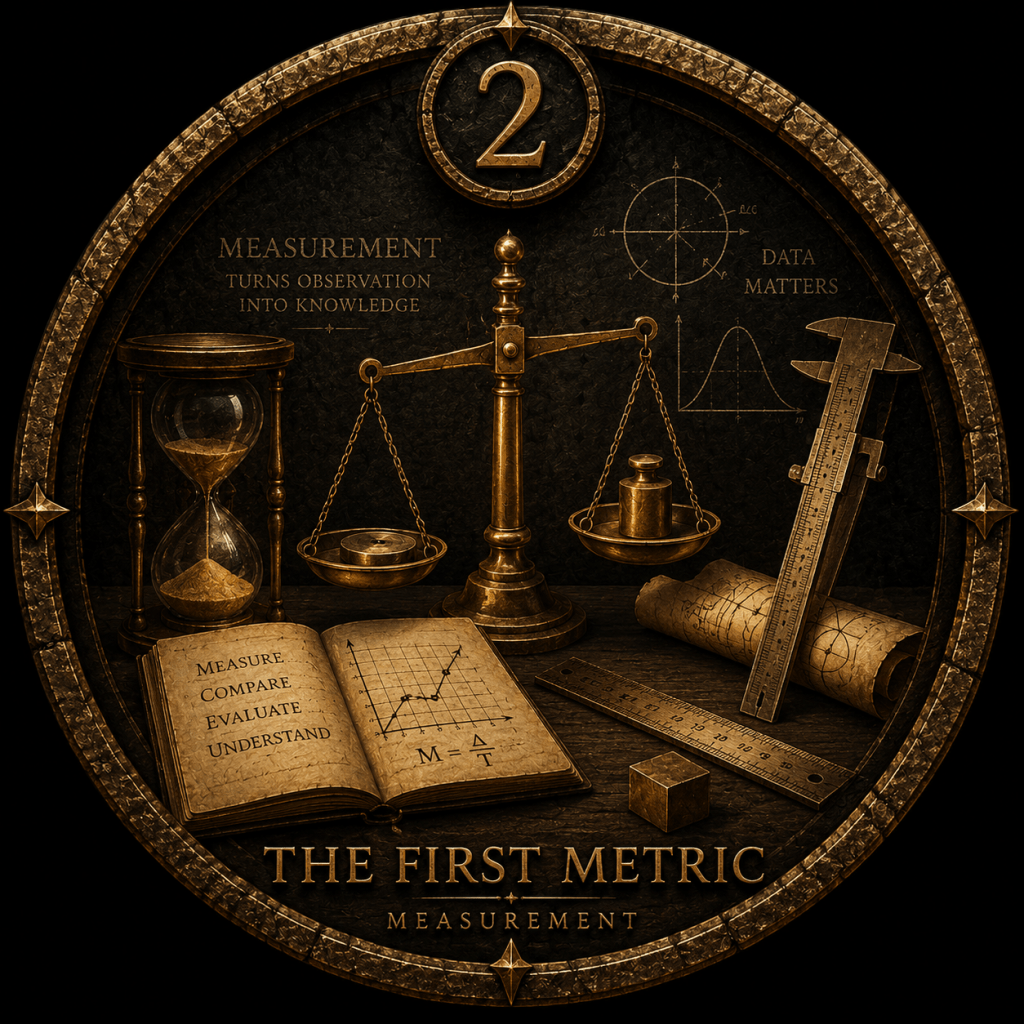
If It Helps You Live Longer, It’s Good
◆
We started simply. The first metric we landed on was lifespan. A technology is good if it extends human life. Bad if it shortens it. Crude — but testable. And it gave us something to work with.
Students chose a technology they cared about and went to work. Some chose smartphones. Some chose the internet. Some chose medical technologies. A few chose guns.
The students who chose guns made the argument you’d expect: guns protect people. They save lives. Therefore — by the lifespan metric — they are good.
I asked them to prove it.
We pulled gun death statistics from the United States — a country with more privately owned firearms than any other on earth. We looked at the numbers: how often guns were used in actual defensive situations versus how often they appeared in homicides, suicides, and accidents. The data was not ambiguous.
By the lifespan metric, the students concluded: guns, on balance, cause more death than they prevent. That was not a comfortable conclusion for a room full of young people in a city where some of them had real reasons to want protection. But they followed the evidence. And something important happened in that moment — they discovered that rigor matters. That you can’t just assert goodness. You have to be willing to test it.
THE WAYPOINT
◆ A metric is only as good as your willingness to follow the evidence wherever it leads.
WAYPOINT 3 · THE INADEQUACY OF ONE METRIC
There’s More to Human Life Than Staying Alive
The lifespan metric worked. But as soon as we used it seriously, it started showing its limits.
Lifespan tells you whether people are surviving. It doesn’t tell you whether they’re actually living. A person can have a long life that is lonely, purposeless, economically trapped, spiritually empty, and relationally hollow. Another can have a shorter life that is full — of meaning, love, contribution, and joy.
In what other ways do human beings flourish? What are all the dimensions of a genuinely good human life?
That question sent me out of the classroom and into the research. I wasn’t looking for a philosophy. I was looking for the best available evidence on what actually makes human life go well or badly — at the level of individuals, communities, and whole societies.
THE WAYPOINT
◆ Survival is necessary but not sufficient. Flourishing requires a richer account of what human life is for.
WAYPOINT 4 · THE SCIENCE OF HUMAN FLOURISHING
The Best Secular Research Points Somewhere
What I found was more rigorous than I expected. Harvard’s Human Flourishing Program had spent decades building an empirically validated account of what flourishing actually looks like. Tyler VanderWeele and his colleagues had identified dimensions that showed up consistently across cultures and life stages: physical health, mental health, happiness and life satisfaction, meaning and purpose, character and virtue, close relationships.
Gallup had tracked wellbeing globally for decades. The UN’s Human Development Index had been measuring capability and freedom since 1990. The World Happiness Report had been mapping subjective wellbeing across 150 countries. The Harvard Study of Adult Development — now in its 85th year — had followed the same people from youth to old age, tracking what actually predicted health and happiness in later life.
The answer was not wealth. It was not status. It was not achievement.
It was relationships. Purpose. Meaning. Connection to something larger than yourself.
The science was genuinely good. It was careful, longitudinal, cross-cultural, and honest about what it didn’t know. I found myself trusting it.
And then I hit the ceiling.
THE WAYPOINT
◆ The best empirical science and the oldest theological wisdom converge on the same answer: relationships, purpose, meaning.
WAYPOINT 5 · THE CEILING OF SECULAR FRAMEWORKS
▸ WORDPRESS: Heading 2 block
The Science Describes the Shape. It Cannot Name the Ground.
The secular flourishing research can tell you what human life looks like when it’s going well. It can measure it, track it, compare it across populations and across time. What it cannot do is tell you why any of it matters.
Why should the vulnerable be protected? Because the data shows it leads to better outcomes? For whom? Over what timeframe? Decided by whom?
Why does meaning matter more than pleasure? The science shows it does — but it cannot explain why a universe that produced human beings by accident should care whether those beings find meaning or not.
The frameworks built on this research — the capabilities approach, social democracy, institutional economics, behavioral economics — each capture something real.
Each falls short of something essential.
They can describe the shape of flourishing without being able to name its ground, provide its telos, or ground the obligations that make it genuinely binding rather than merely advisable.
THE WAYPOINT
◆ Something was missing. Not from the data — from the foundation beneath it.
WAYPOINT 6 · THE SEMINARY
Empire and Kingdom — The Theological Frame That Changed Everything
In 2024, I enrolled in seminary — the School of Everyday Mission, connected to Woodland Hills Church in St. Paul, Minnesota. The school operates in a Neo-Anabaptist emerging tradition, shaped significantly by theologian Greg Boyd. In my first year, the curriculum centered on what the tradition calls the Meta-Narrative — the overarching story of God and scripture, anchored in Jesus as the ultimate revelation, and Scripture the read as a single coherent arc from creation to new creation.
Two things happened that year that pushed me directly toward shalom flourishing.
The first was the emphasis on Jesus as a Jew — not merely a religious founder who happened to be born into a Jewish family, but a man who practiced Judaism, fulfilled Jewish expectation, and was understood by his earliest followers as the Jewish Messiah. And most importantly was/is God incarnate. The more I sat with that, the more I found myself asking a question I hadn’t taken seriously enough before: were there more answers in the Hebrew Bible than I had previously realized? If Jesus was the fulfillment of Israel’s story, and Israel’s story was organized around covenant, Torah, Sabbath, Jubilee, and shalom — what did that mean for how human flourishing should be understood, measured, and pursued?
The second was the framework the tradition uses to make sense of human history: Spiritual War. On God’s side, the logic begins with love, goodness, and life. On the other side — evil, by whatever name one chooses — the logic begins with hatred, corruption, and death.
And when human beings organize themselves into societies, they tend to follow one logic or the other.
| EMPIRE LOGIC — Hatred · Evil · Death — Domination & extraction — Concentrated power — Identity through enemies — Violence as order | KINGDOM / SHALOM LOGIC — Love · Goodness · Life — Covenant & mutual obligation — Distributed power — Identity through belonging — Protection of the vulnerable |
In human history, Empire arrangements have been the norm. Genuine shalom societies have been rare — the Jubilee-structured economy of ancient Israel, the early Christian church, perhaps glimpses elsewhere. Even the best arrangements have been partial and compromised.
But the framework raised a question I couldn’t set down: what if this distinction could be made rigorous? What if the empire-vs-shalom contrast — not just as a theological category but as a structural description — could be applied systematically to historical eras, ideologies, and social arrangements? What does it actually look like to live inside an empire society versus a shalom one? And what does that mean for how a Christian, or a Jew or anyone aligned with shalom, is called to live, work, and act within whatever arrangement they find themselves in?
That last question is Step 7 of this journey — The Calling. But first, the seminary’s Meta-Narrative sent me back to the Hebrew Bible with new eyes. And what I found there changed everything.
THE WAYPOINT
◆ History is the story of Empire and Kingdom in conflict. The question is which logic any arrangement — or any life — is actually following.
WAYPOINT 7 · THE ENCOUNTER WITH SHALOM
A Word That Holds Everything Together
I had known the word shalom my whole life. Like most people shaped by the Christian tradition, I had heard it translated as peace — a warm, somewhat vague word meaning the absence of conflict.
Then I read the scholars who had actually gone back to the Hebrew. It is worth saying plainly: shalom is a Jewish word, from a Jewish tradition, belonging first to a Jewish people. Christian interpreters are reading across a tradition that is not originally theirs. That debt deserves to be named, not assumed.
The Jewish voices came first — Heschel, Sacks, Levenson — and then the Christian scholars who built on that foundation: Plantinga, Wolterstorff, Brueggemann, Pennington, Volf.
And at the popular level, Marty Solomon of the BEMA Podcast and Tim Mackie of The Bible Project brought this scholarship to wider audiences. Across all of them, the word opened up.
Shalom is not the absence of conflict. It is the presence of rightness — the condition of the whole web of relationships, human, divine, and creational, in right order.
It describes a world where every person has enough, where justice is not an aspiration but a structural reality, where the vulnerable are protected not by charity but by covenant, where work has dignity and meaning, where communities remember their past and take responsibility for their future. Where the environment is not an afterthought, but integrated into what it means to be faithful stewards of what we’ve been given.
It is not a private feeling. It is a social condition. It is not achieved by individuals. It is built by communities. It is not a supplement to human life. It is what human life is for.
THE WAYPOINT
◆ This was not a religious gloss on the science. This was the thing the science had been reaching for without being able to name it.
WAYPOINT 8 · THE CONVERGENCE
Science and Shalom Are Pointing at the Same Thing
That was the moment the framework became possible. Because what I found — working carefully through both bodies of material — was that the most rigorous contemporary science of human flourishing and the ancient Hebrew vision of shalom are not in tension. They are convergent.
They describe the same reality from different directions. The science describes the shape. Shalom names the ground it rests on, integrates its dimensions into a coherent whole, provides the telos that orients its direction, and grounds the obligations that make flourishing not merely desirable but genuinely binding.
Without shalom, the science is rich but rootless. Without the science, shalom risks being beautiful but untestable.
Together, they become something more powerful than either alone: a standard for flourishing that is both empirically grounded and theologically grounded — revealed, not merely constructed.
THE WAYPOINT
◆ That convergence is the Shalom Flourishing Framework’s foundation — and its most important claim.
WAYPOINT 9 · THE THREE INSTRUMENTS
One Framework. Three Questions. Three Tools.
As the framework took shape, it became clear that one instrument couldn’t do everything that needed doing. Three distinct questions kept emerging — and they required three different tools to answer.
Instrument One · The Shalom Flourishing Framework Score
“What is the texture of flourishing in this arrangement?”
16 attributes across 6 dimensions, each scored 1–5. Assesses which dimensions of genuine human wellbeing any society, ideology, or era honors — and which it neglects or actively undermines.
Instrument Two · The Shalom-Empire Spectrum
“What is the structural logic underneath?”
12 bipolar pairs across 6 dimensions, each scored 1–6. Asks whether any arrangement’s generative logic tends toward empire’s extractive orientation or shalom’s covenantal one.
Instrument Three · Individual Flourishing Assessment
“Where do I stand, personally, within this vision?”
20 attributes across the same 6 dimensions, assessed through three lenses: what you experience, what your circumstances permit, and what you actively practice. Because individual flourishing is never purely individual.
The three instruments together ask the complete shalom question. A society can score well on the SFF while its structural logic remains extractive. A person can practice flourishing faithfully while the systems around them deny it. No single instrument sees all of this.
THE WAYPOINT
◆ Together, they ask what shalom demands: not just how well is this working for the people it’s working for — but what is it doing to the whole web? And where am I within it?
Where This Leads
This is where the classroom question led. From “is this technology good?”, to how would we know, to lifespan, to the inadequacy of one metric, to the science of human flourishing, to the ceiling of secular frameworks, to seminary, to shalom, to the convergence, to three instruments for assessing any human arrangement — and any human life — against the standard of what God intends.
The framework is not finished. It names its own limitations honestly. The scores are interpretive judgments, not empirical measurements. Four of the sixteen societal attributes can only be proxy-scored because adequate measurement instruments don’t yet exist. No independent validation has been conducted. The work is ongoing.
But the standard is clear. And the question the students first asked in that Minneapolis classroom is still the right one: Is this actually good? And can we prove it?
Step 4 — The Shalom Flourishing Framework — presents the complete standard: 16 attributes across 6 dimensions of societal flourishing, the 12 bipolar pairs of the Shalom-Empire Spectrum, and the 20 attributes of the Personal Flourishing Assessment. The individual assessment is Step 6 — My Flourishing.
 SeePhas