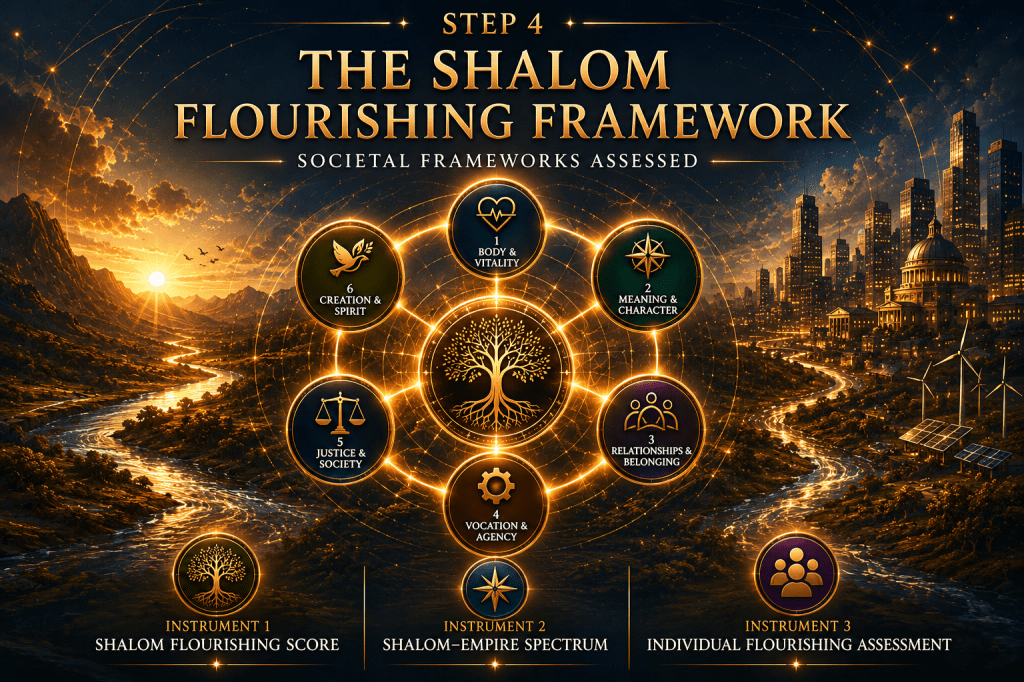
How It Came Together
It started with a simple question about technology: what makes something good? That question didn’t stay simple for long. Good by whose standard? Good measured how? The search for a standard led into the science of human flourishing — Harvard, Gallup, the empirical research on what actually makes human life go well or badly.
But the science wasn’t enough. What I was learning in the seminary about spiritual warfare — about good and evil as genuine forces in human history — made the secular frameworks feel incomplete. They could describe the shape of flourishing without naming its ground or its obligation. Then the categories of empire and kingdom came into focus: human societies don’t just produce different outcomes, they operate from different generative logics. One orients toward domination. The other orients toward shalom.
Finally, pulling together a rigorous definition of shalom and comparing it carefully to what the human science had found — the Shalom Flourishing Framework was born. The convergence was real. The science and the ancient vision were pointing at the same thing from different directions.
But how to fill it in? That’s the story of this step — the three instruments that turn the convergence into something you can actually use.
From Convergence to Instrument
Step 3 ended with a claim: the most rigorous contemporary science of human flourishing and the ancient Hebrew vision of shalom are convergent — pointing at the same reality from different directions. That convergence made a framework possible.
But naming a convergence is not the same as building an instrument. A framework has to do something. It has to ask specific questions, apply specific criteria, and produce results that are honest about both what they show and what they can’t. Three distinct questions emerged. Each required a different tool to answer.
INSTRUMENT 1 · THE SHALOM FLOURISHING SCORE
What Is the Texture of Flourishing Here?
The first question was descriptive: in any given social arrangement — an era, an ideology, an economic system, a community — which dimensions of genuine human flourishing does it honor, and which does it neglect or actively undermine?
Human flourishing is not a single thing. It has texture — a person can be materially sufficient and relationally isolated, politically free and spiritually empty, physically healthy and without meaningful work. A society can produce longevity while destroying meaning. An economic system can generate wealth while crushing agency. To answer the question honestly, every dimension had to be named and assessed separately.
That process produced the Shalom Flourishing Score: 16 attributes across 6 dimensions, each scored 1 to 5 against the best available empirical evidence. One principle runs throughout every assessment: the whole web of people affected is evaluated — not just the population the arrangement most serves.
An arrangement that produces genuine wellbeing for the included population while extracting from everyone else is not flourishing. It is inequality with good marketing.
The Architecture — 6 Dimensions, 16 Attributes
The six dimensions and their attributes are:
| # | Dimension | Attributes |
| 1 | Body & Vitality | Physical Health · Mental Health · Happiness & Life Satisfaction |
| 2 | Meaning & Character | Meaning & Purpose · Character & Virtue |
| 3 | Relationships & Belonging | Close Relationships · Communal Belonging |
| 4 | Vocation & Agency | Material Sufficiency · Vocation · Agency |
| 5 | Justice & Society | Justice & Inclusion · Institutional Integrity · Knowledge & Wisdom · Temporal Integrity |
| 6 | Creation & Spirit | Ecological Embeddedness · Spiritual Groundedness |
6 Dimensions · 16 Attributes · 96 Indicators · 47 Validated Measures · 30 Gap Assessments · 77 Measures Total
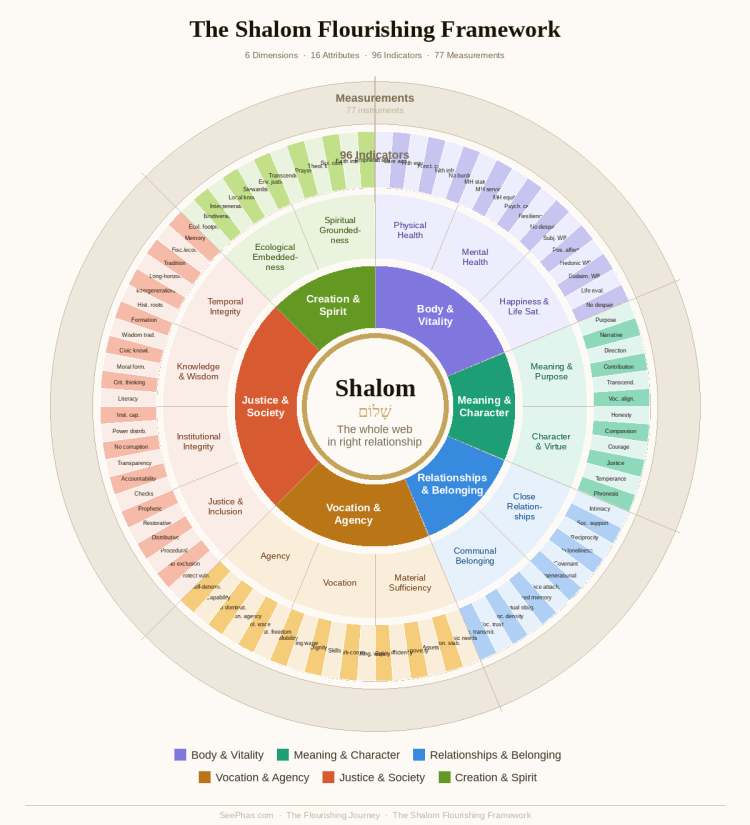
Each attribute carries six specific indicators — observable signs of whether that dimension of flourishing is present or absent — and a set of validated measurement instruments drawn from the best available empirical evidence. The full indicator and measurement set for all 96 indicators is in the companion Architecture Document.
The Scoring Scale — 1 to 5
Each of the 16 attributes is scored on a five-point scale by a trained assessor applying the framework’s criteria to available evidence:
| Score | What It Means |
| 5 — Robustly sustained | Institutionally embedded, consistently present across the population, and structurally protected |
| 4 — Mostly present | Substantially present with significant but not catastrophic gaps |
| 3 — Partial presence | Present for some of the population in some contexts — uneven, inconsistent, contested |
| 2 — Mostly undermines | Systematically neglected; conditions make it harder to achieve |
| 1 — Actively destroys | The arrangement actively damages this dimension — not merely neglects it |
The composite Shalom Flourishing Score is the average of all 16 attribute scores. A score of 5.0 represents full shalom alignment across every dimension — an eschatological horizon rather than an achievable human destination. A score of 1.0 represents systematic destruction across every dimension.
Measured vs. Proxy-Scored Attributes
Twelve of the sixteen attributes are fully measured using validated empirical instruments — data that can be directly compared across eras and arrangements. Four attributes — Character & Virtue, Knowledge & Wisdom, Temporal Integrity, and Spiritual Groundedness — are proxy-scored because adequate direct measurement instruments do not yet exist. Proxy scores carry less evidential weight and are clearly marked in every assessment.
The diagram maps the full architecture reading from center out: Shalom as the ground, six dimensions as the first ring, sixteen attributes as the next, ninety-six indicators as the outer band, and the measurement instruments at the edge.
INSTRUMENT 2 · THE SHALOM-EMPIRE SPECTRUM
What Is the Structural Logic Underneath?
The Shalom Flourishing Score answers the texture question. But a second question kept forcing itself forward — one the Score alone couldn’t answer.
Some arrangements produce genuine wellbeing for the people they include while being structurally extractive toward everyone else. The Golden Age of Western capitalism (1945–73) is the clearest example: a Shalom Flourishing Score of 2.9 — real flourishing for the included population — alongside a Shalom-Empire Spectrum score of 3.3, firmly in empire-leaning territory. The Score captures what the arrangement produces. It doesn’t fully capture what the arrangement is.
Is this arrangement, at its core and in its generative logic, oriented toward domination or toward covenantal life?
That is a different question. And it required a different instrument.
The Shalom-Empire Spectrum emerged directly from the seminary — from the meta-narrative framework and the theological conviction that human societies don’t just produce different outcomes, they operate from different generative logics. Empire’s logic is extraction: resources flow to the center, power concentrates, identity is constituted through enemies, leaders are sacralized, truth serves power, and the vulnerable are structurally excluded. Shalom’s logic is covenantal: resources flow toward universal sufficiency, power is accountable, identity is constituted through belonging, leadership serves downward, and justice is structural rather than aspirational.
The Architecture — 12 Bipolar Attributes
12 Attributes · 72 Indicators · 60 Validated Measures · 23 Gap Assessments · 83 Measures Total · Scale: 1 (Full Empire) – 6 (Full Shalom) · No neutral midpoint
The Shalom-Empire Spectrum assesses any arrangement against twelve bipolar attributes. Each attribute describes two poles — empire on the left, shalom on the right:
| Attribute | Empire Pole → Shalom Pole |
| 1. Anthropology | Humans as instruments of hierarchy → Every human as image-bearer with inherent dignity |
| 2. Loyalty vs. Covenant | Personal loyalty to the ruler → Covenant obligation to God and neighbor |
| 3. Resource Distribution | Resources extracted to the center → Universal sufficiency — enough for all |
| 4. Violence and Peace | Redemptive violence — order by force → Covenantal peace — right relationship |
| 5. Truth and Narrative | Narrative control — truth serves power → Truthfulness including critique of power |
| 6. Identity Formation | Identity through constitutive enemies → Identity through covenant inclusion |
| 7. Power Architecture | Power concentrated at the center → Power distributed and accountable |
| 8. Leadership | Sacralized ruler — will is law → Servant authority — serving the most vulnerable |
| 9. Time Horizon | Short-term extraction — consume the future → Intergenerational covenant obligation |
| 10. Vocation and Participation | Instrumentalized labor — humans as tools → Covenantal vocation — work as calling |
| 11. Spiritual Register | Religion co-opted by power → Prophetic groundedness — religion critiques power |
| 12. Justice and the Vulnerable | Structural exclusion — protects the powerful → Designed to protect the most vulnerable first |
The Scoring Scale — 1 to 6
Each attribute is scored 1 to 6 with no neutral midpoint. The absence of a midpoint is deliberate — every arrangement is making a claim about what human beings are and what power is for. There is no neutral position.
The composite Shalom-Empire Spectrum score is the average of all 12 attribute scores, reported on the 1–6 scale. The midpoint is 3.5. Scores below 3.5 are empire-leaning; scores above are shalom-leaning.
| Score | Zone and Meaning |
| 6 — Full Shalom | Dimension at the most fully realized shalom pole — comprehensive and institutionally embedded |
| 5 — Shalom | Predominantly shalom-oriented with limited empire characteristics |
| 4 — Shalom-leaning | More shalom than empire — shalom orientation present and partially institutionalized |
| 3 — Empire-leaning | More empire than shalom — empire logic dominant but not total |
| 2 — Empire | Predominantly empire-oriented with minimal shalom characteristics |
| 1 — Full Empire | Dimension at the most fully realized empire pole — systematic and comprehensive |
Composite Score Zones
| Range | Zone |
| 1.0 – 2.3 | Full Empire — empire logic realized comprehensively across most attributes |
| 2.4 – 3.4 | Empire-leaning — empire logic dominant; shalom characteristics present but subordinate |
| 3.5 | Midpoint — the outer boundary of what secular frameworks have achieved |
| 3.6 – 4.6 | Shalom-leaning — shalom logic dominant; empire characteristics present but subordinate |
| 4.7 – 6.0 | Shalom — shalom logic realized substantially across most attributes |
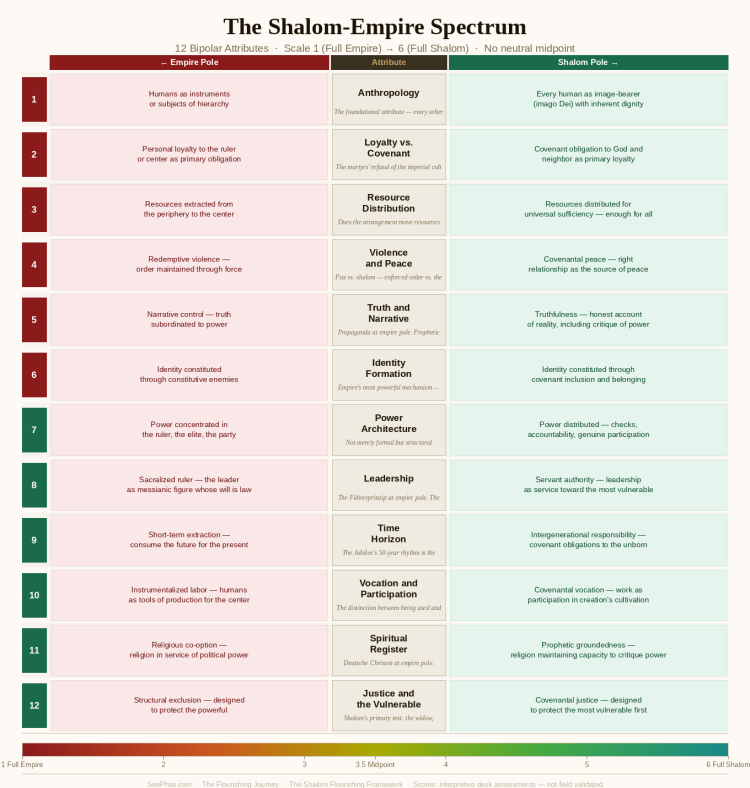
The twelve attributes cover the full range of structural logic — from what an arrangement believes about human beings to whose interests it protects first. Together they reveal not just what an arrangement produces but what it believes, and whether that belief is oriented toward shalom or toward empire.
INSTRUMENT 3 · THE INDIVIDUAL FLOURISHING ASSESSMENT
And Where Do I Stand Within It?
Both instruments assess arrangements from the outside — societies, ideologies, historical eras, economic systems. But shalom is not only a social condition. It is also a personal one. The framework would be incomplete if it only ever looked outward.
Where do I stand, personally, within this vision? How am I flourishing — or not? And what does my situation reveal about the systems around me?
That question produced the Individual Flourishing Assessment: twenty attributes across the same six dimensions, designed not to produce guilt but to provide honest orientation. It is a mirror, not a verdict.
The Architecture — 6 Dimensions, 20 Attributes
6 Dimensions · 20 Attributes · 20 Indicators · 48 Questions · 20 Personal Experience · 14 Systemic Reality · 14 Personal Practice · Scale: 1 (Never) – 4 (Almost Always)
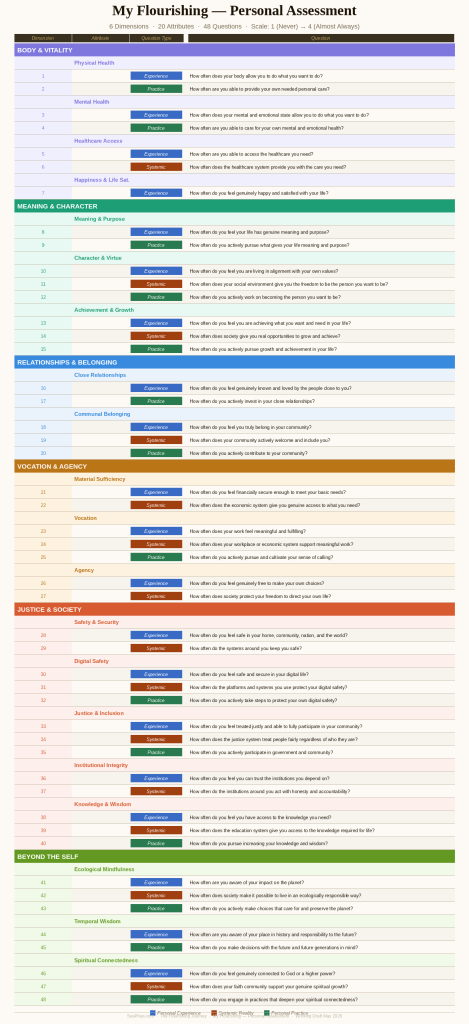
The individual assessment adds four attributes not present in the societal Score, reflecting dimensions of flourishing that are primarily personal in scale:
| # | Dimension | Attributes |
| 1 | Body & Vitality | Physical Health · Mental Health · Healthcare Access · Happiness & Life Satisfaction |
| 2 | Meaning & Character | Meaning & Purpose · Character & Virtue · Achievement & Growth |
| 3 | Relationships & Belonging | Close Relationships · Communal Belonging |
| 4 | Vocation & Agency | Material Sufficiency · Vocation · Agency |
| 5 | Justice & Society | Safety & Security · Digital Safety · Justice & Inclusion · Institutional Integrity · Knowledge & Wisdom |
| 6 | Beyond the Self | Ecological Mindfulness · Temporal Wisdom · Spiritual Connectedness |
The Three Question Lenses
Each attribute is assessed through three separate question types rather than one composite score. This three-lens structure carries a fundamental claim: individual flourishing is never purely individual. Where you land is shaped by what you feel, what your circumstances permit, and what you choose to do within both.
| Question Type | What It Measures |
| Personal Experience | What you actually feel and live in this dimension right now. Example (Close Relationships): “How often do you feel genuinely known and loved by the people close to you?” |
| Systemic Reality | Whether the systems around you support or undermine this dimension. Example (Close Relationships): assessed through community belonging questions about whether your community actively welcomes and includes you. |
| Personal Practice | How actively you contribute to this dimension in your own life and for others. Example (Close Relationships): “How often do you actively invest in your close relationships?” |
The gap between your Personal Experience score and your Systemic Reality score is often the most revealing number on the assessment. A large gap — high Personal Practice, low Systemic Reality — identifies someone working hard against structural headwinds. A large gap in the other direction — high Systemic Reality, low Personal Practice — identifies someone in a supportive environment who is not yet engaging it.
The Scoring Scale — 1 to 4
| Score | Meaning |
| 4 — Almost Always | This is consistently true for me |
| 3 — Often | This is frequently true for me |
| 2 — Rarely | This is occasionally true for me |
| 1 — Never | This is not true for me |
The four-point scale with no neutral midpoint follows the same design logic as the Shalom-Empire Spectrum. Flourishing is not a neutral condition. Every answer is a reading of a real situation, and the instrument is designed to produce honest readings rather than comfortable ones. Scores below 2.5 indicate struggle in that dimension; scores above 2.5 indicate relative flourishing.
The Reflection Questions
After completing the assessment, four reflection questions guide interpretation:
Where is the gap between your personal experience and the systems around you largest? What does that tell you?
Which dimensions are you receiving well but not actively practicing or giving?
Which single attribute — if it improved — would most change your experience of flourishing?
Where does your everyday mission begin?
The individual assessment is completed through a Google Form instrument. The diagram below shows the full architecture — all six dimensions, all twenty attributes, all forty-eight questions, and the question type for each.
— GRAPHIC: My Flourishing — Personal Assessment Framework (06_MyFlourishing_Assessment.png) —
Three Instruments. One Question.
The three instruments together ask what neither alone can ask. A society can score well on the Shalom Flourishing Score while its structural logic is extractive. A person can practice flourishing faithfully while the systems around them deny it. An arrangement can look covenantal in structure while failing real people in practice. No single instrument sees all of this.
Together, they ask what shalom demands: not just how well is this working for the people it is working for — but what is it doing to the whole web? And where am I within it?
The framework is not finished. It names its own limitations honestly. The scores are interpretive judgments, not empirical measurements. Four of the sixteen societal attributes can only be proxy-scored. No independent validation across multiple assessors has been conducted. The work is ongoing.
But the standard is clear. And the question that opened in a Minneapolis classroom in 2020 is still the right one: Is this actually good? The Shalom Flourishing Framework is the answer to how we would know.
Step 5 applies the framework to twenty-one historical, contemporary, and ideological arrangements — from Jubilee economics to the Third Reich — and shows what the instruments reveal across the full range of what human societies have tried.

