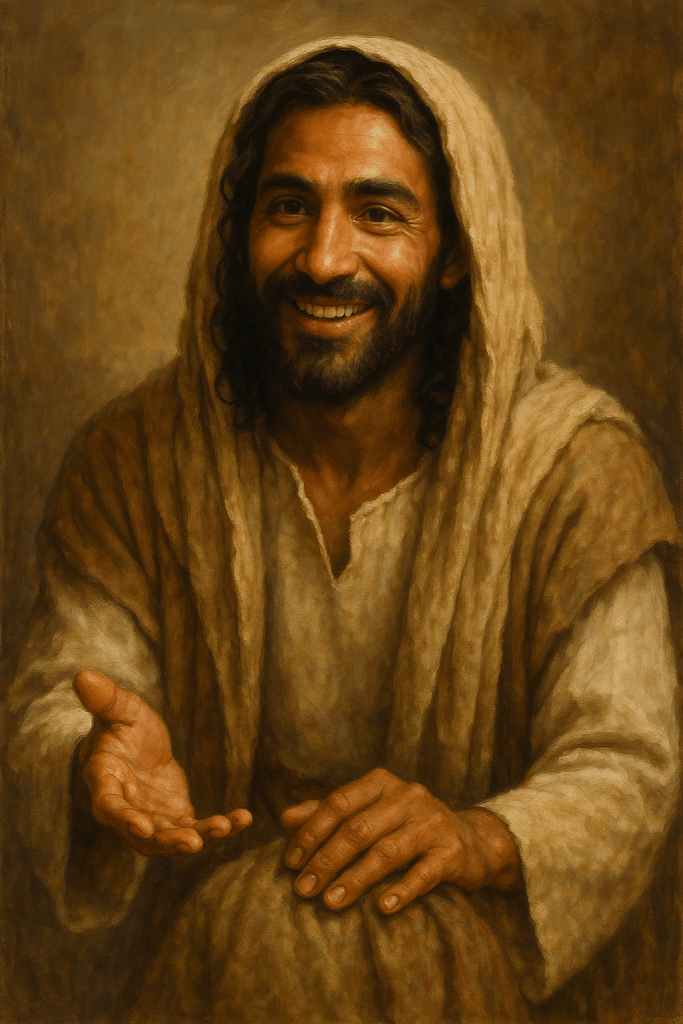
Why Jesus Is the Center
This conviction did not emerge lightly. It sits at the very core of my faith—my understanding of reality, my trust in that reality, and my commitment to live in alignment with it. Faith, for me, is not merely believing that God exists; it is trusting, loving, acting, and committing myself to the God revealed in the world. Most days I live into this imperfectly—but I keep returning to it.
That God, I believe, is most clearly and decisively revealed in Jesus of Nazareth.
Recent scholarship has helped sharpen this conviction.

Meghan Larissa Good’s Divine Gravity exposes how distorted Christian stories have left many disillusioned and argues that re-centering theology on Jesus is the path toward renewal.

Greg Boyd’s God Looks Like Jesus presses the same truth from another angle: if we want to know what God is like, we look at Jesus. Not abstract attributes. Not detached doctrines. Jesus.
This is what it means to hold a Jesus-centered (Christocentric) theology: Jesus’ life, teachings, death, and resurrection are not merely part of the Christian story—they are the lens through which everything else is understood.
Who Jesus Is / Was
Deeply Jewish, Fully Human, Revealing God
Jesus was born into a real place, a real time, and a real people—and that people was Israel. He was born as a Jew, lived as a Jew, worshiped as a Jew, taught as a Jew, and died as a Jew. He did not stand outside Judaism critiquing it from afar; he spoke from within it, seeking its renewal and fulfillment.
Jesus was born in Bethlehem, the City of David, placing him firmly within Israel’s royal and messianic hope (2 Samuel 7; Micah 5:2). Christians confess his birth as miraculous—not merely because of the virgin conception, but because God took on flesh. The God of Israel chose to dwell among his people, fulfilling Israel’s deepest longing: that God would come near (Isaiah 7; Isaiah 40).
Almost immediately, political violence intruded into his story. Herod’s slaughter of Bethlehem’s children forced Jesus’ family into exile in Egypt, echoing Israel’s own story of suffering, displacement, and return. From the beginning, Jesus reenacts Israel’s story bodily—entering suffering from within it rather than standing above it.
Raised in Nazareth, Jesus grew up in Galilee—often dismissed by Jerusalem elites, yet in reality one of the most vibrant centers of Torah-shaped life in the first century. Synagogues were widespread. Scripture was read aloud, memorized, debated, and lived. Faith was practiced not only in the temple, but in homes, workplaces, and villages.
Jesus was formed in this world. His teaching style—parables, ethical argument, and scriptural debate—fits naturally within Pharisaic modes of instruction. His disagreements with Pharisees were not outsider attacks, but family arguments over how best to live faithfully before God. He shared many Pharisaic convictions—belief in resurrection, angels, and the authority of Scripture—while re-centering Torah around mercy, inclusion, and love.
Jesus also learned a trade, working as a tekton—a builder shaped by stone, sweat, and endurance. He lived an ordinary, hidden life for nearly thirty years. Luke tells us he grew “in wisdom and stature, and in favor with God and people.” There was no bypassing formation, time, or faithfulness.
At twelve years old, after a Passover pilgrimage, Jesus was found in the Jerusalem temple astonishing teachers with his insight. His words—“Did you not know I must be in my Father’s house?”—reveal an early awareness of identity and calling. Yet he returned home and submitted to his parents. Even divine vocation did not override human obedience.
Jesus knew the Scriptures deeply and was formed within Israel’s interpretive traditions. By the time he began teaching publicly, he was recognized and addressed as rabbi. Some evidence and scholarly opinion suggest that John the Baptist functioned as one of Jesus’ formative teachers within Israel’s renewal movement—placing Jesus firmly within an existing Jewish stream of prophetic and rabbinic formation, even as he would soon surpass it.
Jesus did not suddenly become who he was at baptism. He lived it quietly, patiently, and relationally long before anyone noticed.
From Formation to Mission
Jesus’ public life began through a reunion with John the Baptist. John had been in the wilderness at the River Jordan. This was the same river where Israel had entered the Promised Land after the Exodus. Now, Jesus steps into those same waters as He begins His mission – repossession of God’s people. Fittingly, John had been calling people to repent and prepare for the arrival of the Messiah and God’s Kingdom and .to repentance and readiness for God’s reign. Jesus stepped into that movement in humility and solidarity. Yet Jesus’ baptism was not a moment of personal discovery; it was the public revealing of who he already was and the sign that God’s reign was now present and active through him.
From there, Jesus proclaimed the Kingdom of God—not as a distant future, but as God’s reign being restored and made present. He was not announcing something foreign to Israel’s faith. God’s kingship had always stood at the center of Jewish hope. What Jesus declared was that this reign was now breaking back into history, actively re-inviting and re-possessing God’s people after centuries of exile, occupation, and distorted leadership.
Jesus was not founding a new religion. He was re-gathering Israel, calling the people back into their covenantal identity and vocation. His disciples—fishermen, laborers, tax collectors, and those pushed to the margins—were not merely students, but living signs of a renewed people of God.
Jesus enacted the Kingdom as much as he proclaimed it. Healing, forgiveness, shared meals, and restoration were not incidental acts of kindness; they were signs that God was reclaiming what already belonged to him. He healed all who came to him. He ate with those considered sinful or unclean. He restored dignity and belonging to the excluded. By bypassing monopolized religious systems and restoring people directly to community, Jesus demonstrated that God’s covenant faithfulness could not be controlled.
The Kingdom, Jesus taught, was both present and unfolding—here and now, yet growing over time. Like seed in soil or leaven in dough, it would quietly infiltrate lives and societies, bearing fruit as people were continually called back into alignment with God’s purposes.
His life revealed:
- God’s love made visible
- Power expressed through service
- Justice rooted in mercy
- Authority exercised through self-giving love
Jerusalem, Confrontation, and Resurrection
This path led Jesus to Jerusalem, where his presence exposed deep fractures within Israel’s life. His confrontation was not a rejection of Judaism nor an attack on legitimate religious authority. Jesus honored Torah, the Prophets, and Israel’s sacred writings; he worshiped the God of Israel as his Father and affirmed faithful teachers and leaders. His critique arose from deep covenantal fidelity, not rebellion.
What he challenged was corruption masquerading as authority—especially within the Sadducean priestly elite who had turned the temple into a monopolized, extractive system aligned with Herodian and Roman power. Jesus’ disruption of the temple economy was therefore prophetic and restorative, echoing Israel’s own prophets who confronted exploitation within sacred institutions.
Jesus stood not against Israel’s faith, but for it—seeking its renewal, purification, and fulfillment.
His execution by crucifixion followed, carried out by Rome at the urging of those whose power he unsettled. Yet Christians confess that his resurrection was not a rejection of Judaism, but the vindication of Israel’s deepest hope: that corruption, injustice, exile, and even death itself would not have the final word.
What This Means for Us
A Jesus-centered theology asks one guiding question:
Does this belief, action, or interpretation look like Jesus?
Scripture is read through him. God is known through him. Salvation is understood through him.
Salvation: Union with Jesus, Not Transactional Exchange
In a Jesus-centered understanding of faith, salvation is union with Christ—a shared life shaped by his faithfulness, mission, and self-giving love. It is relational and participatory at its core: being drawn into the life Jesus lives with the Father and extending that life into the world. Salvation is not an abstract doctrine or metaphysical mechanism; it is life restored, life shared, and life made whole.
From this union flows a way of life. Ethics are not rooted in fear, compliance, or moral scorekeeping, but in imitation: loving God, loving neighbor, loving even enemies, and caring for the poor, the excluded, and the wounded. Salvation is not something merely believed or secured—it is something embodied.
Only later—and problematically—did salvation come to be framed primarily as a legal transaction. Shaped by Roman law, medieval scholasticism, and later Reformation debates, this model recasts the story of Jesus in courtroom terms: humanity is guilty, God is judge, Jesus pays a penalty, and believers are declared “not guilty.” While this language borrows biblical metaphors, it distorts the center of Jesus’ life and mission when made primary—reducing salvation to a change in legal status rather than a transformation of relationship, character, and communal life.
In the Jewish world Jesus inhabited, salvation was never abstract or transactional. It meant covenant restoration, healing, return from exile, reconciliation, and renewed faithfulness. It was about God reclaiming and re-forming a people—restoring them to their vocation and wholeness. When Jesus spoke of salvation, he spoke of life: life restored, life shared, life lived in communion with God and others.
Seen this way, salvation is not about Jesus absorbing divine punishment to satisfy God’s anger toward human depravity. It is about God, in Jesus, entering human brokenness to heal it from within. Jesus does not save by becoming a payment; he saves by becoming the faithful human Israel was always called to be, and by inviting others into that same restored life.
Salvation, then, is not something Jesus does instead of us, but something he draws us into—a participatory life in which forgiveness, transformation, and faithfulness flow from abiding in him.
In Short
Jesus is Israel’s Messiah—the one through whom God makes himself known and draws his people back to himself, inviting all people and all nations to share in the life of God’s Kingdom and to live with God in a way marked by shalom.
He came to reclaim and re-gather God’s people, to re-possess them into the Kingdom of God, and to restore them to a life of shalom—wholeness, justice, mercy, right relationship, and shared flourishing. Through his life, teaching, healing, and self-giving love, Jesus embodied what life under God’s reign looks like and invited others to live within it.
To follow Jesus is to enter that life—to order our lives around him, to participate in God’s renewing work, and to become people through whom God’s peace takes root in the world.
This is where my faith rests.
And it is from here that everything else must grow.
 SeePhas