What Does Hell Reveal About God?
A Working Essay for SeePhas and School of Everyday Mission
Introduction: Why This Matters

In the faith portion of my life story, I tell about my conversion to Christianity during my sophomore year of college. Before that, I had been repelled by the seemingly endless attempts of Christians to “save me”—always, it seemed, from damnation and hell. I wanted nothing to do with the people or the religion behind those ideas.
Nope. Not interested.
If I burn, I burn.
Then something very different happened. At my Catholic college, a Catholic priest told me, simply but emphatically, that God loved me no matter what.
I believed him.
For the next ten years, I pursued my faith alongside people from Young Life whose faith seemed to begin in much the same place: God loves us. God loves everyone. Christianity is good news about who God is and about our relationship to God, not a warning about what God might do to us.
Then my circumstances changed. I moved away from that community, and my family and I began choosing churches largely by whether we liked the people and whether the church seemed “okay.” I had no real idea what “okay” meant—other than something about God’s love had to be included somewhere. I did not yet know enough theology to recognize what was being taught beneath the surface.
Over the years, we attended churches from several evangelical traditions. Some were warm and relational but taught very little theology. Some were deliberately seeker-friendly and emphasized only the reassuring parts of the faith. Eventually, I joined my son at a community church that had grown out of a deeply Calvinist tradition, but was aimed specifically at college students. Much of the Calvinist theology was more or less tucked away from public presentation.
But the intellectual rigor of this place intrigued me. So there, I began to learn theology more seriously—and I inherited certainties I had never examined. There were some anomalies that bothered me—like embracing Complementarianism—but by and large I felt more at home than not.
Eventually, I also went to work at an inner-city Christian school from that same theological family, where those certainties stopped being soft-pedaled. Depravity wasn’t taught so much as confessed, every prayer starting with how corrupt and unworthy we were. God was presented as controlling everything—good and evil, salvation and damnation. The line between “us” and “them” hardened; people outside our theological boundaries were sometimes treated less as neighbors than as threats. And hell was a real and live possibility for anyone God hadn’t chosen to elect—which meant it was never really my choice at all.
During those years, I entered what I would later recognize as spiritual trauma. I began the painful process of taking apart the beliefs I had assumed were certain—commonly called deconstruction.
Then someone of that persuasion told me, in a well-meaning way, that Jesus talked more about hell than almost anything else. I had better reorient my spiritual priorities.
Tilt.
What had happened to the God who loved me, and whom I believed loved everyone else, unconditionally and infinitely?
God is love. I still wanted that God.
So I began reading. I searched across the Christian tradition for scholars, pastors, theologians, historians, and biblical interpreters who had taken hell seriously—even when they disagreed with one another. I wanted to understand what scripture actually said, what Jesus meant, and how the doctrine I had inherited had developed.
During that search, I rediscovered theologian and pastor Greg Boyd. Years earlier, his book Letters from a Skeptic had helped shape my faith. Now I found myself returning to it for a different reason. His starting point was the same one that had first drawn me to Christianity:
God is love.
That conviction wasn’t merely a comforting slogan. It was the organizing principle of his theology. I soon discovered the seminary was built upon that same foundation, and I enrolled.
For the first time, I found a theological framework that gave language to questions I had been carrying for years. Looking back, I could finally name four convictions I had been expected to accept—teachings that had become the source of my spiritual trauma.
First, I was told that I was depraved by nature, incapable of genuine good until God changed me. Yet I could never accept this and was considered a rebel for doing so.
Second, I was taught that God controlled everything—including evil and suffering—leaving no real room for human agency. Yet I struggled to reconcile believing I had free will, and being told oh you have that, too – but limited.
Third, I was expected to believe that possessing the truth justified excluding, and even condemning, those who saw it differently. Yet kept hearing Jesus calling to us – love your neighbor and your enemy.
And last, hardest of all, I was told that human beings could be sentenced to eternal conscious torment for their unrighteous beliefs or way of living—or even for simply never knowing about and acknowledging the all-sovereign God. Yet, thinking not if God is all-loving.
I found myself resisting every one of those claims—not because I wanted an easier faith, but because they increasingly seemed incompatible with the God I met in Jesus.
During my first year in seminary, we wrestled directly with the first three of those questions under what the school calls the Meta-Narrative of God—a framework I learned was based on Neo-Anabaptism, built on the same foundation: it begins with the conviction that God is love and that every Christian doctrine must ultimately be measured against the character of God revealed in Jesus.
I felt at home. Free will, the difference between dogma and doctrine and open to question, good and evil and spiritual warfare, empire versus kingdom and shalom—all of it became the core of my reconstructed faith.
Hell, though, wasn’t part of that first year. I’m told a fuller treatment is still ahead in the program.
But I haven’t been able to wait. That impatience produced some earlier writing on my traumas, and now this article—the one place I haven’t yet made peace.
Christianity makes an extraordinary claim about how we know what God is like.
We are told to look at Jesus.
He is “the image of the invisible God.” Jesus tells Philip, “Whoever has seen me has seen the Father.” Christians disagree about a great many doctrines, but they largely agree on this: Jesus is not simply one revelation of God’s character among others. He is the center and cornerstone through which every other revelation must be read.
That means every doctrine eventually becomes a question about God.
Including hell.
Once I understood that, I realized I was no longer wrestling primarily with a doctrine. I was wrestling with a character—God’s character.
The question was not only whether hell exists. It was what kind of God could create, impose, or sustain it—and whether that God resembled the God revealed in Jesus.
That concern distilled into two questions.
A character question: If God is all-loving, and God is fully revealed in Jesus, can eternal conscious torment be part of—or even consistent with—God’s character?
If the answer is yes, Christians should be able to show how Jesus taught it, how he justified it, and how it reflects the God he revealed.
If the answer is no—or even uncertain—a second question follows.
A historical question: How did Christians come to believe it?
The deeper I dug, the more I realized those two questions couldn’t be answered directly. Each depended on answering several prior questions first. Those two questions turned out to break into five, each with a test attached. For eternal conscious torment to be what the tradition claims, each of these would also have to be true.
First, the character question already asked above. Is hell compatible with a God whose defining trait is love, fully revealed in Jesus? For eternal conscious torment to be true, it would have to be something that God’s own clearest self-revelation could have taught and embodied without contradiction.
Second, the Jewish precedent. What did Judaism—Jesus’s own tradition, before him and after him—actually teach about postmortem judgment, and is there even a Hebrew word for what we now call “Hell”? For eternal conscious torment to be a Jewish idea before it became a Christian one, Israel’s own scriptures and later Jewish thought would have to already contain it.
Third, Jesus’s own words. What did Jesus himself—a Jew speaking to other Jews—actually say about judgment, and did he teach something new, or intensify something already there? For eternal conscious torment to be Jesus’s own teaching, it would have to be found in what he said, not read into it afterward.
Fourth, the wider scriptural and cultural record. Beyond Jesus’s own words, what does the rest of scripture actually say about hell, and where else—outside scripture—did the idea of eternal conscious torment come from? For the doctrine to be biblical in the fullest sense, its content would have to trace back to scripture itself, not to Greek philosophy, Roman law, or other outside sources.
Fifth, the historical development. How did eternal conscious torment become the dominant doctrine in Western Christianity? For the doctrine to be the church simply recognizing what was always true, its rise would have to look like clarification—not invention, centuries after the fact. All core beliefs, dogmas, doctrines, and opinions come from somewhere—somebody, or somebodies. Where does the idea of hell come from? How did it become so central to the Western Christian tradition?
That is the journey behind this article.
But before we begin, let’s get the definition of what Hell is, or said another way:
What the Hell Is Hell?
As I said at the beginning of this essay, I’ve spent a lot of time—probably too much time—thinking about hell.
So after years of pondering it, after hearing countless sermons, reading books, and spending time in churches spanning evangelical, Baptist, Calvinist, and Reformed traditions, I assumed I knew what hell was.
I couldn’t have been more wrong.
If you had asked me to describe hell before I began this effort, I probably would have said something like this:
Hell is a place of eternal conscious torment. It is where God sends wicked people after they die. They remain alive forever, fully conscious, experiencing endless punishment with no possibility of escape or restoration.
I suspect many Christians would give a similar answer.
Without realizing it, I had inherited a picture of hell that had been shaped by centuries of preaching, art, literature, and tradition.
Perhaps no single work has influenced that picture more than Dante Alighieri’s Inferno.
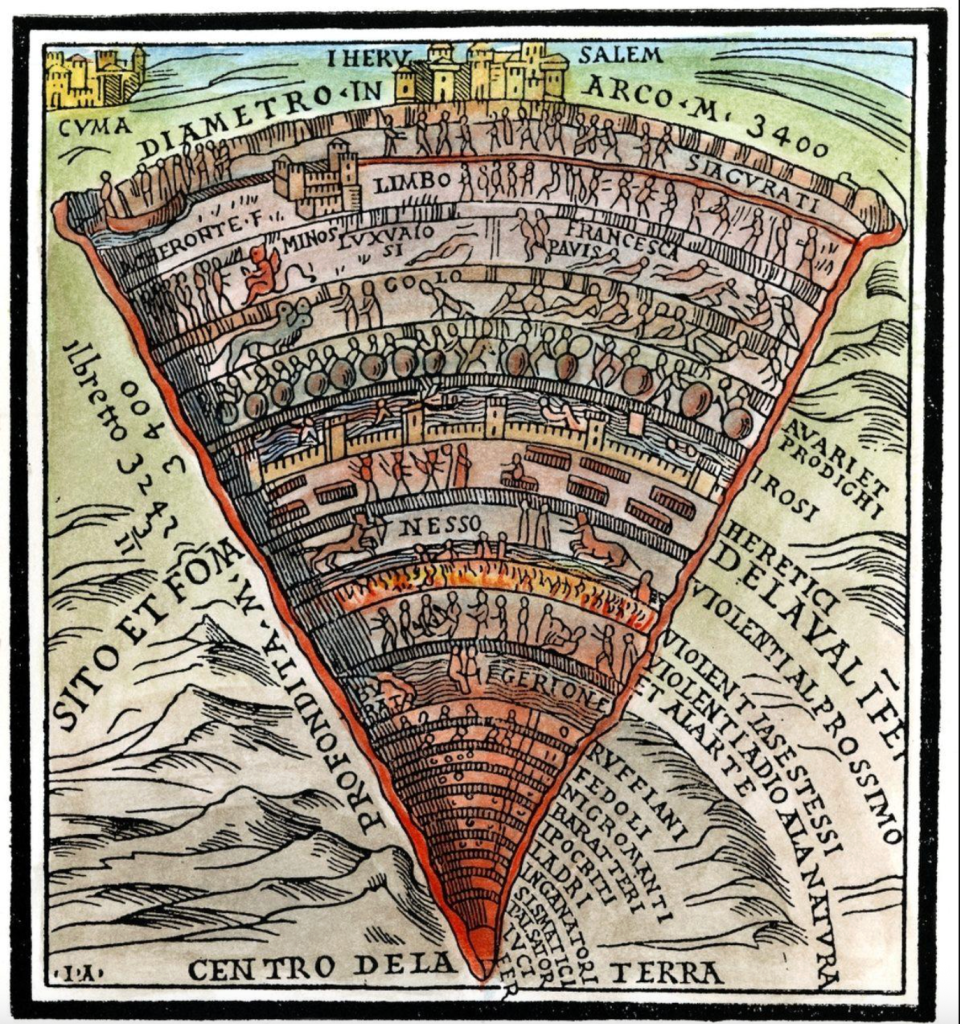
Written in the early fourteenth century, Inferno was the first part of Dante’s three-part Divine Comedy, followed by Purgatorio and Paradiso. Dante imagined hell as nine descending circles, each reserved for different kinds of sinners, with punishments carefully matched to the sins committed. His purpose was not simply theological. He was writing political satire, criticizing the corruption of his own day while exploring the soul’s journey toward God. His descriptions were so vivid that generations of artists brought them to life in paintings, engravings, and illustrations. Over time, many Christians began to picture Dante’s imagination as though it were biblical reality.
It isn’t.
Inferno may be one of the most influential books ever written about hell, but it is neither Scripture nor a work of systematic theology. Few Christians have ever read Augustine or Aquinas, but millions have encountered Dante’s vision through literature, sermons, paintings, films, and popular imagination.
Yet if I’m honest, much of what I imagined when I thought about hell looked remarkably like Dante’s vision.
And naturally, I had my own list of people who must be in Dante’s Inferno.
Hitler.
Stalin.
Judas.
Pontius Pilate.
Caiaphas.
Nero.
Attila the Hun.
Charles Manson.
The list wasn’t difficult to make.
Then I remembered something else.
Throughout my journey in Christianity, I had also been told different—and sometimes contradictory—answers to a much more important question.
Why does anyone go to hell?
Throughout my journey in Christianity, I had been given different—and sometimes contradictory—answers to that question.
Sometimes I was told it was because people didn’t believe in Jesus.
Sometimes because they rebelled against God.
Sometimes because they died with unrepented sin.
Sometimes because God had not chosen them before the foundation of the world.
Those are not small differences. They reflect profoundly different understandings of God, salvation, human freedom, and judgment.
Perhaps I wasn’t nearly as clear about hell as I had imagined.
So I decided to begin again—not by asking whether hell exists, but by asking a much simpler question:
What is hell?
For roughly three thousand years, Israel and the Jewish tradition have wrestled with divine judgment—its meaning, purpose, consequences, and relationship to God’s justice, mercy, and restoration. Christians have been discussing hell for nearly two thousand years. Surely, then, we should at least agree on what we mean by the word.
I quickly discovered that the answer was not nearly so simple.
Nearly every Christian tradition agrees that God judges the world.
But even that apparent agreement conceals a deeper divide. Is God’s judgment primarily retributive—a determination of guilt followed by deserved punishment? Or is it restorative—God’s work of exposing evil, vindicating those harmed, healing what has been broken, and putting creation right?
That larger question will matter throughout this inquiry because different understandings of judgment reveal very different understandings of God.
For the moment, however, I began with a narrower question: Within the familiar framework of final judgment, what happens to those who receive an adverse judgment?
Broadly speaking, Christians have given three different answers.
If God’s final judgment is unfavorable, what ultimately becomes of the person judged?
The first is Hell or Eternal Conscious Torment—the belief that those finally condemned remain consciously alive forever under divine judgment. This has been the majority view in Western Christianity for most of the last fifteen hundred years and is what most people mean today when they speak of hell.
The second is Conditional Immortality, often called Annihilationism. This view teaches that those who receive a final adverse judgment do not suffer forever. Their punishment is ultimately death. Eternal life belongs only to those who receive it as God’s gift.
The third is Universal Reconciliation. This view also affirms God’s judgment but understands its purpose differently. Divine judgment is real, but its ultimate end is restoration rather than endless punishment. In the end, no one remains eternally separated from God.
One observation immediately stood out to me.
Of these three possible outcomes, only Eternal Conscious Torment requires hell as most Christians have traditionally imagined it: an irreversible state in which a person remains conscious forever under divine punishment.
Conditional immortality ends – in ceasing to exist.
Universal reconciliation ends – in restoration.
Those alternatives deserve their own consideration later. But the subject of this inquiry was the doctrine I had been taught—the doctrine ordinarily meant when Christians speak of eternal hell.
So, I began with what seemed like the most basic question:
What exactly is the Christian doctrine of eternal hell?
I assumed there would be a definitive answer.
After all, Christians have been teaching about hell for almost 1,500 years. The doctrine appears in sermons, catechisms, confessions, evangelistic appeals, church membership statements, and descriptions of salvation. Surely the churches that taught it could tell me precisely what it was.
So before asking whether Jesus taught eternal conscious torment, I first turned to the Christian traditions themselves.
I wanted to know:
What does each church officially teach about hell?
Who goes there, and why?
What happens to them?
Is hell a place, a condition, a punishment, or a self-chosen separation?
Is its suffering imposed by God or experienced as the consequence of refusing God?
And does any church claim to know who is actually there?
That seemed like the obvious place to begin.
If there is a Christian doctrine of eternal hell, the churches should be able to define it.
What Do the Churches Actually Teach?
The first answer was straightforward.
There is no single institution called the Church that speaks for all Christianity on this question. There are churches—Catholic, Orthodox, Anglican, Lutheran, Reformed, Baptist, Methodist, Mennonite, Adventist, Pentecostal, and many others—and they do not all teach the same thing about hell.
Nor do they express their teachings with the same level of authority. Some beliefs have been established as dogma. Others appear in confessions or catechisms. Others remain theological opinions, popular traditions, or inherited images that were widely believed but never formally required.
This distinction matters because much of what Christians imagine when they hear the word hell has never actually been defined by any church.
The fire may be literal or figurative.
Hell may be described as a place or a state.
Its suffering may be understood as punishment imposed by God, punishment by the evil one, separation from God, the consequence of rejecting God, or even the painful experience of God’s unchanging love.
And the churches give substantially different answers to the question of why anyone would be there.
So, the problem was not that Christianity had no teaching about hell. The problem was that Christianity had many teachings about hell, each held with different levels of authority and built upon different understandings of God, salvation, freedom, judgment, and the human person.
There was no single definitive answer waiting for me.
The Character of God and Hell
By now I had begun to realize that the question wasn’t simply whether scripture contains words like Gehenna, Hades, or aiōnios. Those words matter, and they deserve careful attention. But beneath them lies a deeper question—one that every Christian doctrine must eventually answer.
What does this doctrine tell us about God?
Christianity makes an extraordinary claim. If we want to know what God is like, we look to Jesus. He is “the image of the invisible God.” Jesus tells Philip, “Whoever has seen me has seen the Father.” Every Christian tradition affirms that Jesus is God’s clearest and fullest self-revelation.
That means every doctrine ultimately becomes a question about God’s character.
Including hell.
In fact, hell may be unique among Christian doctrines. Most doctrines describe something God has done or will do. The doctrine of hell goes a step further. It tells us what kind of God we believe God to be—and what kind of God God will forever remain. If eternal conscious torment is true, then eternal punishment is not merely one of God’s actions. It becomes an everlasting expression of God’s character.
That is why this question matters.
The Purpose of Judgment
As I continued my study, I realized that the disagreement about hell actually begins before hell. Before Christians can answer what hell is, they must first answer what God’s judgment is for.
Nearly every Christian tradition agrees that God judges the world. The disagreement lies in the purpose of that judgment.
One understanding is primarily retributive. God judges humanity as a sovereign judge. Guilt is established, a verdict is rendered, and punishment follows. Justice is accomplished when wrongdoing receives the penalty it deserves. Whether punishment heals, restores, or reconciles is secondary. Justice lies in its being deserved.
Another understanding is restorative. Throughout Israel’s scriptures, justice (mishpat) is God’s work of exposing evil, vindicating those who have been harmed, rescuing the oppressed, calling sinners to repentance, and putting creation right. Judgment may involve painful consequences, but punishment is never its final purpose. Restoration is.
These two understandings inevitably produce different understandings of hell because they begin with different understandings of God.
A retributive framework can regard endless punishment as just so long as it is deserved.
A restorative framework asks a different question:
What does endless punishment restore?
That, I eventually realized, is really a question about God’s character.
The Image I Didn’t Know I Carried
That question became unexpectedly personal for me. During my seminary program we were given a simple exercise.
“When you think of God, what immediately comes to mind? Don’t edit yourself. Just notice.”
I’m a visual thinker, so an image appeared almost immediately.

An old man. Angry.
The image horrified me.
For years I had sincerely professed that God is love. I became a Christian because I believed that. At a Catholic college, a priest told me that God loved me no matter what. I believed him. During my years with Young Life, that conviction only deepened.
Scripture says something even stronger than “God loves.”
It says, “God is love.”
So where had this angry old man come from?
Our instructor suggested that this was probably a deeper issue. What I confessed with my theology and what I carried in my imagination were not the same. Somewhere along the way, another image of God had quietly settled beneath my conscious beliefs.
Since then, I have practiced a form of imaginative prayer. I intentionally picture the welcoming Jesus of the Gospels while slowly reflecting on the passages that describe God’s loving character, allowing the image of Jesus—the image of the invisible God—to reshape the fearful image I have carried for so many years.

The change has been slow, almost imperceptible. But it has been real.
I tell this story because I suspect I’m not alone. Many of us sincerely confess that God is love while quietly imagining someone else.
If God’s very nature is love, then every doctrine we hold—including hell—must somehow fit that reality.
So I went looking.
Part of me expected that my instincts were simply sentimentality—I wanted God to be love, to love me. I’d heard the sentimentality criticism before, often from the same people who confidently assured me that “Jesus talked more about hell than almost anything else.”
Instead, I discovered that scripture itself begins with exactly the question I was asking.
God’s Character Is Revealed Before His Judgments
Long before Jesus, God had already declared who God is. When Moses asks to see God’s glory, God responds not by describing divine power, sovereignty, holiness, or wrath. Instead, God describes God’s own character.
This is the first great self-revelation of God’s character in scripture.
“The LORD, the LORD, a God merciful and gracious, slow to anger, and abounding in steadfast love and faithfulness…” (Exodus 34:6–7)
This became Israel’s defining confession. The Psalms repeat it. Joel repeats it. Nehemiah repeats it. Even Jonah—furious that God has shown mercy to Nineveh—quotes it back to God in frustration.
Again and again, whenever Israel answers the question, “Who is God?” it returns to these words.
This is remarkable because Israel experienced nearly every imaginable national catastrophe: slavery, invasion, exile, civil war, corruption, famine, occupation, and national collapse. If there were ever a place where scripture might explain that God’s justice ultimately culminates in eternal conscious torment, these would seem to be the moments.
Yet the Hebrew Scriptures never do.
Sheol receives both the righteous and the wicked. Judgment is real. Consequences are real. Exile is real.
But eternal conscious torment never appears.
That silence does not prove a doctrine false. But it is striking.
The very scriptures that repeatedly define God as merciful, gracious, patient, and overflowing with steadfast love never present eternal conscious torment as the culmination of that character.
Instead, Israel’s hope is consistently directed toward restoration: the return from exile, the healing of the nations, the resurrection of the dead, the coming of the Messiah, and ultimately the renewal of creation.
God has declared who God is. History has not yet fully reflected that reality. So the prophets look not for a doctrine of everlasting punishment but for a coming rescue.
A Messiah.
Someone who will finally make good on the promises embedded in God’s own self-description.
Then Jesus Arrives
Into that unfinished story comes Jesus. Not introducing a different God. Not correcting the Father. But revealing the Father perfectly.
He heals enemies. He welcomes sinners. He seeks the lost. He restores the excluded. He confronts evil without becoming evil. He judges without abandoning mercy. He forgives those who are killing him.
Again and again, Jesus demonstrates that God’s justice is not opposed to God’s love. God’s justice is God’s love setting things right.
If Exodus 34 is God’s self-description, Jesus is that description embodied.
He is mercy with skin on. He is steadfast love walking among us. He is what God’s character looks like in history.
What Does Love Actually Do?
At this point another question emerged for me.
When scripture declares that “God is love,” what kind of love is it describing?
Certainly not sentimental affection.
Biblical love seeks. It forgives. It restores. It disciplines. It bears all things. It hopes all things. It endures all things. It never fails.
None of that eliminates judgment.
Quite the opposite.
But for Christians, love is not measured against judgment.
Judgment is measured against love.
Throughout scripture God’s judgments can be severe. Yet they consistently serve larger purposes: exposing evil, defending the vulnerable, calling people to repentance, purifying, healing, and restoring creation.
The question, then, is not whether God judges.
The question is whether judgment ultimately serves restoration—or becomes an end in itself.
The New Testament’s Vision
The same trajectory continues throughout the New Testament.
Paul repeatedly describes God’s purposes in terms of reconciliation, renewal, and bringing all things together in Christ. He speaks of creation moving toward its fulfillment, toward the day when God will be “all in all.”
Christians disagree about exactly how those promises should be understood. Some conclude they anticipate the ultimate reconciliation of all creation. Others understand them more narrowly.
But regardless of where one lands in that discussion, the New Testament consistently describes God’s ultimate purposes in terms of restoration, reconciliation, renewal, and completion. Its vision moves toward creation being set right.
A Conversation That Has Never Ended
None of these observations settles the question of hell.
Jews have contemplated judgment, restoration, and the afterlife for three millennia. Faithful Christians have reached different conclusions for centuries. Some believe God’s justice ultimately requires eternal conscious torment. Others believe those who finally reject God cease to exist. Still others conclude that God’s judgments are ultimately restorative, while some hope for the restoration of all things without claiming certainty.
I do not expect this essay to settle that debate.
What I am asking is simpler.
If Jesus truly is the fullest revelation of the Father, then every doctrine—including hell—must finally be consistent with the character of God revealed in him.
That conviction now leads naturally to the next question.
Jesus did not teach in a vacuum. He lived, worshiped, and taught as a Jew within a long tradition of reflection on God’s judgment, justice, and the hope of resurrection. Before examining Jesus’ words, we must first understand that world. I believe we’ll discover it is quite different from what many Christians assume.
The Story Jesus Inherited
One of the most significant changes in my understanding of scripture over the past several years has been learning to read Jesus as a first-century Jew. Scholars and teachers such as David Fohrman, Lois Tverberg, Marty Solomon, Tim Mackie, Greg Boyd, and many others have helped me see the Bible less as two disconnected testaments and more as one unfolding story of God’s relationship with humanity. The Hebrew Scriptures, the prophets, Jesus, and the apostles are all participating in the same conversation.
That realization has profoundly changed how I approach difficult doctrines—including hell.
Jesus was Jewish.
His disciples were Jewish.
Paul was Jewish.
Indeed, I believe every author of the books of the New Testament, was Jewish.
They were steeped in Israel’s Scriptures. They worshiped the God of Israel. They spoke from within Israel’s story and understood God’s promises through Israel’s hopes. If we want to understand what Jesus meant when he spoke about judgment, Gehenna, the kingdom of God, or the age to come, the most natural place to begin is with the world in which he lived rather than with theological systems developed centuries later.
It is heartbreaking that, over time, Christianity and Judaism grew apart—particularly after the destruction of the Temple in AD 70 and the generations that followed. As that separation widened, Christians increasingly interpreted Jesus through Greek and Latin philosophical categories rather than through the Jewish worldview that had shaped him. Christian theology produced many profound insights, but something essential was also lost: the interpretive framework Jesus and his earliest followers simply assumed.
If we hope to understand what Jesus taught about hell, we must first ask a simpler question:
What story had already shaped the minds of Jesus and his hearers before he ever spoke about judgment, Gehenna, or the kingdom of God?
That is where our journey continues.
Israel’s Story of Judgment
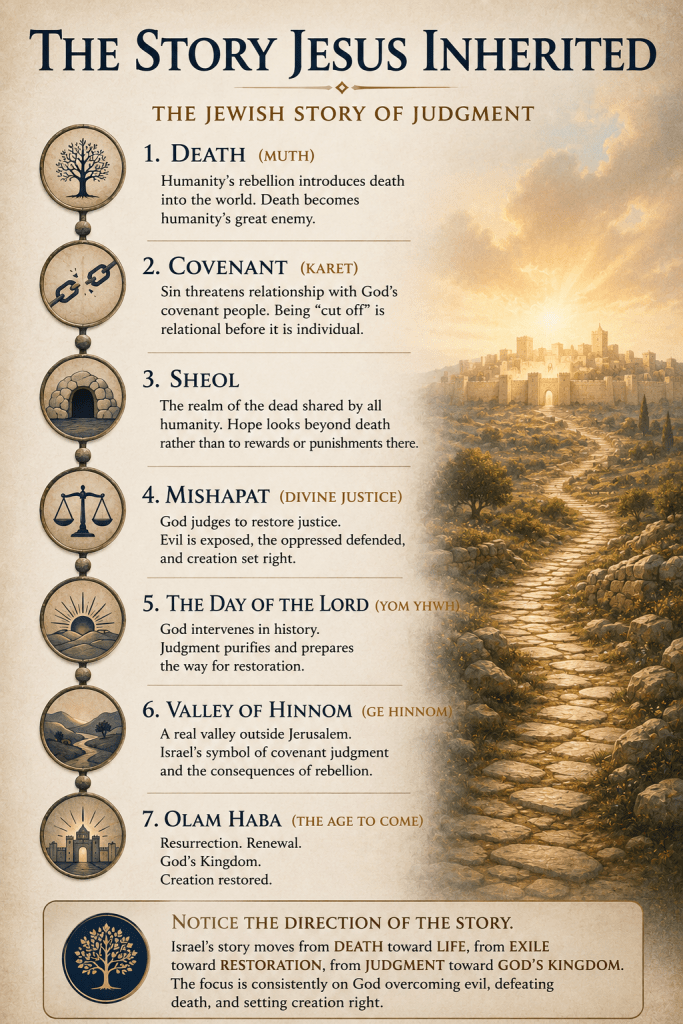
From the beginning, Israel’s Scriptures tell a remarkably consistent story…
Humanity was created for life with God—to flourish. Yet through temptation and disobedience, death entered the world. From that point forward, the story is not about escaping to heaven or avoiding hell. It is about God’s determination to rescue his creation and restore what has been broken.
God formed a covenant with Israel, calling them to become the people through whom the nations would come to know him and learn the way of flourishing. When Israel lived faithfully, they experienced life, justice, peace, and flourishing. When they abandoned the covenant through idolatry, injustice, and violence, the consequences were real. Judgment came in the form of famine, defeat, exile, and national catastrophe—not because God delighted in punishment, but because a people who reject the way of flourishing inevitably suffer its consequences.
Neither judgment nor punishment was God’s final word. Restoration was.
Again and again, the prophets called Israel to repentance—not to announce condemnation, but to invite restoration. God’s judgment exposed what was broken so that his people might return to him.
The Valley of Hinnom
One place came to embody Israel’s story more vividly than any other.
Just outside Jerusalem lay the Valley of Hinnom (Ge Hinnom).
Centuries before Jesus, it became infamous as the place where some of Judah’s kings and people sacrificed their children to foreign gods. Through the prophet Jeremiah, God declared that because of these horrific acts, judgment was coming upon Jerusalem.
Jeremiah warned that unless the nation repented, Babylon would invade. Jerusalem would be besieged. The city would be destroyed. Many would die by the sword, famine, and disease. The Temple would be burned, and the survivors would be carried into exile. He even declared that the Valley of Hinnom would become “the Valley of Slaughter,” because so many would die there that there would be no room left to bury the dead.
A generation later, Jeremiah’s warning came to pass. Babylon invaded Judah, destroyed Jerusalem, burned the Temple, devastated the land, and carried much of the population into exile.
For every Jew who knew Israel’s Scriptures, the Valley of Hinnom became far more than a geographical location. It became a symbol of what happens when a people persistently reject God’s covenant. It reminded them that idolatry, injustice, and violence ultimately destroy both people and nations.
In Jeremiah, Gehenna was a warning about the consequences of covenant unfaithfulness in this life.
By the time Jesus began teaching, Gehenna carried more than one layer of meaning. Some Jews continued to hear Jeremiah’s warning of historical judgment. Others also used the image when speaking of God’s final judgment. Yet both understandings remained rooted in Israel’s story of covenant, judgment, repentance, and hope—a hope centered on God’s restoration of his people and, ultimately, of his creation.
This was the Gehenna that Jesus inherited.
Resurrection and the Kingdom
Israel’s story did not end in exile.
The prophets looked beyond judgment to a day when God would finally act. Death would not have the last word. Evil would be defeated. God would raise the dead, judge with perfect justice, renew creation, and establish his kingdom forever.
By the time Jesus was born, many Jews lived in expectation of that coming day. Different Jewish groups understood the details differently, but they shared the same fundamental hope:
When will God finally set the world right? When will creation be restored?
That was the world into which Jesus stepped announcing,
“The kingdom of God has come near.”
The Starting Point
This is where our study of Jesus must begin.
Not with medieval paintings of hell.
Not with later theological systems.
Not even with centuries of Christian debate.
We begin where Jesus began—with Israel’s story.
When Jesus spoke about judgment, Gehenna, eternal life, and the kingdom of God, he was speaking into a world already shaped by covenant, exile, prophetic warning, resurrection, and hope.
Only after hearing those words as his first hearers would have heard them are we ready to ask the next question:
What did Jesus actually mean when he spoke about judgment?
Only after understanding that story are we ready to ask a more focused question.
When Jesus warned about Gehenna, what would his first hearers have understood him to mean?
Did Jesus Say “Hell?”
As stated earlier, one of the statements I heard recently was simple:
“Jesus talks more about hell than almost anything else.”
But, did Jesus actually say the word “hell”?
The literal answer is no.
Jesus spoke primarily Aramaic and was also familiar with Hebrew. His teachings were later written down in Greek by the Gospel writers. None of those languages has a word today, nor in that time, that means what most modern Christians mean when they say “hell.”
That may sound surprising, but it is simply a fact of history.
The English word hell did not appear until Old English developed in the seventh and eighth centuries—nearly seven hundred years after Jesus lived. It comes from the Old English hel or helle, derived from the Proto-Germanic haljō, meaning “the hidden place” or “the covered place”—the unseen world of the dead. Originally it referred simply to the realm of the dead, much like the Hebrew Sheol or the Greek Hades. Only over centuries did it acquire the meanings of eternal punishment, demons, and everlasting torment that many people associate with it today.
Jesus no more spoke the English word hell than he spoke the word computer.
That observation is more than a curiosity. It reminds us that whenever we read an English Bible, we are already reading an interpretation. Translators must decide which English word best represents the words found in Hebrew, Aramaic, and Greek.
So if Jesus did not speak of hell, what words did he actually use?
Many Words, One Translation
One of the biggest surprises in my research was discovering that the Bible speaks with several different words where many modern translations simply say hell.
| Biblical Word | Language | Basic Meaning |
| Sheol | Hebrew | The realm of the dead; the common destiny of humanity. |
| Gehenna (Gehinnam) | Hebrew / Aramaic | The Valley of Hinnom outside Jerusalem, associated with covenant judgment. |
| Hades | Greek | The Greek equivalent of Sheol, the realm of the dead. |
| Tartarus | Greek | The prison of rebellious angels; used only once (2 Peter 2:4). |
| Aiōnios | Greek | Belonging to the age to come; often translated “eternal.” |
| Kolasis | Greek | Punishment, correction, or discipline. |
These words come from different languages. They come from different cultures. They describe different realities. Yet in many Western translations they were frequently rendered with a single familiar word:
Hell.
The same pattern occurred across Europe. German translators often used Hölle. French translators used enfer. Spanish translators used infierno. Italian translators used inferno.
In other words, the translation issue is not uniquely English. Across Western Christianity, multiple biblical words gradually became one theological word.
That does not necessarily mean the translators were wrong. Every translation requires difficult choices.
But it does mean we should be cautious about assuming that every occurrence of hell in our English Bibles refers to exactly the same thing.
The biblical authors themselves never tell us that.
The Word Jesus Actually Used
When Jesus warned about coming judgment, his most common word was Gehenna—or more precisely, the Aramaic form Gehinnam.
As we saw in the previous section, Gehinnam was not an abstract theological concept. It was a real valley outside Jerusalem whose history stretched back through Israel’s story. It evoked memories of idolatry, child sacrifice, Jeremiah’s prophetic warnings, Babylon’s destruction of Jerusalem, and the consequences of covenant unfaithfulness.
By the first century, Gehenna had become a powerful symbol. Some Jews still heard it primarily as Jeremiah’s warning of national judgment. Others also used it as imagery for God’s final judgment.
Jesus entered that existing conversation. He did not invent a new vocabulary. He spoke the language of Israel’s story.
A Necessary Distinction
This raises an important distinction.
Words are not doctrines.
Showing that Jesus spoke of Gehenna instead of hell does not, by itself, tell us what he believed about judgment, punishment, or the fate of the wicked.
It simply reminds us that before asking what later Christians meant by hell, we should first ask what Jesus meant by Gehenna.
Those are not necessarily the same question.
The next section turns from vocabulary to substance.
If Jesus did not teach in the language of later Christian theology, what did he actually say about God’s judgment?
What verdicts did he pronounce?
What consequences did he describe?
And do those teachings amount to the doctrine of Eternal Conscious Torment that became dominant centuries later?
Jesus on Judgment, Verdicts, and Punishment
By this point in my study, I had answered one question. Jesus never actually spoke the English word hell. But that answer immediately led to another, far more important question.
What did Jesus actually teach about God’s judgment?
Like many people looking at Christianity from the outside, I assumed judgment stood at the center of Jesus’ message. In my late teens and early twenties, that was one of the reasons I wanted nothing to do with it. Why would I voluntarily join a religion that seemed centered on trying to act perfectly, always under the threat that if I failed, I would spend eternity in a place called hell? Live your life. Make mistakes. Plead your case. Be judged—first by other Christians, then by God—and almost certainly end up in eternal punishment. Heaven and hell appeared to be the great dividing line of everything Christianity was about. Jesus’ mission, it seemed, and by implication, Christian’s, was to warn people about hell and persuade them to avoid it.
But then, I was told that God’s purpose was love. I believed it.
Then I actually read the Gospels. And I found that to be true.
Jesus certainly warned about judgment. There is no honest way to read the Gospels and deny that. He spoke of accountability before God, of consequences for rejecting God’s kingdom, and of a day when everything hidden would be brought into the light.
What surprised me was the proportion.
Judgment occupies an important place in Jesus’ teaching, but it is far from its center. The word Gehenna, often translated hell, appears only about eleven times in his recorded teaching. By contrast, Jesus speaks of the Kingdom of God or the Kingdom of Heaven roughly one hundred times. Again and again he announces that God’s reign has arrived and invites people to enter it.
Even that observation, however, doesn’t tell the whole story.
Jesus spent even less time talking about the Kingdom than he did living it.
He embodied the very life he was inviting others to embrace.
Everywhere he went he restored what had been broken. He healed the sick, welcomed those society rejected, forgave sinners, touched lepers, fed the hungry, blessed children, cast out evil spirits, challenged religious hypocrisy, comforted the grieving, and reconciled people who had been pushed to the margins. Even his harshest rebukes were directed toward those whose power and religion crushed other people rather than setting them free.
His ministry was not simply a series of sermons about God’s love.
It was God’s love in action.
When Jesus invited people into the Kingdom, he was inviting them into an entirely different way of being human. He taught them to love God with all their heart, soul, mind, and strength, and to love their neighbors as themselves. Then he stretched that command even further. Love your enemies. Forgive without keeping score. Show mercy. Welcome the stranger. Care for the poor. Become servants rather than masters. Seek reconciliation before retaliation. Be peacemakers. Give generously. Judge yourself before judging others.
This is what life in the Kingdom looks like.
Against that backdrop, Jesus’ warnings about judgment began to sound different. They were not isolated threats hanging over humanity. They were warnings about refusing the very life of love and flourishing that God is offering.
That realization also changed the way I understood the word judgment itself.
For much of my life, I imagined judgment as a courtroom. That picture came naturally to me. My father was an attorney, and for many years I expected to follow him into law. In my mind, judgment worked like a trial. Someone is wronged. Evidence is gathered. Arguments are presented. A verdict is rendered. A sentence is imposed. Justice is served.
Jesus’ understanding seems much richer than that.
Standing within Israel’s Scriptures, judgment is God’s work of setting things right. It is truth exposed. Evil confronted. Oppression ended. The innocent vindicated. The guilty called to repentance. What is hidden is brought into the light, and what is broken begins to be restored.
Only then is a verdict revealed.
Only then do consequences follow.
Seen this way, judgment and punishment are not the same thing. In much of Western Christianity, however, they are almost inseparable. Life is imagined as a trial before God. A verdict is rendered, and then comes the sentence—heaven or hell.
What surprised me was that Jesus rarely speaks that way. He never pauses to explain the punishment God imposes on those he judges. Instead, he describes what becomes of lives lived apart from God’s kingdom. Branches cut off from the vine wither. Houses built on sand collapse. Fruitless trees are cut down. Those outside the banquet never share in its celebration. The consequences belong to the reality Jesus is describing rather than to a punishment he carefully defines.
That also helps explain why Jesus uses so many different images. Sometimes he speaks of Gehenna. Sometimes of outer darkness. Sometimes of fire, a closed door, weeds burned, or sheep separated from goats. These are prophetic pictures, not a systematic doctrine of the afterlife. They awaken people to the seriousness of life apart from God’s kingdom.
Perhaps the most striking observation, however, is not what Jesus says but what he never says. He never defines Gehenna. He never explains how judgment unfolds after death. He never describes an eternal torture chamber ruled by Satan or demons tormenting human beings forever. Readers may conclude that some of those ideas are implied, and Christians have debated them for nearly two thousand years. But Jesus himself never explains them.
Instead, he keeps returning to the same invitation:
The Kingdom of God has come near.
Repent.
Believe the good news.
Come and live.
Only after seeing judgment and punishment within the larger story of God’s invitation are we ready to ask the next question:
How did Christians come to believe that God punishes people with eternal conscious torment?

