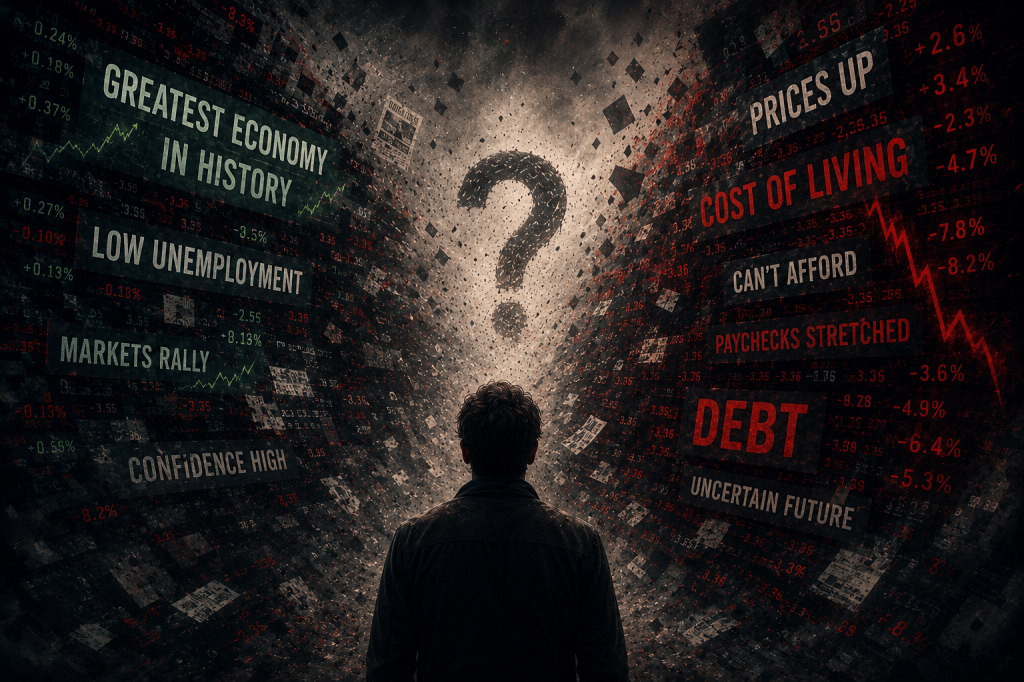
If so, why does it feel so shaky now?
The Snapshot
The economy gets reported every day. Almost none of it is useful — not through dishonesty, but because condensing a complex behavioral science into a two-minute sound bite is structurally impossible. Add a low public literacy, with a high unearned confidence, and the narrative becomes remarkably easy to manipulate.
That manipulation is not accidental. Political actors operate in the gap between what the data shows and what the public understands — with every incentive to exploit it.
In February 2026, the U.S. President declared: “I think we have the greatest economy actually ever in history.”
Full year GDP growth in 2025 was 2.1% — down from 2.8% the year before. Inflation was re-accelerating. Seventy-four percent of Americans said the economy was poor or at best fair. The claim wasn’t analysis. It was a narrative with no obligation to the data.
So I built my own framework — reliable data, independent evaluation, an honest accounting of where things actually stand. Two reports. Two audiences.
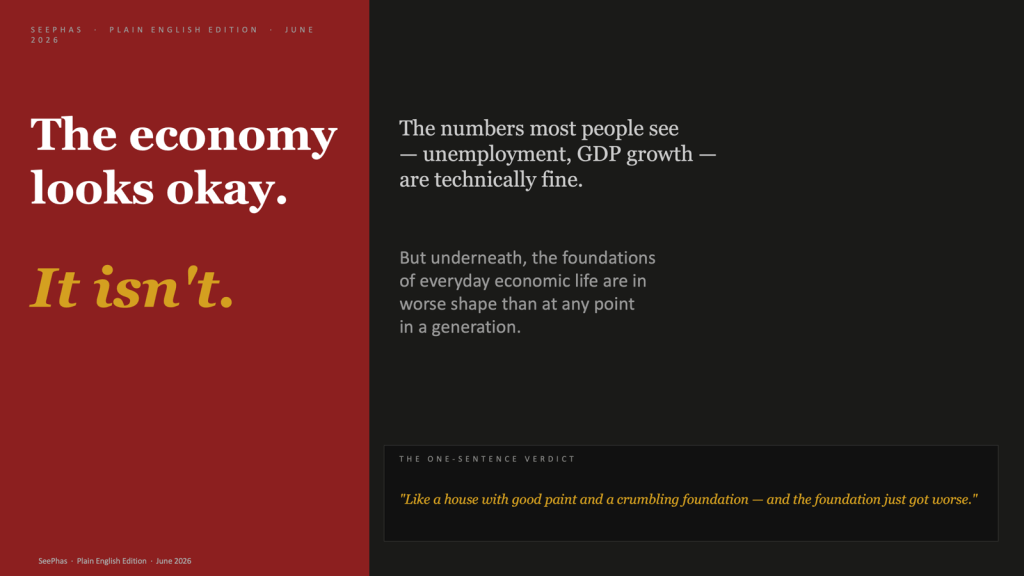
The Plain Language Report is for anyone willing to admit the economy isn’t their native language. No jargon. No assumed knowledge. Just what’s actually happening and what it means for ordinary life.
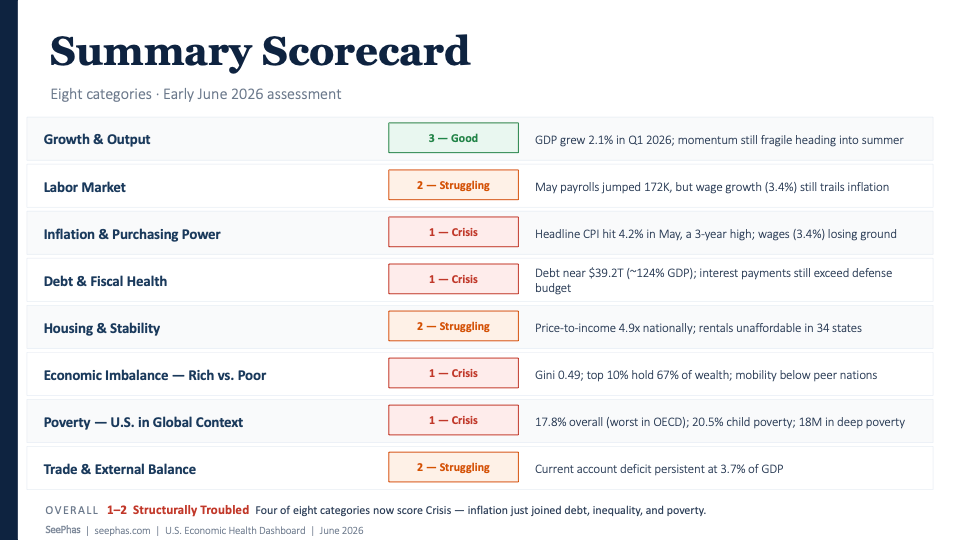
The Economic Aficionado Snapshot is for those who want the full picture — six categories, nineteen indicators, trend lines across one, five, and ten years. The economy as it actually is, not as it has been declared to be.
The Plain Language Report
The Economic Aficionado Snapshot
This report is for readers who want more than the headline numbers.
Unemployment and inflation get reported every news cycle — but as isolated figures, stripped of context, they tell an incomplete story. This dashboard was built on a different premise: that an honest picture of the economy requires breadth, depth, and a longer time horizon than the last quarter.
It is organized around six categories — Growth and Output, Labor, Inflation and Purchasing Power, Debt and Fiscal Health, Housing and Social Stability, and Trade and External Balance — with three to five indicators in each. Together they surface what the headlines miss and what self-serving political statements, delivered with confidence from what appears to be an alternative reality, routinely obscure.
This is not the economy of sound bites. It is the economy as it actually is.
Two questions follow the reports.
The first is — what do you think of the reporting?
The second — what should we do?
I have ideas. They’re open for debate.

