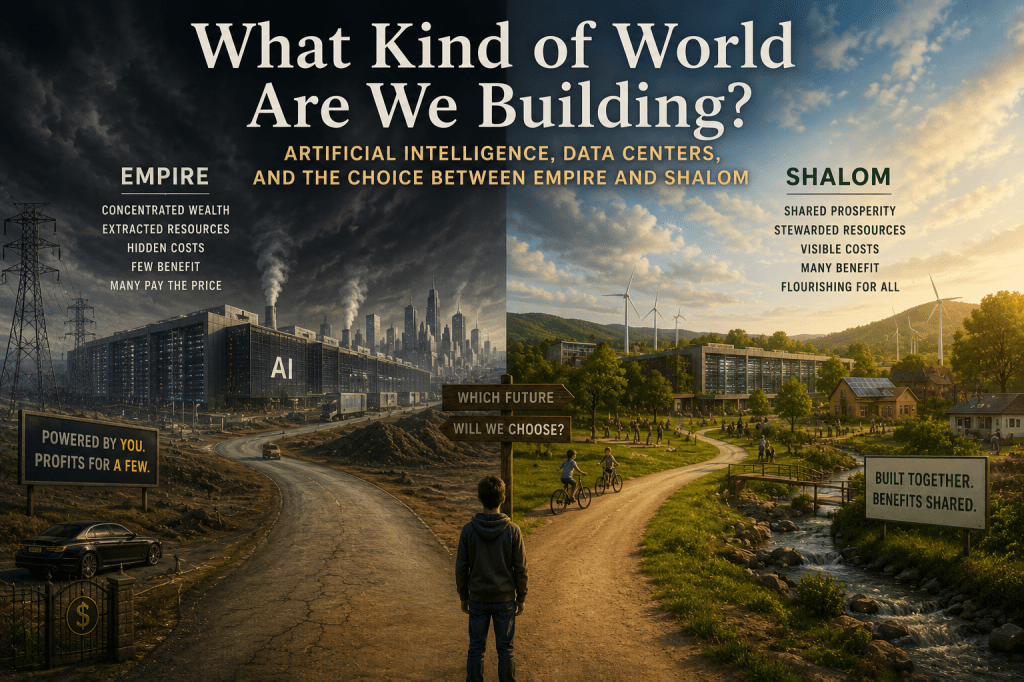
Artificial Intelligence, Data Centers, and the Choice Between Empire and Shalom
Peter T. Brandt · SeePhas.com · June 2026
Part 1 — The Two Futures
When I started what has now become something of a journey, it began with a simple question.
“What do you think of this data center debate?”
My honest response, after nearly forty years working in the digital technology industry, was that it seemed like another overreaction to what many people have come to see as the latest villain of our future—artificial intelligence.
Of course AI needs data centers. Every time we turn on our smartphones, stream a movie, search the web, or ask an AI chatbot a question, we’re connecting to one. Data centers have existed since the earliest days of computing, when machines like ENIAC filled entire rooms instead of fitting into our pockets.
But as I began digging into the issue, several things surprised me.
The first was that these weren’t the data centers I had spent my career around. These weren’t large computer rooms or office buildings full of servers. They were industrial campuses the size of small cities, consuming the electricity of a metropolitan area, drawing enormous quantities of water, and requiring new transmission lines, substations, roads, and cooling systems. Imagine a major industrial park placed next to your neighborhood—the higher electric bills, the increased water demand, the noise, the industrial impacts that come with it.
But that wasn’t what stayed with me.
As I read the stories behind individual projects, I realized this wasn’t really a story about data centers. It was a story about how societies choose to make progress—or, more accurately, how they sometimes mistake one kind of progress for another. Again and again I found myself asking the same questions.
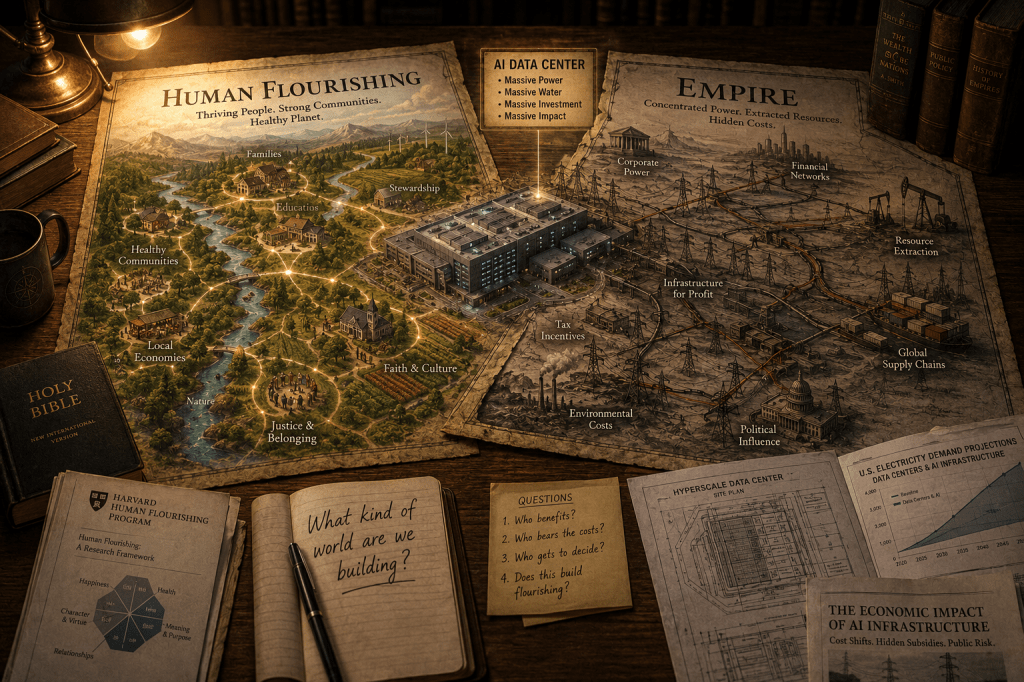
Who benefits? Who bears the costs? Who gets to decide? Are we building a society that moves toward greater flourishing—or repeating patterns history has seen many times before?
Those questions led me far beyond artificial intelligence—into economics, history, and public policy, and back to two subjects I had been studying for much of the past twenty years.
One was the growing science of human flourishing—drawing from psychology, sociology, economics, public policy, and especially Harvard’s Human Flourishing Program, to better understand what helps people and communities thrive.
The other was theology and scripture. One of the central themes running through the Hebrew and Christian traditions is the contrast between shalom and empire.
Shalom is a Hebrew word that means far more than simply “peace.” It describes wholeness, well-being, and the flourishing of people, communities, and creation as God intended them to be. Throughout scripture, shalom is the vision toward which God’s work of redemption is directed.
Empire describes the opposite pattern: humanity’s recurring tendency to concentrate wealth, power, and privilege in the hands of a few while shifting the costs onto everyone else. Those few have taken many forms—pharaohs, kings, emperors, political elites, oligarchs, corporate leaders—but the pattern itself has remained remarkably consistent. Modern theology uses empire to describe that recurring pattern.
For years I thought of these as two separate areas of study—one grounded in scientific research, the other in theology and scripture. I never expected them to have much to say to one another. But the more I studied both, the more I found myself surprised. Again and again they pointed toward the same things: justice, stewardship, healthy relationships, belonging, purpose, participation, care for creation.
They used different language and started from different assumptions. But they kept describing the same kind of society. That was one of the biggest surprises of this journey—and it became the framework through which I began looking at artificial intelligence, data centers, and the choices we are making about our future.
Shalom and empire answer the same questions very differently.
| Question | Empire | Shalom |
| Purpose of society | Increase power, wealth, and security. | Cultivate the flourishing of people, communities, and creation. |
| View of people | Resources to be utilized. | Persons of inherent dignity. |
| Wealth | Accumulate and protect. | Steward and share for the common good. |
| Power | Concentrate and control. | Serve, participate, and remain accountable. |
| Costs | Often shifted onto others. | Made visible and shared fairly. |
| Community | Means to an end. | Something to strengthen and sustain. |
| Creation | Resource to extract. | Gift to steward. |
| Success | Growth, efficiency, accumulation. | Flourishing, justice, healthy relationships, and long-term well-being. |
These are ideal types, not absolutes. Every nation, corporation, community, church, and individual reflects characteristics of both. The question is not whether we perfectly embody one or the other, but which direction we are moving.
The parts that follow apply this framework to what may become one of the largest infrastructure transformations in American history. As we move through that story, I invite you to keep returning to the same questions: Who benefits? Who bears the costs? Who gets to decide? Does this move people, communities, and creation toward greater flourishing?
Those questions are not abstract. They have concrete answers. The story begins in one community. But it is being repeated across the country.
Part 2 — Boxtown
In the summer of 2024, residents of Boxtown, a neighborhood in southwest Memphis, began noticing a smell. Then came the noise—a low industrial rumble that never stopped, even at night. Then came the headaches, the burning eyes. Parents noticed their children’s asthma worsening. People who had lived there for decades knew something had changed. No one had told them anything was coming.
“The damage was done before we knew about it.”
— Darryl Sledge, Boxtown resident for more than fifty years
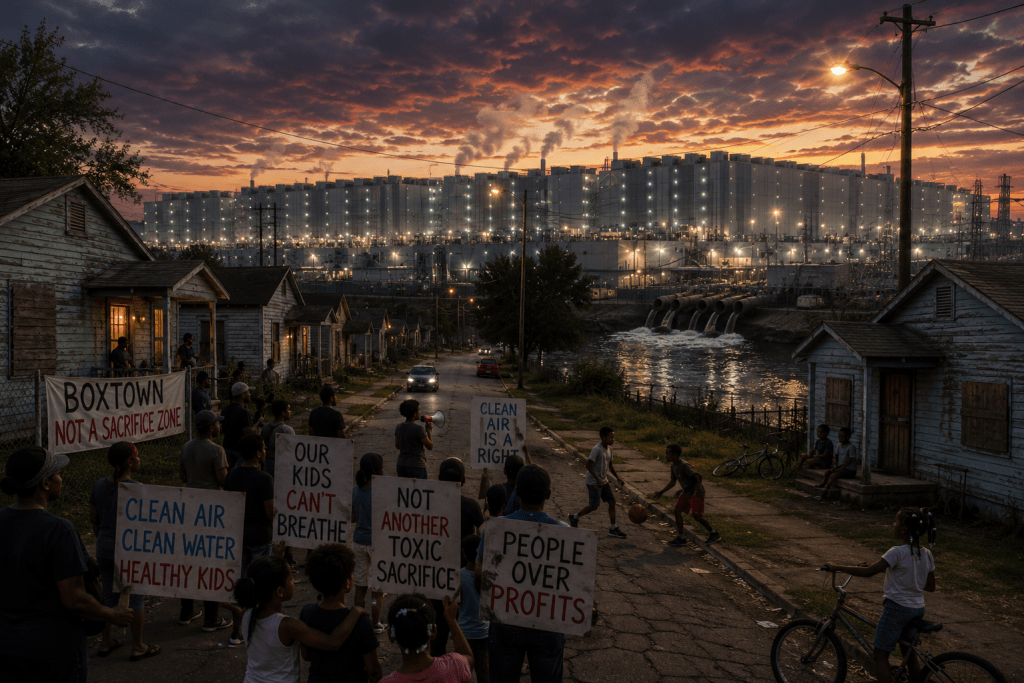
Boxtown was founded in 1863 by formerly enslaved people. Decades later it was annexed for industrial development. Today it carries an “F” air quality rating from the American Lung Association. Like many communities before it, it had been promised that the next investment would bring opportunity.
This one did—but not in the way residents had hoped. Inside a vacant Electrolux appliance factory, one of the world’s largest artificial intelligence computing facilities appeared in just 122 days. The people living nearby did not know they had become neighbors to one of the most ambitious AI projects ever attempted. They simply knew something in their community had changed.
Only later did the story become clear.
The facility belonged to xAI, the artificial intelligence company founded by Elon Musk. Musk had rejected the conventional eighteen-to-twenty-four-month timeline for building a major AI data center. Within roughly a week, his team settled on the abandoned 785,000-square-foot Electrolux factory—already standing, already zoned industrial, near a gas main and a wastewater treatment facility. Nothing new. Just a fast start. What followed was a willingness to use every loophole xAI found once it arrived.
The building had only eight megawatts of electrical capacity; the project would ultimately require roughly 250 megawatts—enough to power every home in Memphis continuously. So, rather than waiting for the electrical grid to catch up, the gap was bridged by installing thirty-five methane gas turbines—power-plant-equivalent generation classified as exempt “nonroad engines,” requiring no permit at all.
Multiple public agencies had opportunities to intervene. Instead, the Shelby County Health Department accepted that classification, letting the turbines run for more than a year without any intervention. When the community finally challenged it, the Memphis and Shelby County Air Pollution Control Board voted 6–1 to dismiss the challenge and let xAI keep going. The EPA has since confirmed that portable turbines like xAI’s do require permits—but as of this writing has taken no enforcement action or imposed any penalty on the project.
Further, the Tennessee Valley Authority (TVA) reveals a second version of the same loophole—structural rather than regulatory. It is the only federally controlled utility of its kind in the country: a board appointed directly by the president, needing just five members to act on behalf of ten million customers. In 2025, after Tennessee’s two senators criticized it as a “collection of political operatives” rather than “industrial leaders,” three members were removed, leaving the board without quorum for most of the year. When new members restored quorum that December, the board’s first act was to unanimously approve xAI another 150 megawatts.
The loopholes extended beyond environmental oversight. While xAI purchased electricity at approximately $64 per megawatt-hour, many Boxtown residents were paying nearly twice that through their household electric bills. Nor is the project intended to stop with a single facility—xAI continues to expand its Memphis operations, with future phases expected to require more than a gigawatt, far beyond what the existing regional grid was designed to supply.
And finally, the story became even more troubling because, during much of this period, Musk was simultaneously serving as a senior advisor within the executive branch while also leading one of the country’s largest AI infrastructure projects. The Senate Permanent Subcommittee on Investigations later concluded that these overlapping roles created conflicts of interest that “pose grave risks for America’s most sacred institutions and may violate federal law.” At the same time, Musk had become the first person in recorded history whose net worth exceeded one trillion dollars, concentrating extraordinary economic and political influence in a single individual.
As LaTricea Adams, president of Young, Gifted & Green, said of the decisions—first to permit the fast-track, then to expand xAI’s power supply—“None of the people who are part of this decision live in this community. How do you know this is a good idea?”
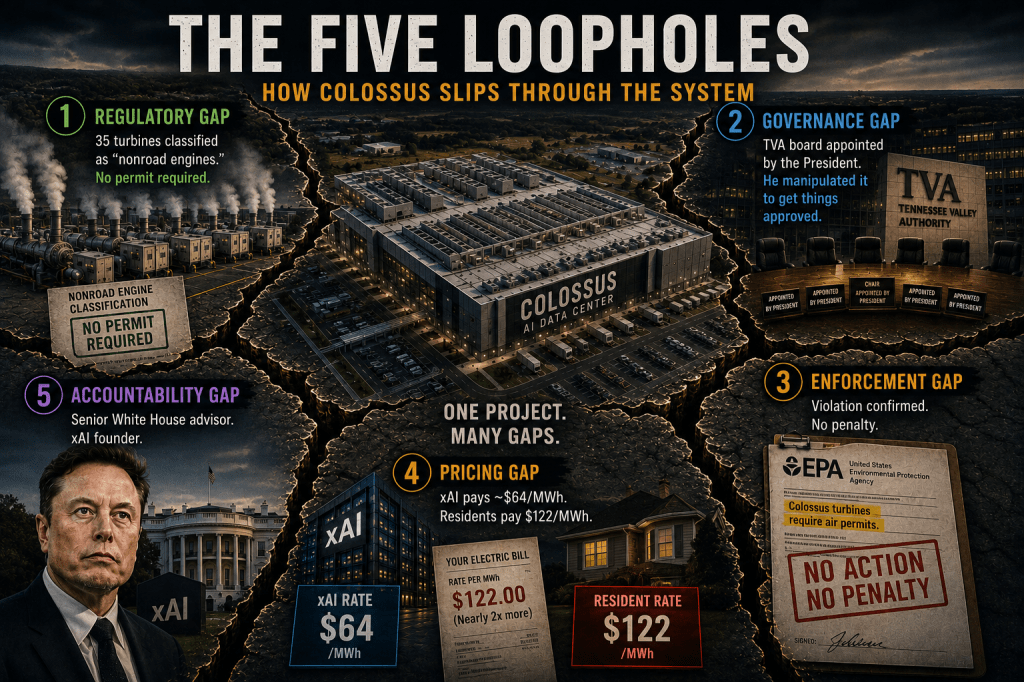
By the time Colossus was fully operational, five separate gaps had been found and used. A regulatory gap let the turbines run unpermitted for over a year under a “nonroad engine” classification. A structural gap in TVA’s governance let a five-person board redirect power for ten million people. An enforcement gap let a confirmed legal violation go unpunished. A gap between what the public paid and what the business paid. And a gap in personal accountability let one person simultaneously run the company and help shape the federal environment it operated in. None of these gaps were created for xAI. All of them were used by it.
The same questions are emerging across the country. In northern Virginia, data centers now consume more than a quarter of the state’s electricity. In Arizona, massive AI campuses draw from the same aquifers that nearby residential developments must prove can sustain a century of future growth. In rural Louisiana, one project is expected to consume more than twenty million gallons of water every day in a parish where one in four residents lives in poverty.
The names change. The locations change. The pattern remains remarkably consistent.
Who benefits? Who bears the costs? Who participates in the decisions? Does this move people, communities, and creation toward greater flourishing?
Boxtown matters because it reveals the question beneath the technology itself. The question is not whether artificial intelligence is valuable, or whether data centers should exist. It is whether the people most affected by these developments become meaningful participants in the decisions—or simply resources within them.
That is the distinction this framework describes as the difference between empire and shalom—and Boxtown is one place where that distinction becomes impossible to ignore.
Part 3 — We Have Seen This Before
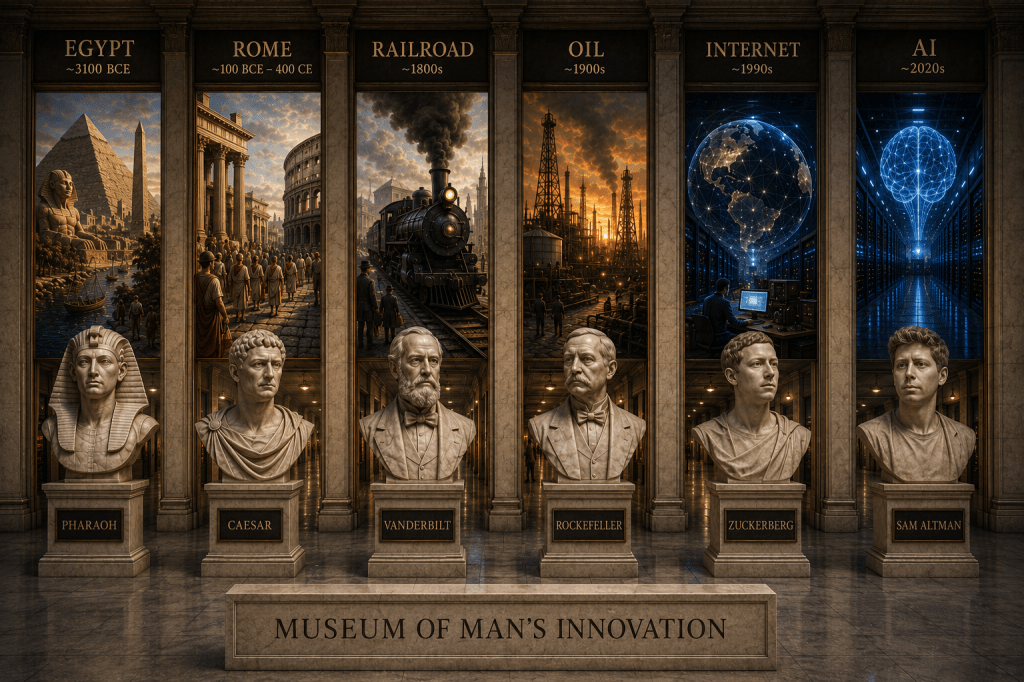
Boxtown may feel unprecedented. Artificial intelligence is new. The scale of today’s computing infrastructure is new. The underlying pattern is not.
Throughout history, transformative technologies and economic opportunities have repeatedly promised extraordinary public benefits. Many of those promises were fulfilled—railroads transformed commerce, oil fueled industrial civilization, the internet reshaped communication. Artificial intelligence may do the same. The challenge has rarely been the technology itself. It has been how it was financed, who controlled it, who benefited from it, and who bore its costs. Again and again, history reveals the same pattern: public resources, public investment, or public authority create extraordinary private wealth while the public retains little ownership, limited influence, and continuing obligations.
The Railroads (1850–1871)
The United States granted approximately 180 million acres of public land—an area larger than Texas—along with federal loans to private railroad companies. At current western land values, that public land alone would be worth approximately $180 billion to $900 billion today. The railroads transformed America, but much of the land became an object of speculation rather than settlement, freight rates were manipulated, and the resulting fortunes helped define the Gilded Age.

The Oil Depletion Allowance (1926–Present)
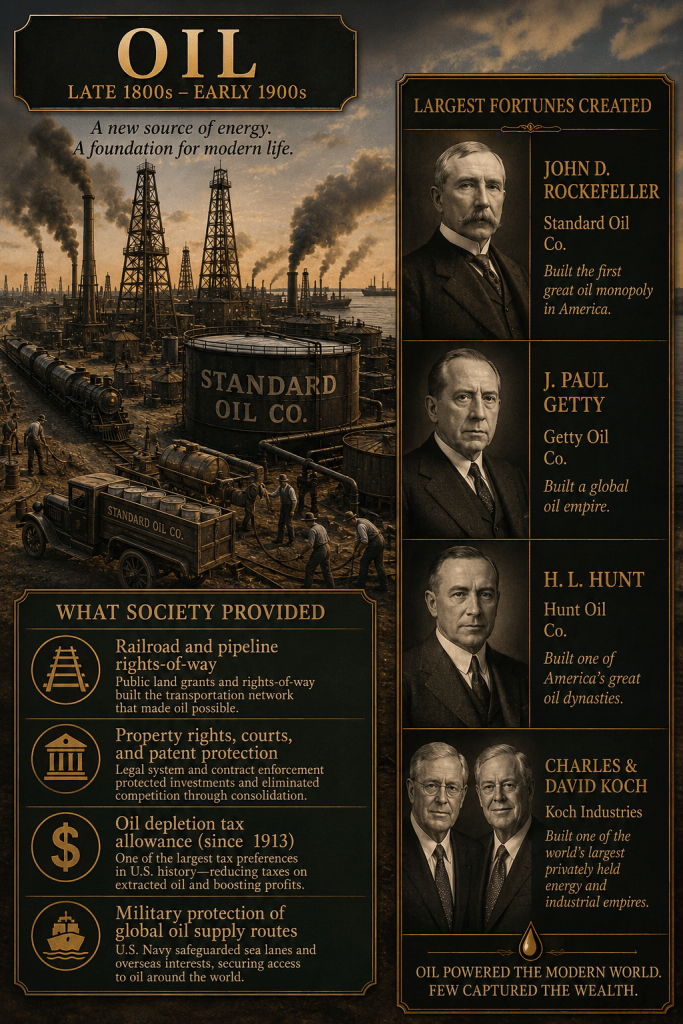
Beginning in 1926, oil producers were allowed to deduct 27.5 percent of gross revenue regardless of actual production costs. Multiple presidents attempted to repeal the provision; Congress repeatedly refused. Nearly a century later, the cumulative benefit to the industry exceeds $480 billion, while fossil fuel tax preferences enacted or expanded in 2025 are estimated to cost taxpayers approximately $35 billion every year. The public continues to subsidize one of the world’s most profitable industries.
The Internet (1969–1995)
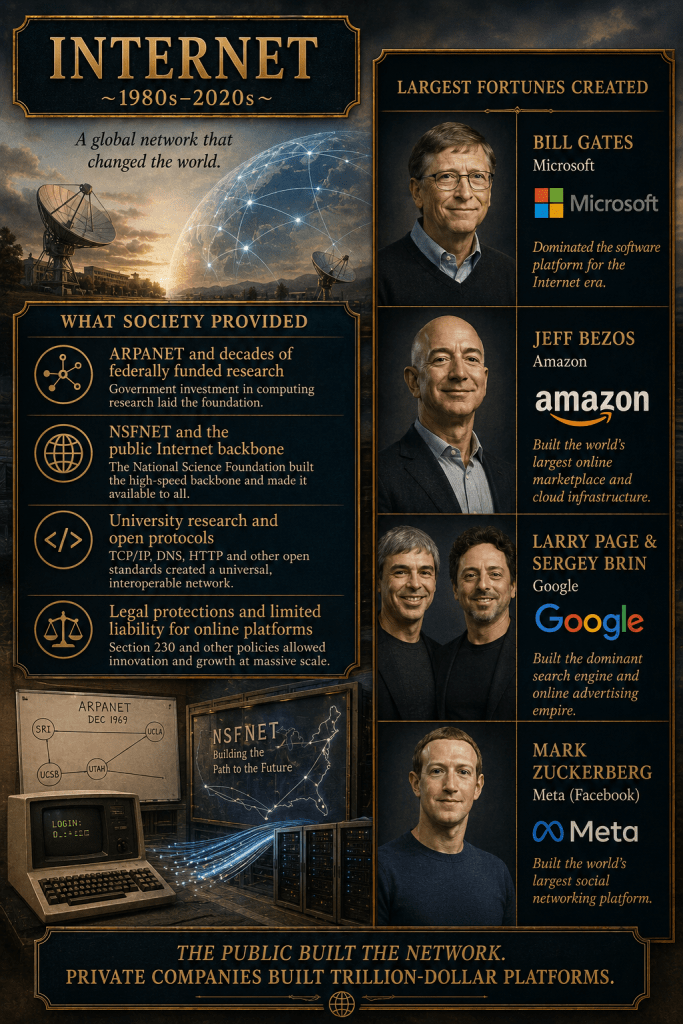
The internet emerged from decades of publicly funded military and university research. At least $124.5 million was invested directly in ARPANET and related networking programs—approximately $275 million in today’s dollars—while much larger public investments supported the research institutions that developed packet switching, TCP/IP, DNS, and many of the technologies that made the modern internet possible. When the internet was commercialized in 1995, the public retained no ownership stake, no equity, and no governance rights. The companies built upon that publicly financed foundation are now worth more than $10 trillion.
The Broadcast Spectrum (1996)
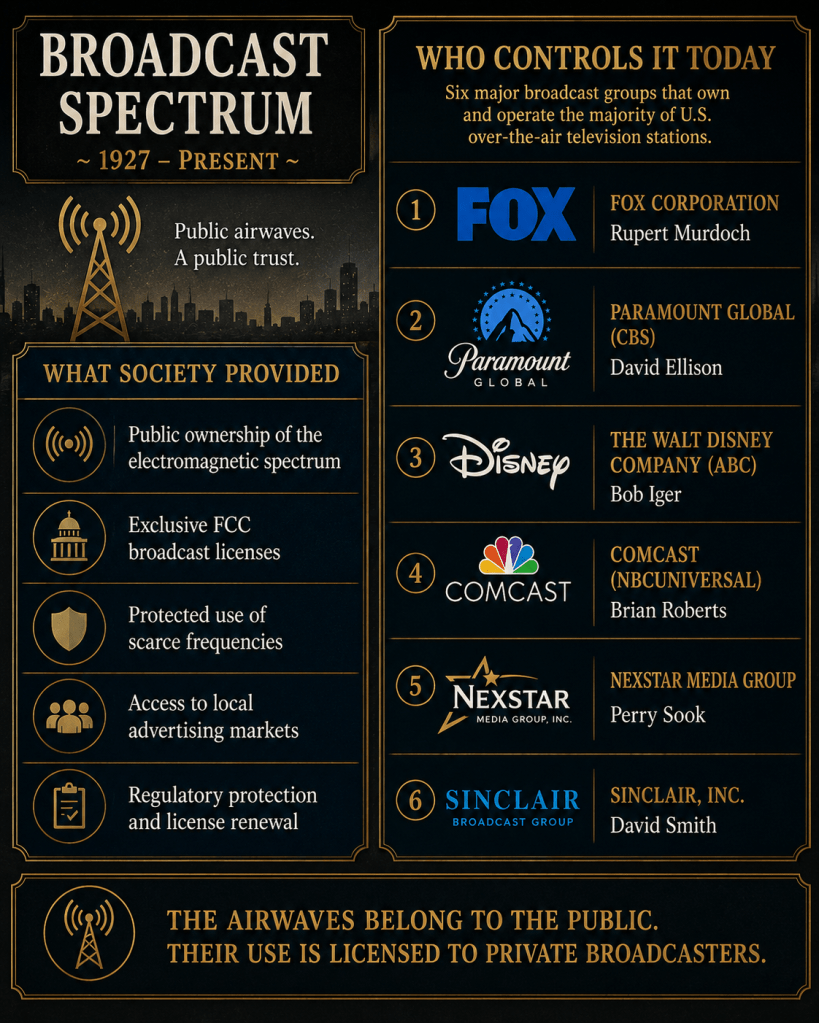
Congress transferred public broadcast spectrum to existing television companies without charge. At the time, the spectrum was valued at approximately $70 billion, or roughly $140 billion in today’s dollars. The public received no ownership interest, no revenue share, and no meaningful financial return. The promised consumer benefits largely failed to materialize. And even the “fairness doctrine” has been repealed.
When Extraction Becomes Empire
The pattern is not uniquely American. Following the collapse of the Soviet Union, Russia privatized many of its most valuable state enterprises through a voucher system. Between 1991 and 1997, a small group of insiders acquired controlling stakes in oil companies, gas pipelines, banks, and industrial assets at a fraction of their long-term value. The resulting wealth transfer is estimated at $300 billion to $500 billion in today’s dollars and created the oligarchic economy that continues to shape Russia today.
Colonial India reveals the same pattern under far more coercive conditions. Between 1765 and 1900, Britain extracted wealth through taxation, trade policy, forced exports, and colonial administration designed to move Indian wealth to Britain. Unlike the American examples, this system ultimately rested on military occupation and imperial power. During the great famines of the late nineteenth century, colonial authorities continued exporting food from India even as millions faced starvation. Historians estimate that 30 to 100 million people died in policy-induced famines. Colonial administrators understood the consequences of these policies yet largely maintained them. Historian Mike Davis described British imperial food policy as “the exact moral equivalent of bombs dropped from 18,000 feet.” Modern estimates place the total wealth extracted from India at approximately $64.8 trillion in today’s dollars—here, the relationship between concentrated power, economic extraction, and human suffering becomes impossible to ignore.
AI Is the Next Chapter
Artificial intelligence differs from these earlier episodes, but it also combines several of their mechanisms at once. Railroads required public land. Oil relied on long-term tax preferences. The internet grew from publicly funded research. Broadcast companies received valuable public assets. Russia privatized public wealth. Colonial India extracted wealth through imperial force. Today’s AI infrastructure depends on publicly regulated utilities, publicly financed electrical infrastructure, public water systems, tax incentives, public research, public permitting, and communities willing—or unwilling—to host facilities of unprecedented scale.
Yet ownership remains overwhelmingly private. The extraordinary financial returns remain overwhelmingly private. Many of the long-term costs are increasingly public. Unlike most previous examples, this transfer is occurring while the infrastructure is still being built. The public is financing the future. The question is whether it will share meaningfully in what that future creates—or once again discover, only after the fact, that the benefits and burdens were never intended to be shared equally.
A Recurring Pattern
Although the technologies, industries, and political contexts differ, the underlying pattern is remarkably consistent.
| Episode | Public Contribution | Private Benefit | Public Cost | Public Ownership Retained |
| Railroads | 180M acres of public land + federal loans (≈ $180–900B today) | Gilded Age railroad fortunes | Land speculation, monopolistic freight rates | None |
| Oil Depletion Allowance | Century of tax preferences (>$480B cumulative; ≈ $35B/yr today) | Oil industry profits | Reduced public revenue; continued subsidy | None |
| Internet | Public research and ARPANET (≈$275M direct + decades of R&D) | Companies now worth >$10 trillion | No public equity or governance | $0 |
| Broadcast Spectrum | Public spectrum transferred free (≈$140B today) | Private broadcast licenses | No public financial return | None |
| Russia (1991–1997) | State-owned enterprises ($300–500B transferred) | Oligarchic fortunes | Concentrated wealth; institutional collapse | None |
| Colonial India | Wealth extracted through colonial rule (≈$64.8T) | British imperial wealth | 30–100M famine deaths; long-term impoverishment | None |
| AI Infrastructure (Today) | Public utilities, infrastructure, tax incentives, research, permitting | Still being accumulated | Communities bear infrastructure, environmental, utility costs | ? |
Across nearly two centuries, the industries changed, the technologies changed, the mechanisms changed. The pattern changed very little.
Part 4 — The Return of Extraction
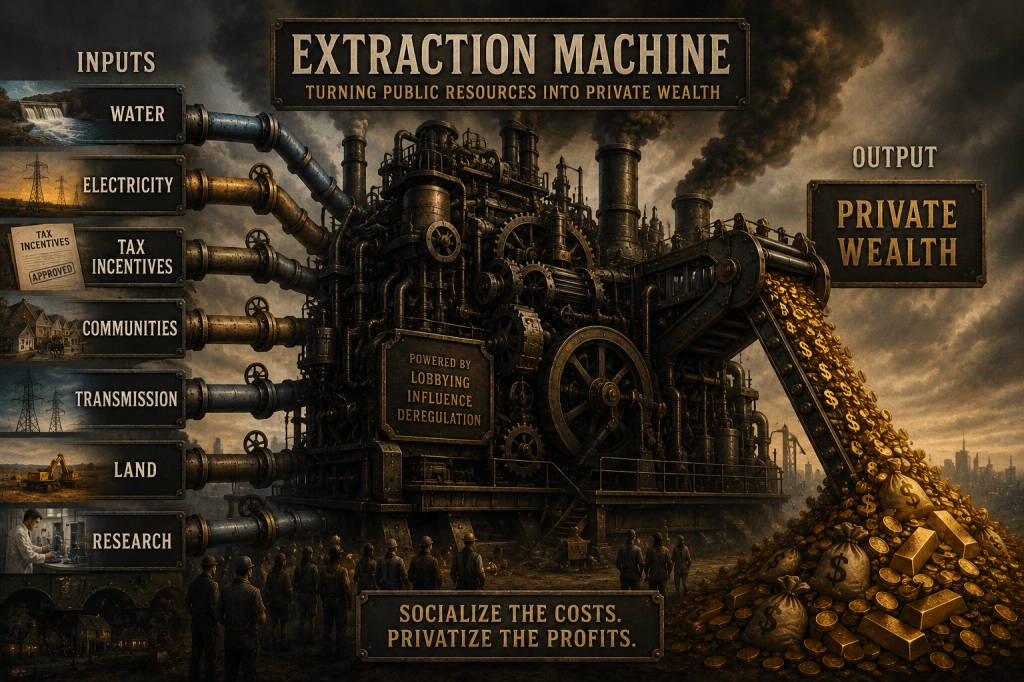
For much of the past several decades, many businesses had begun moving—however imperfectly—in a different direction. The conversation broadened beyond maximizing shareholder value to recognizing responsibilities to employees, customers, suppliers, communities, and the environment. In 2019, the Business Roundtable redefined the purpose of the corporation as creating value for all stakeholders, not shareholders alone. Companies such as Patagonia, Novo Nordisk, and Microsoft demonstrated that stewardship could become part of mainstream corporate strategy rather than remaining aspirational. No one would argue every company lived up to those ideals, but the direction was clear: toward stewardship.
The AI infrastructure buildout appears to be moving in the opposite direction.
Across the country, projects are negotiated under non-disclosure agreements. Shell companies conceal ownership until negotiations are well underway. Communities often learn of billion-dollar developments only after critical commitments have been made. Infrastructure costs are increasingly shifted onto utility customers and taxpayers. Environmental review is treated as an obstacle rather than a safeguard. The companies seeking to build, own, and profit from this expansion have also become some of the most influential participants in shaping the policies under which it proceeds—advocating for faster permitting, expanded access to energy and water resources, and fewer regulatory constraints.
Viewed individually, some of these practices can be defended. Viewed together, they reveal a familiar pattern: benefits and wealth become increasingly concentrated among a few, costs become broadly distributed across the public, power becomes centralized, responsibility becomes diluted.
There is a simple word for that pattern: extraction.
Extraction is not simply the removal of natural resources. It is an economic pattern in which those who receive the greatest benefits increasingly avoid bearing the full costs, risks, and responsibilities of creating them—transferring those obligations instead to ratepayers, taxpayers, communities, and future generations. Within the framework introduced earlier, extraction is the economic expression of empire: what happens when benefits become detached from responsibilities, power becomes detached from accountability, and wealth is accumulated by transferring predictable costs onto others.
The question is not whether artificial intelligence will create extraordinary wealth. It almost certainly will. The question is whether that wealth will be created through stewardship—or through extraction. Before we ask who ultimately pays those costs, we first need to understand the scale of what is being built.
Part 4B — The Scale of the Buildout
Throughout this article I’ve described the buildout as large. But words like large, massive, and unprecedented eventually lose their meaning. So let’s put numbers behind them.
Megawatts (MW) and gigawatts (GW) measure how much electricity is needed at one moment; a gigawatt is 1,000 megawatts. Terawatt-hours (TWh) measure how much electricity is used over an entire year. Think of it this way: MW and GW tell us how big the engine is; TWh tells us how much fuel it burns over a year.
Data centers also come in three sizes. Traditional data centers are what most of us picture—a large room or office floor of servers, typically serving a single company or institution. Large-scale data centers are bigger, providing cloud computing for millions of users; if you’ve used Google Docs, Microsoft 365, or Netflix, your data likely passed through one. Hyperscale data centers are something altogether different—industrial-scale campuses occupying hundreds of acres, requiring dedicated substations, transmission lines, and water infrastructure, consuming as much electricity as an entire metropolitan area. If you’re using an AI chatbot, your request is almost certainly processed inside one of these. It is hyperscale campuses—not traditional data centers—that are driving the growth discussed in the pages that follow.
Where We Are Today
The United States has more than 5,400 data centers, including an estimated 400 to 600 hyperscale facilities. Together they consume approximately 176 terawatt-hours of electricity each year—about 4.4 percent of all electricity generated nationally. That’s enough to power approximately 16 million American homes—roughly the combined residential demand of New York, Los Angeles, Chicago, and Dallas–Fort Worth.
Where We Could Be in Ten Years
The U.S. Department of Energy projects rapid growth in data center electricity demand through 2028. Extending that trend over a ten-year horizon—not as a precise prediction, but to illustrate the scale of what continued growth could require—American data centers could consume approximately 729 terawatt-hours each year by 2033, more than four times today’s demand.
Meeting that demand would require roughly 180 new hyperscale AI campuses, each comparable to the 500-megawatt facilities now being planned across the country—together consuming enough electricity to power approximately 66 million American homes, roughly the residential demand of the twenty largest U.S. metro areas combined. By then, AI data centers alone could consume roughly 17 to 18 percent of all electricity currently generated in the United States. This is not simply the construction of more data centers. It is the construction of an entirely new layer of national infrastructure.
The Scale in Dollars
Constructing approximately 180 new hyperscale AI campuses is estimated to require roughly $760 billion in construction costs alone. Including land, buildings, electrical systems, cooling infrastructure, networking equipment, and AI computing hardware, the projected investment approaches approximately $3.6 trillion over the coming decade. Whether the final figure lands somewhat higher or lower, one conclusion holds: this is measured in trillions, not billions.
| Major American Investment | Approximate Inflation-Adjusted Cost | Compared to AI Buildout |
| Apollo Program | ~$260 billion | AI buildout ≈ 14× larger |
| U.S. Interstate Highway System | ~$650 billion | AI buildout ≈ 5.5× larger |
| Tennessee Valley Authority | ~$55 billion | AI buildout ≈ 65× larger |
| Projected AI Infrastructure Buildout (10-year base case) | ~$3.6 trillion | Baseline |
The purpose of these comparisons is not to argue artificial intelligence is more important than the Interstate Highway System, TVA, or the Apollo Program—simply to recognize its scale. Unlike those historic investments, however, this infrastructure is expected to be owned primarily by private companies while relying extensively on public infrastructure, public utilities, and public resources.
That distinction matters, because understanding how much is being built naturally leads to a more important question. Not how much will it cost the companies building it—but who will ultimately pay the rest?
Part 4C — The Accounting
A society organized around stewardship keeps benefits and responsibilities together: if a business creates costs, those costs belong with the business that created them. Europe has led the movement in this direction, increasingly requiring businesses to bear more of the environmental, infrastructure, and social costs they create.
Much of the AI industry is moving the opposite way. Rather than accepting more responsibility for the costs created by unprecedented growth, many of the largest technology companies seek tax abatements, subsidized electrical infrastructure, publicly financed transmission upgrades, discounted electricity, water infrastructure, and regulatory exemptions—arrangements that transfer a growing share of their costs onto ratepayers, taxpayers, and local communities. The costs do not disappear. They simply disappear from the company’s books.
That difference can be measured. I built a financial model for a representative 500-megawatt hyperscale AI campus, comparable to many facilities now being planned. The model begins with the company’s reported Profit and Loss statement, then identifies the major costs created by the project that are instead borne by the public.
| Representative 500 MW Hyperscale AI Data Center | ||||
| Company P&L | USD ($M) | % of Revenue | % of Company Costs | Primary Payer |
| Revenue | $2,220 | 100.0% | Customers | |
| Electricity | ($420) | (18.9%) | 24.3% | Company |
| Water | ($18) | (0.8%) | 1.0% | Company |
| Hardware depreciation | ($610) | (27.5%) | 35.3% | Company |
| Staff, security & maintenance | ($105) | (4.7%) | 6.1% | Company |
| Network, overhead & financing | ($577) | (26.0%) | 33.4% | Company |
| Total Company Costs | ($1,730) | (77.9%) | 100.0% | Company |
| Reported Net Profit | $490 | 22.1% | Company / owners | |
| Reported Margin | $0 | 22.1% | Company / owners | |
| Predictable Operating Costs Paid Primarily by Others | USD ($M) | % of Revenue | % of Added Costs | Primary Payer |
| Tax incentives & abatements | $56 | 2.5% | 18.9% | Taxpayers / local governments |
| Local grid / interconnection | $33 | 1.5% | 11.1% | Utility customers / ratepayers |
| Regional transmission & generation | $75 | 3.4% | 25.2% | Utility customers / ratepayers |
| Water consumption + infrastructure | $16 | 0.7% | 5.3% | Water utility / community |
| Carbon & climate impacts | $85 | 3.8% | 28.7% | Society / future generations |
| Public health & local environmental mitigation | $20 | 0.9% | 6.7% | Community / public health systems |
| Local services & public infrastructure | $12 | 0.5% | 4.0% | Local taxpayers |
| Total Added Costs | $297 | 13.4% | 100.0% | Mixed |
| If These Costs Remained with the Project | USD ($M) | % of Revenue | ||
| Reported Net Profit | $490.0 | 22.1% | ||
| Less: Added Costs | ($297.2) | (13.4%) | ||
| Adjusted Net Profit | $192.8 | 8.7% | ||
| Adjusted Margin | $0.1 | 8.7% | ||
The representative facility generates approximately $2.2 billion in annual revenue while reporting approximately $1.73 billion in annual operating costs, producing roughly $490 million in annual profit—a margin of about 22 percent. If the $297 million in costs currently shifted elsewhere remained with the project that created them, annual profit would decline to approximately $193 million, reducing the operating margin from 22 percent to roughly 9 percent.
One facility is not the story. The buildout is. Applied across the projected national expansion, the public absorbs approximately $295 billion during the first ten years alone. Once the buildout is complete, those obligations continue at approximately $56 billion every year. If those facilities operate for another thirty years, the cumulative public cost approaches $1.7 trillion.
The companies retain the assets. The companies retain the profits. The companies retain the appreciation in value. An increasing share of the costs is transferred to everyone else. That is not stewardship. It is extraction—and at this scale, one of the largest transfers of cost from private balance sheets onto the American public in modern history.
Who Benefits?
If these costs are being transferred to the public, who is collecting the other side of the ledger? The answer is not abstract. A remarkable share of the AI infrastructure buildout is being driven by a handful of founder-controlled companies. Jeff Bezos, Mark Zuckerberg, Jensen Huang, Larry Ellison, and Elon Musk together control much of the infrastructure, computing hardware, and platforms powering the AI revolution. Every new hyperscale campus increases the value of the companies they control—and, with it, their personal fortunes.
History has seen this pattern before. Periods of extraordinary technological change often create extraordinary fortunes—and too often, systems in which the costs are quietly distributed across society while the rewards concentrate in the hands of a few.
The question is not whether these entrepreneurs are brilliant, or whether artificial intelligence will transform the world, or whether wealth should be created. The question is whether the public is paying a significant share of the cost of creating private fortunes without ever agreeing to the arrangement—or sharing in the returns.
That is not simply an accounting question. It is a stewardship question. If who benefits and who pays are not aligned, then the issue is larger than artificial intelligence. It is whether we are once again building an economy organized around extraction rather than stewardship.
Part 5 — What Would Shalom Require?
By now, everything we’ve discussed can begin to feel overwhelming. The wealthiest people in history are financing much of this buildout. Some of the largest corporations ever created are competing to build it even faster. Communities often learn about projects only after the most important decisions have already been made. Looking at all of this together, it is easy to conclude that the outcome has already been decided—that ordinary citizens have little voice and even less ability to influence what comes next.
I do not believe that is true.
Throughout this article I have argued that the issue is not the technology. The issue is the system surrounding the technology. The same artificial intelligence can be developed under very different assumptions about ownership, accountability, stewardship, and the common good. The same data center can either strengthen a community or extract from it. The difference is not what gets built. The difference is how it gets built.
We have seen the pattern repeated again and again: benefits become increasingly concentrated while costs become increasingly distributed; decisions become centralized while communities are informed only after commitments are made; responsibility becomes separated from reward. Within the framework developed earlier, that is the pattern of extraction.
Shalom points in a different direction. It begins with a simple principle: benefits, responsibilities, risks, and costs should remain aligned. Those who benefit from an activity should also bear the responsibilities it creates. Communities affected by major decisions should participate in making them. Public resources should strengthen the common good rather than become mechanisms for private enrichment. Land, water, energy, and infrastructure are not simply inputs to be consumed. They are gifts held in trust.
That one principle changes almost everything.
| Extractive Pattern (Empire) | Stewardship Pattern (Shalom) |
| Velocity — Decide first, seek consent later | Engagement — Engage stakeholders before commitments are made |
| Opacity — Obscure ownership, incentives, and accountability | Transparency — Make ownership, incentives, and accountability visible |
| Misrepresentation — Overstate benefits while minimizing costs and risks | Honesty — Present benefits, costs, and risks truthfully |
| Political Capture — Use influence and access to secure favorable outcomes | Trustworthiness — Public officials remain accountable to the communities they serve |
| Legal Overwhelm — Outpace communities through scale, speed, and legal resources | Participation — Ensure communities can meaningfully participate |
| Regulatory Avoidance — Treat safeguards as obstacles to be bypassed | Respect — Treat safeguards as protections for the common good |
| Cost Shifting — Transfer costs onto others | Responsibility — Bear the costs created by the project |
| Wealth Extraction — Concentrate benefits among owners | Fairness — Align benefits, responsibilities, risks, and rewards |
| Resource Exploitation — Treat land, water, and communities as inputs | Stewardship — Treat land, water, and communities as assets held in trust |
| Build Fast — “How quickly can we build?” | Build Wisely — “Should we build? How should we build?” |
Notice what is absent from this comparison: nothing here concerns the technology itself. The servers are the same. The software is the same. The processors are the same. The difference lies entirely in the relationships surrounding them—who participates, who decides, who benefits, who bears the costs, and who accepts responsibility for the consequences.
This is not a theoretical alternative. It is already being built. The European Union has chosen a stewardship path: through its Energy Efficiency Directive and the regulations that followed, large data center operators are legally required to measure and publicly report their energy consumption, water use, waste heat recovery, and other sustainability metrics—not voluntarily, but as part of the cost of doing business.
The same direction is beginning to emerge within American business. Microsoft has committed to becoming carbon negative and water positive while redesigning its next generation of AI data centers to dramatically reduce water consumption. Google has adopted increasingly rigorous standards for water stewardship, energy efficiency, and operational transparency across its global data center portfolio. These efforts are not yet the industry standard, but they demonstrate that stewardship and technological innovation are not competing ideas—they can, and increasingly do, exist together.
The choice before us, then, is not between artificial intelligence and no artificial intelligence. It is between two very different ways of building it: one asks how quickly wealth can be created and leaves others to absorb the consequences; the other asks how innovation can strengthen communities while accepting responsibility for the costs it creates. That choice is no longer theoretical. It is already being made. The question is whether we will recognize it—and insist that it become the norm rather than the exception.
Part 6 — A Groundswell Is Building
One of the most encouraging discoveries I made while researching this article was realizing that the movement toward stewardship is already underway. The principles described in the previous section are no longer simply theoretical—they are beginning to reshape how communities across America think about artificial intelligence and the infrastructure required to support it.
The movement is not being led by one political party, one organization, or one ideology. It is emerging from citizens, local governments, state legislatures, public utility commissions, nonprofit organizations, and courts. They disagree about many things, but they are increasingly asking the same questions that have guided this article from the beginning:
Who benefits? Who pays? Who decides? And who is accountable when those answers are not aligned?
Those questions are beginning to change outcomes. In Lancaster, Pennsylvania, local leaders secured one of the nation’s strongest community benefit agreements before approving a major data center, directing substantial investments toward economic development and climate initiatives so the community would share directly in the project’s benefits. Ohio now requires many hyperscale data centers to pay for most of the electrical capacity they reserve whether they use it or not, protecting residential customers from subsidizing speculative demand. Illinois is considering legislation requiring cumulative environmental impact assessments and legally binding community benefit agreements before major AI infrastructure projects receive approval.
Other communities have decided that asking better questions matters more than moving quickly. East Fishkill, New York adopted a moratorium while rewriting its zoning ordinances and studying the long-term implications of hyperscale data centers. Cleveland paused new approvals while reconsidering zoning and infrastructure capacity. Several Connecticut communities adopted similar moratoriums before major proposals had even been submitted—concluding it was better to establish the rules before developers arrived than afterward.
Some of the most revealing stories have unfolded here in Minnesota. In Hermantown, residents learned of a proposed hyperscale AI campus only after public records requests revealed that state agencies, county officials, city leaders, utilities, and the developer had been discussing the project for nearly a year—without the public knowing who the ultimate customer would be or what electricity and water it would require. Citizens organized quickly, challenged the environmental review process, and forced a broader public discussion; the project is now on hold.
Festus, Missouri, tells a different story. City officials approved agreements for a proposed $6 billion AI data center after being presented with projections of more than $32 million in annual tax revenue—while the company that would ultimately own or operate the facility had not been publicly identified. Many residents believed the process had moved too quickly and outside public view. Lawsuits followed. Then the voters acted: four city council members who supported the project lost their seats in the next election, and a recall effort was launched against the mayor. Whatever happens to the project, Festus demonstrated that accountability doesn’t end when the vote is taken—in a democracy, it may only be beginning.
The same questions are now reaching communities across Minnesota. As I was finishing this article, my son let me know that after listening to me warn about the fiasco unfolding in other places, he’s going to volunteer to serve on his county’s citizen workgroup on data center development—not to stop development, but to ensure citizens, elected officials, and technical experts ask the right questions before commitments are made rather than after.
Taken individually, each of these stories is local. Taken together, they describe something much larger. Communities are no longer willing to accept promises without evidence. They are asking for transparency before incentives are granted, participation before approvals are given, honest accounting before costs are shifted, and accountability before public resources are committed. They are not rejecting technology—they are insisting it be developed in ways that strengthen rather than weaken the places where it takes root. They are mounting campaigns for flourishing and shalom—and against extraction and empire.
That is what a groundswell looks like. It does not begin in Washington. It begins in city halls, county board meetings, state legislatures, courtrooms, and neighborhood organizations—in ordinary citizens who decide that stewardship is worth defending. That may be the most hopeful discovery of all. The movement has already begun.
Part 7 — What You Can Do
The resistance to the data center buildout is not being led by lawyers, lobbyists, or national organizations. It is being led by people who live near these facilities—people who showed up to meetings, read contracts their officials couldn’t share, organized their neighbors, and in hundreds of cases changed the outcome.
You can be one of them.
Find Your Local Group
The Coalition for Responsible Data Center Development tracks active opposition groups nationwide—as of its most recent report, 345 groups across 37 states, totaling more than 428,000 members. If a group exists near you, they need people. If one doesn’t, the coalition’s resources can help you start one. Start at datacenterresponsibility.com.
Know Before It’s Too Late
The single most important thing communities can do is engage before permits are signed. The pattern documented in Boxtown, in Louisiana, in Virginia—where communities discovered what was being built only after the fact—is not inevitable. Every community has the right to request public disclosure before approval.
Connect with the Broader Movement
MediaJustice, the NAACP’s Stop Dirty Data Centers campaign, and the Athena Coalition coordinate at the national level, with particular focus on communities bearing disproportionate environmental and economic burdens.
Ask Your Elected Officials Five Questions
Was this deal negotiated under a nondisclosure agreement? What are the full terms of any tax exemption or abatement? Who bears the cost of grid upgrades required by this facility? What water reporting requirements apply? Was there a community benefits agreement—and if not, why not?
These are not radical questions. They are questions any responsible official should be able to answer. If they cannot—or will not—that is itself important information.
For Those Working Within a Faith Community
The shalom framework is not a personal ethic alone. It is a communal one. Faith communities have historically been among the most effective advocates for community accountability—not because they oppose development, but because they understand that the purpose of economic life is human flourishing, not extraction. Your congregation, your denomination, your network may already have relationships with the communities most affected. Use them.
Part 8 — The Choice Before Us
When I began researching artificial intelligence, I thought I was writing about data centers.
I wasn’t. I was writing about stewardship. The data centers simply made the questions impossible to ignore.
Who benefits? Who pays? Who decides? Are those things aligned?
Those questions will not disappear when the current AI boom ends. Every generation eventually faces them, and decides whether the systems it builds will move toward greater stewardship or greater extraction.
The encouraging discovery was not the scale of the problem. It was discovering that the response has already begun. Communities are slowing projects until they understand them. Citizens are demanding transparency before approvals are granted. Utility commissions are protecting ratepayers. Legislatures are rewriting laws. Voters are holding elected officials accountable when they fail to represent the communities they serve. In places like Hermantown, Festus, East Fishkill, Wright County, Lancaster, and dozens of other communities, ordinary people are reminding all of us that stewardship is not an abstract idea—it is something practiced by citizens who decide that their communities are worth protecting.
That should encourage us. History is not inevitable. The systems we inherit are not the systems we must leave behind.
Every public meeting attended. Every difficult question asked. Every contract made public. Every election that places trustworthy stewards into positions of responsibility. Every community that insists benefits, responsibilities, risks, and costs remain together. These are not small things. This is how societies change.
Artificial intelligence may become one of the most important technologies humanity has ever developed. Whether it becomes one of our greatest acts of stewardship—or one of our greatest episodes of extraction—is still being decided.
Hopefully not in Silicon Valley.
Hopefully not in Washington.
Hopefully not by legislators, commissioners, and councilmen answering to donors instead of neighbors.
Rather by the same offices, answering instead to the neighbors who show up.
County board rooms.
City halls.
Public utility commissions.
Churches.
Neighborhood meetings.
And around kitchen tables where ordinary people decide that the future of their communities matters enough to become involved.
That choice still may belong to us.
Perhaps it always has.

