And the distinction between “freedom through autonomy” versus “freedom in Jesus”.
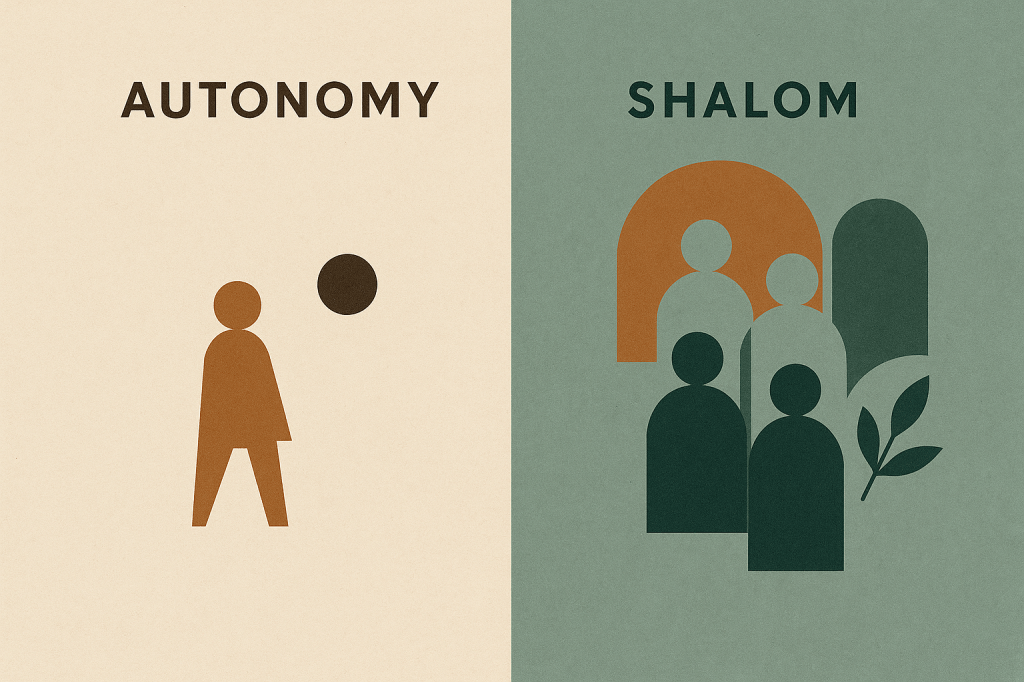
In a recent seminary discussion, a few classmates described what might be called a Libertarian Lifestyle Ideal: minimal reliance on the state, no taxes, limited technology, an off-grid vision of self-sufficiency. I was genuinely grateful for their sincerity and their desire for simplicity and integrity.
As I listened, two words from our studies rose to the surface for me: Shalom and Mishpat.
Shalom is God’s vision for the world ordered toward wholeness—relationships restored, creation flourishing, life woven together in peace. It calls us toward what nurtures life and away from what fractures it.
Mishpat is God’s perspective on justice—an active, relational righteousness that seeks the well-being of others, protects the vulnerable, and orders community toward fairness and compassion.
Taken together, Mishpat—God’s justice—always assumes relationship. It imagines people bound to one another in responsibility, mercy, and shared life. A community shaped by shalom doesn’t step away from its neighbors; it steps toward them. And that movement requires structures, contributions, and forms of collective care capable of nurturing human flourishing. In our modern world, this includes shared resources—and taxation is one of the ways we participate in that shared responsibility.
The same lens applies to technology. It’s rarely helpful to call tools simply “good” or “bad.” Scripture and history show that our tools—like our words, our cities, our hands—extend what we love or, if we are not attentive, what we fear or resent. They can heal or they can wound. The invitation is not withdrawal or suspicion but discernment: learning to use what we have in ways that reflect shalom and mishpat as embodied in the life of Jesus.
Later, in a separate conversation on imaginative prayer, I noticed a similar theme: a gentle pull away from extremes and toward the spacious center where Jesus meets us. Not in our certainty, not in escape, but in presence—in the willingness to remain open to God, to our neighbors, and to our own hearts.
Both moments pointed toward the same truth:
Shalom rarely grows in isolation or in the pursuit of perfect purity.
It grows in connection—patient, mutual, imperfect connection.
It grows as we stay engaged with the systems we inhabit, the neighbors we are given,
and the God who holds all things together.
Mishpat is not an exit door.
It is a calling—
a way of stepping into the world with responsibility and love,
so that all may flourish in the life God hopes for and offers.
 SeePhas