
A Brief Word Before You Read
This reflection occupies a difficult space.
It names real wrongdoing—and also how that wrongdoing can be stretched, repurposed, and narrated in ways that distort rather than clarify, often causing additional harm.
It is not written to excuse failure, defend institutions, or minimize misconduct.
It is written to protect proportion.
In moments of crisis, truth is most vulnerable not to outright lies, but to partial truths rearranged to provoke fear. When that happens, accountability hardens into accusation, reform gives way to suspicion, and judgment loses its footing.
This is less an argument than an invitation: to slow down, to hold complexity, and to resist panic.
That footing matters.
The Fraud of the Fraud
Fraud is real.
It matters.
It should be investigated and prosecuted.
But there is another problem that deserves attention—one that is rarely named:
the fraud of the fraud narrative itself.
This is not a denial of wrongdoing.
It is a concern about proportion, framing, and selective outrage.
Fraud Exists — and So Does Scale
Recent headlines have focused intense attention on public-sector fraud, particularly in programs designed to serve vulnerable communities. In Minnesota, the $250 million Feeding Our Future case has rightly drawn scrutiny and accountability. Tens—perhaps hundreds—of millions of dollars were misused.
To date, seventy-eight people have been charged. More than fifty have pled guilty. Seven have been convicted at trial, some receiving multi-year prison sentences. Courts have ordered more than $50 million in forfeitures and restitution across individual cases so far.
That is serious.
No one disputes that.
The investigation remains ongoing.
A Second Large Fraud — and a Different Outcome
In New York State, a court found that a $364 million fraud had occurred—very large by New York standards—involving a private business that systematically misrepresented its finances over many years. The business and its owners were found liable.
One senior executive served a short prison sentence in a related criminal case. No funds have yet been recovered, with enforcement delayed through prolonged post-trial litigation. Certain individuals were temporarily barred from serving as corporate officers, but the company continues to operate.
That, too, is serious.
No one disputes that.
The consequences, however, have been limited—neither catastrophic for the business nor materially threatening to its owners.
What Often Goes Missing: Proportion
Now widen the lens.
The U.S. retail industry generates roughly $7.4 trillion in annual revenue. Industry estimates place inventory shrink— theft, fraud, pilferage, and administrative loss—at about 1.6% annually.
That is well over $100 billion every year.
This loss is not hidden.
It is not shocking.
It is not treated as a civilizational crisis.
It is managed.
Priced in.
Insured against.
Rarely politicized.
When Fraud Becomes a Story
Public-sector fraud, by contrast, often becomes something else entirely: a story.
Not simply about misused funds, but about moral failure, cultural pathology, incompetence, corruption “over there.”
The numbers are often smaller.
The outrage is often larger.
This asymmetry should give us pause.
Not because fraud in public programs does not matter—it does—but because how we narrate fraud reveals what we are really policing.
Fraud during the Pandemic
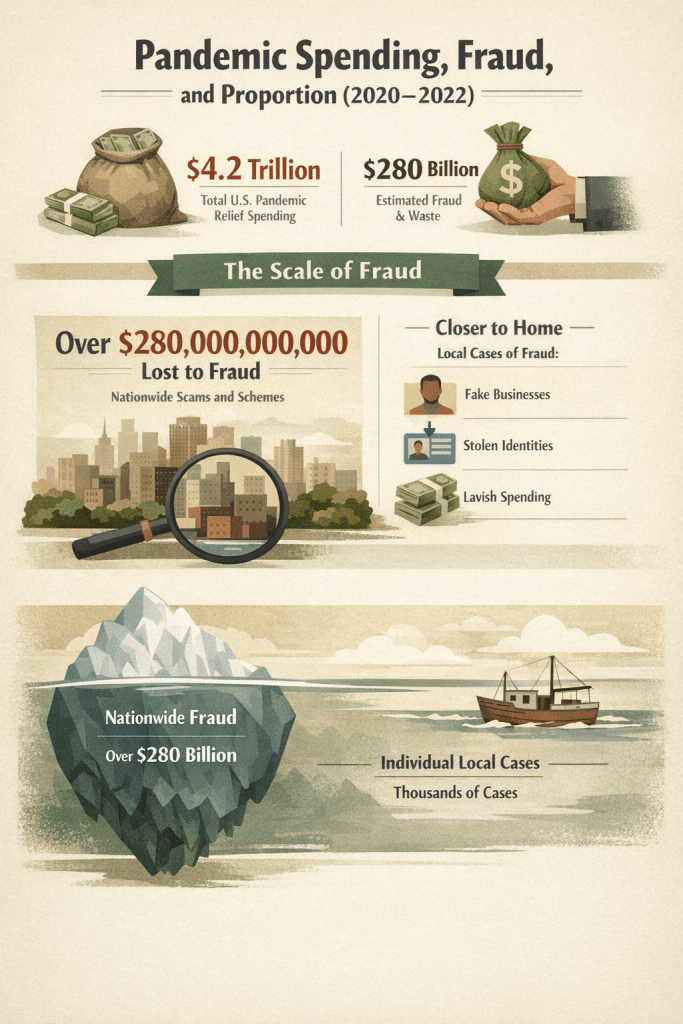
By total dollars, most pandemic-era fraud occurred not in localized programs, but in large national systems designed to move money quickly: unemployment insurance, PPP and EIDL loans, stimulus payments, and health-care spending.
Pandemic programs were intentionally designed to prioritize speed over verification. Congress and federal agencies explicitly accepted higher fraud risk as the cost of preventing economic collapse. Inspectors and administrators warned—accurately—that oversight would lag and losses would be substantial.
Both were right.
How the Tradeoffs Were Framed
Republican leaders emphasized rapid economic stabilization—keeping businesses alive, avoiding prolonged shutdowns, and reducing regulatory friction by routing aid through banks and states. Speed and scale were prioritized to prevent mass business collapse.
Democratic leaders emphasized speed to households and workers—expanded unemployment insurance, child nutrition, housing, and broad eligibility with reduced documentation—to prevent hunger, eviction, and widespread job loss.
The strongest warnings about fraud came not from politicians, but from auditors, inspectors general, and state administrators. These risks were publicly documented, acknowledged, and ultimately overridden.
The risk was known and accepted—not hidden.
One State That Sounded the Alarm
Officials at the Minnesota Department of Education identified irregularities and potential fraud indicators in USDA nutrition programs, including Feeding Our Future, as early as 2020 and began rejecting applications before the largest influx of federal funds. In early 2021, MDE attempted to freeze payments to dozens of affiliated nonprofits, but a court order required payments to resume.
This was not indifference.
It was constraint.
Proportion Is a Moral Discipline
Proportion is not relativism.
It is moral clarity.
If tens of billions vanish annually in private commerce with little public fury, while smaller losses in social programs trigger existential panic, the issue may not be fraud alone.
It may be selective attention.
Selective enforcement.
Selective outrage.
History offers uncomfortable parallels. Social programs have often been discredited not by data, but by narrative – remember the “welfare queens’ of the 1980’s – extreme cases elevated into symbols and repeated until they feel representative. Fraud becomes the hook. Distrust becomes the outcome. Policy follows fear.
Disinformation: When Narrative Becomes a Weapon
This is where disinformation enters.
Disinformation is not simply falsehood. It is the strategic use of selective truth, stripped of context and arranged to provoke fear, anger, or moral certainty. It relies less on lying than on sequencing, emphasis, and implication.
For this reason, disinformation is widely recognized—by military, intelligence, and security communities—as a tactic of conflict and war. Its purpose is not to inform, but to destabilize: to erode trust, polarize communities, and collapse complexity into suspicion.
When fraud becomes a narrative rather than a fact pattern, it becomes susceptible to this tactic. Real cases are stretched into symbols. Local failures are made to stand in for entire systems. Accountability gives way to accusation.
At that point, truth is no longer clarifying reality—it is being used to fracture it.
The Deeper Risk
The deepest risk is not wasted money.
It is that fraud narratives become tools—used to delegitimize institutions, stigmatize communities, and narrow our moral imagination about who deserves help and under what conditions.
When fraud becomes a story rather than a fact pattern, it stops informing judgment and starts replacing it.
Better Questions
The question is not:
Was there fraud?
The better questions are:
How much?
Compared to what?
And why does this instance command so much attention while others fade into the background?
The Ground Beneath Our Feet
Real fraud must be prosecuted.
Systemic failure must be reformed.
Truth must remain proportional.
When truth is weaponized, it becomes disinformation.
When fear becomes a political tool, everyone loses.
And when “fraud” itself is stretched beyond evidence—repurposed into narrative—we commit a different kind of fraud:
not against the treasury,
but against truth itself.

