
Untangling Hell and Rediscovering the God Who Is Love
INTRODUCTION
Preamble
In the early 2020s, I spent three years implementing a technology program and occasionally teaching at an inner-city Christian school. I arrived excited by the opportunity to contribute. By the time I left—under difficult circumstances—I was spiritually exhausted and deeply confused.
The school’s leadership was strongly influenced by Calvinist theology. I began noticing its effects in something as ordinary as prayer. Leaders would often begin by describing themselves as worthless and contemptible before God. I connected this language with the first point of the Calvinist TULIP framework: total depravity.
And I remember thinking, I’m not depraved!
Over time, the spiritual environment pulled me down. The underlying conflict eventually centered on how Christians should treat LGBTQ+ people. It culminated in a call to staff to identify anyone considered sympathetic to LGBTQ+ inclusion, then a requirement that staff personally affirm the Danvers Statement on sex and gender. My brother is gay, and I believe deeply in the dignity and social equality of LGBTQ+ people.. For me, that was enough. I challenged the school’s leadership to remove me from my position, and they did.
I left spiritually bereft and deeply anxious about my faith. I threw myself into frantic, largely unfocused research and study.
Then I entered a seminary, and came to understand what I had experienced as spiritual trauma. Through study, reflection, and the help of others, I began to recognize four fundamental conflicts beneath the trauma:
- Humanity as totally depraved versus humanity created in God’s image and declared very good.
- God controlling everything—including evil and suffering—versus God granting freedom and working with humanity against evil.
- Christians receiving Jesus’ love while condemning others, including LGBTQ+ people, versus Jesus’ call to love our neighbors and enemies.
- God consigning the unelected or unrepentant to eternal torment versus God desiring human flourishing and restoring creation.
I gradually worked through the first three conflicts and adopted and developed beliefs I could embrace.
The question of hell remained.
I read books, listened to teachers, and spoke with others. Still, I could not shake the possibility that hell might be part of God’s creation. Every new biblical interpretation sent me into another round of asking, Is this true? If it was, what did that say about God?
What kind of God would permit conscious suffering to continue forever?
This article brings together what I found through an integrated exploration of Scripture, history, theology, and lived experience. For me, this journey has brought healing. I hope it may help others recover a faith they can honestly believe and live.
You may have struggled with similar doubts.
You may have already rejected hell as incompatible with God. Hell may remain part of your beliefs even though you have never examined it closely. Or it may be foundational to your faith, and you may not be able to imagine Christianity without it.
I have written for family, friends, and inquirers who want to understand this journey; for Christians and former Christians whose faith has been wounded by fear; for those willing to reconsider what they have been taught; and for pastors, students, teachers, and others interested in the biblical, historical, and theological argument.
I am not asking you to decide before we begin.
Wherever you stand, I invite you to walk through the question with me. The purpose is not merely to settle a doctrine. It is to ask whether the God we find at the end is the God revealed in Jesus—and whether the Christian story is still good news.
The Question Before Us
For centuries, much of Western Christianity has treated hell—understood as Eternal Conscious Torment—as a non-negotiable measure of biblical orthodoxy. Many Christians have been taught to accept it, however troubling it may seem, because “the Bible clearly says so.”
This article asks a deeper question:
Does Eternal Conscious Torment faithfully reflect the character of God revealed in Jesus?
Article Guide
This long-form article is organized into eight sections and takes approximately one hour to read it all. The article can be read straight through or over several sittings. This is how the sections are laid out:
- Sections 1 through 5 establish the personal, interpretive, biblical, and theological foundations. Each section is about 5 minutes.
- Section 6—the longest—traces the historical development of hell. It will take a good 20 minutes to read.
- Section 7 tests Eternal Conscious Torment through the Shalom–Flourishing Framework. It takes 10 minutes to read.
- Section 8 returns to the larger Christian story and provides
real hope.
In 10 minutes.

Guidance for Reading
The complete article takes approximately one hour to read. Because several sections raise difficult historical, theological, and personal questions, it may be better read over several sittings.
Section 1: Why This Matters
— 5 minutes
The personal journey from fear and spiritual trauma to the central question about hell and the character of God.
Section 2: How Do We Know What We Think We Know?
— 4 minutes
Theological humility, circles of authority, the Wesleyan Quadrilateral, and the interpretation of Scripture.
Section 3: What Is Hell?
— 5 minutes
The biblical vocabulary translated as “hell,” competing understandings of final punishment, and the distinction between judgment, verdict, and sentence.
Section 4: Jesus—God With Us in a Jewish World
— 5 minutes
Creation, covenant, Torah, prophetic judgment, resurrection, and Israel’s hope that God would restore the world.
Section 5: What Did Jesus Actually Say?
— 5 minutes
Jesus’ teaching about judgment, Gehenna, Jerusalem’s approaching catastrophe, and the Kingdom of God.
Section 6: How Did Christians Come to Believe in Hell—and Why Do So Many Still Believe It?
— 20 minutes
The gradual development of the doctrine through the early church, Augustine, imperial Christianity, medieval institutions, the Reformation, and revivalist preaching.
Section 7: One Final Test—Hell and the Logic of Shalom
— 10 minutes
Two assessments of eternal conscious torment as a place to be and then as an organizing ideology for a society through the Shalom–Flourishing Framework lens.
Section 8: Recovering the Story
— 10 minutes
Life beyond the fear of hell, the meaning of restorative judgment, genuine accountability, and an invitation to participate in God’s healing of the world.
Selected Sources and Notes
Primary Christian writings, biblical resources, historical scholarship, and sources related to human flourishing.
And so we begin…
SECTION 1: Why This Matters
I’ve spent far too much of my life thinking about hell.
That probably sounds like a strange admission. Most Christians don’t spend much time thinking about hell unless they’re trying to avoid it, and most people outside the Church would rather not think about it at all. Yet, for reasons I never expected, it became one of the most significant theological questions I have ever wrestled with.
It wasn’t always that way.
When I first became a Christian, hell was not my focus. In fact, before becoming a Christian, it was one of the reasons I wanted nothing to do with Christianity. I had little interest in a religion that seemed preoccupied with telling people they were destined for eternal punishment in the afterlife. If that was the message, I wasn’t interested.
My attitude was simple: “Leave me alone. If I burn, I burn.”
I also wondered why I should be so concerned about the next life when I was still trying to figure out which way was up in this one. Did anyone really know what happened after death? Had anyone been there and returned to tell us? Why devote so much attention to something about which we seemed to know so little?
Perhaps that reasoning was not entirely wrong. Nevertheless, here I am.
But then something happened that changed my life.
In a moment of personal heartbreak, I sought solace, and a Catholic priest looked at me and told me, simply but emphatically, that God loved me.
I believed him.
That conviction shaped my faith for the next decade. It was reinforced through my involvement with Young Life, where the emphasis was always on the love of God revealed in Jesus. I came to believe that the good news really was good news—that God loved the world and was inviting people into his kingdom. For the first decade of my Christian life, that understanding was enough.
But a decade later, after moving, I found myself in churches where hell occupied a much more central place—and the love of Jesus much less. I accepted what I was taught because I assumed it was biblical. I assumed Jesus had clearly taught Eternal Conscious Torment (ECT) and that faithful Christians simply accepted it, however difficult it might be.
For a long time, I did exactly that. In fact, I often found myself asking others,
“You have an eternal destiny no matter what. Where do you want to spend it?”
Much later, I went to work at an inner-city Christian school from that same theological family, where many of those beliefs were no longer soft-pedaled.
Depravity wasn’t simply taught; it was confessed. Nearly every prayer began with reminders of how corrupt and unworthy we were. God was presented as controlling everything—good and evil, salvation and damnation. The line between “us” and “them” became increasingly defined, and people outside our theological boundaries were sometimes viewed less as neighbors and more as enemies standing under God’s judgment—people to be punished, even treated as expendable.
Hell was not merely a theological possibility; it was understood to be the eternal destiny of anyone God had not chosen to elect—which meant, in the end, it was never really my choice at all.
During those years, something inside me began to unravel. What I would later recognize as spiritual trauma slowly gave way to a painful process of questioning beliefs I had once assumed were beyond question.
Then, during that struggle, someone from that theological tradition said to me, in a well-meaning way, that
Jesus talked more about hell than almost anything else.
Tilt.
I didn’t know how to answer. More importantly, I didn’t know whether it was true.
What had happened to the God who loved me—and whom I believed loved everyone else, unconditionally and infinitely?
Over the past several years, I have learned to interpret Scripture more carefully—attending to historical context, literary form, language, the ways biblical passages reference and interpret one another, and the Jewish interpretive framework known as PaRDeS. I have also learned how easily the Bible can be weaponized through proof-texting: isolating passages from their contexts to make Scripture support conclusions we already want it to support.
This changed how I approached the question of hell. Reading Jesus within the Jewish world in which he lived transformed the questions I was asking. I wasn’t looking for a different doctrine of hell or trying to overturn centuries of Christian belief. I simply wanted to know whether the doctrine I had inherited actually arose from the life and teaching of Jesus.the doctrine I had inherited actually arose from the life and teaching of Jesus.
As I continued that study, I realized I had been asking the wrong question.
The question was not simply whether hell exists or even whether Jesus spoke about it. The deeper question was:
Does the doctrine of Eternal Conscious Torment faithfully reflect the character of God revealed in Jesus?
Christianity makes an extraordinary claim: if we want to know what God is like, we look to Jesus. He is “the image of the invisible God” (Colossians 1:15), and he tells one of his disciples, Philip,
“Whoever has seen me has seen the Father” (John 14:9).
If that is true, then every Christian doctrine—including the doctrine of hell—must ultimately be examined in the light of Jesus’ life, teaching, and character. That conviction became the starting point for everything that follows.
Before examining the doctrine of hell, however, we must first ask how theological beliefs come to be regarded as authoritative.
How do we know what we think we know?
Article Guide
SECTION 2: How Do We Know What We Think We Know?
As I grew in my faith, I heard people say a lot of things about Christianity, God, Jesus, the Bible, and nearly every other subject—including hell.
Some of those claims were wildly wrong. I heard that the earth was flat, that the Rapture would occur on May 21, 2011, that dark skin resulted from God’s curse on Ham’s descendants, and that if people would only “sow their seed” into a particular ministry, God would multiply it back to them a hundredfold.
What troubled me was the confidence with which these claims were presented as Christian truth. Bible verses were quoted, sermons were preached, and conclusions were announced as though no faithful Christian could question them. Yet confidence did not make them true, and quoting Scripture did not guarantee that Scripture had been understood faithfully.
Eventually, I had to ask how I had come to believe what I believed. When I applied that question to hell, I realized that I had not reached my conclusions through an independent study of Scripture, history, language, and theology. I had inherited them. People I trusted taught me what hell was, who went there, and how long it lasted. Their interpretation became my belief and, over time, felt nearly indistinguishable from the Bible itself.
But hell is not self-evident or universally understood. Christians committed to Jesus and Scripture reach different conclusions about it. Nor can hell be examined through ordinary observation. Visions and near-death experiences may be meaningful to those who experience them, but they cannot independently establish a doctrine for everyone else. What we believe about hell therefore depends upon what we accept as revelation and how we interpret it.
That does not mean every conclusion is equally convincing. It means that our confidence should not exceed the evidence. Before deciding what to believe about hell, I needed to ask what supported the doctrine, how closely it stood to the center of Christian faith, and whether it came from Jesus, Scripture, later Christian interpretation, or the culture and imagination surrounding me.
Helpful Frameworks to Understand
The following recently learned framework has helped me organize those questions. It places Jesus at the center of Christian faith, followed by Scripture, dogmas, doctrines, and opinions. The boundaries are not always clear, and Christian traditions define these categories differently. Still, the framework reminds me that as interpretation increases, so should humility.
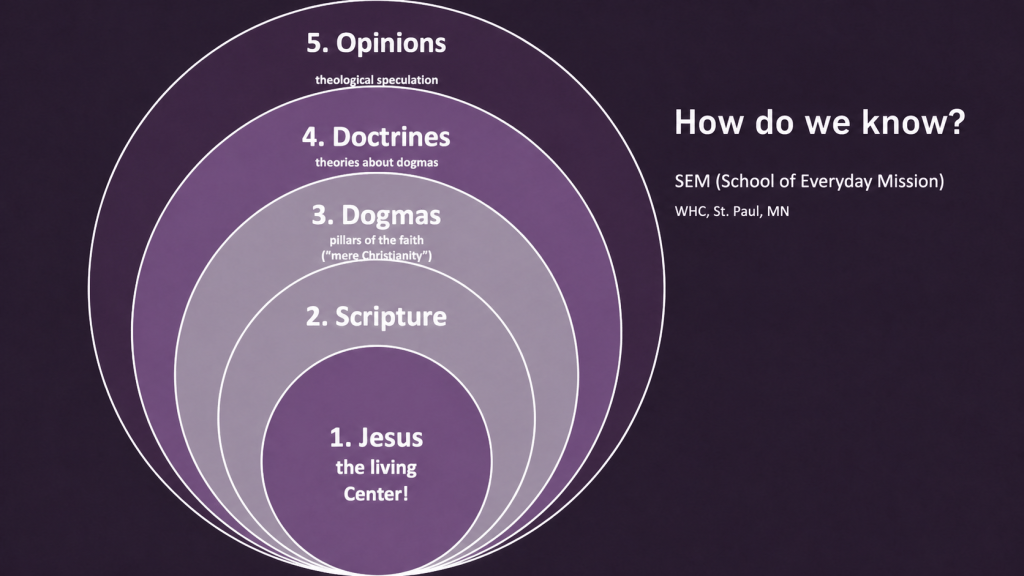
Christian traditions also understand theological authority differently.
Roman Catholicism looks to Scripture and Sacred Tradition as one deposit of faith interpreted by the Magisterium.
Eastern Orthodoxy understands Scripture within the larger life of Holy Tradition.
The Protestant Reformation insisted that Scripture alone is the final, infallible authority, while other authorities remain subordinate to it.
Methodism developed within the Anglican and Protestant world shaped by John Wesley. This is what is now called the Wesleyan Quadrilateral: Scripture remains primary while tradition, reason, and experience help us interpret it.
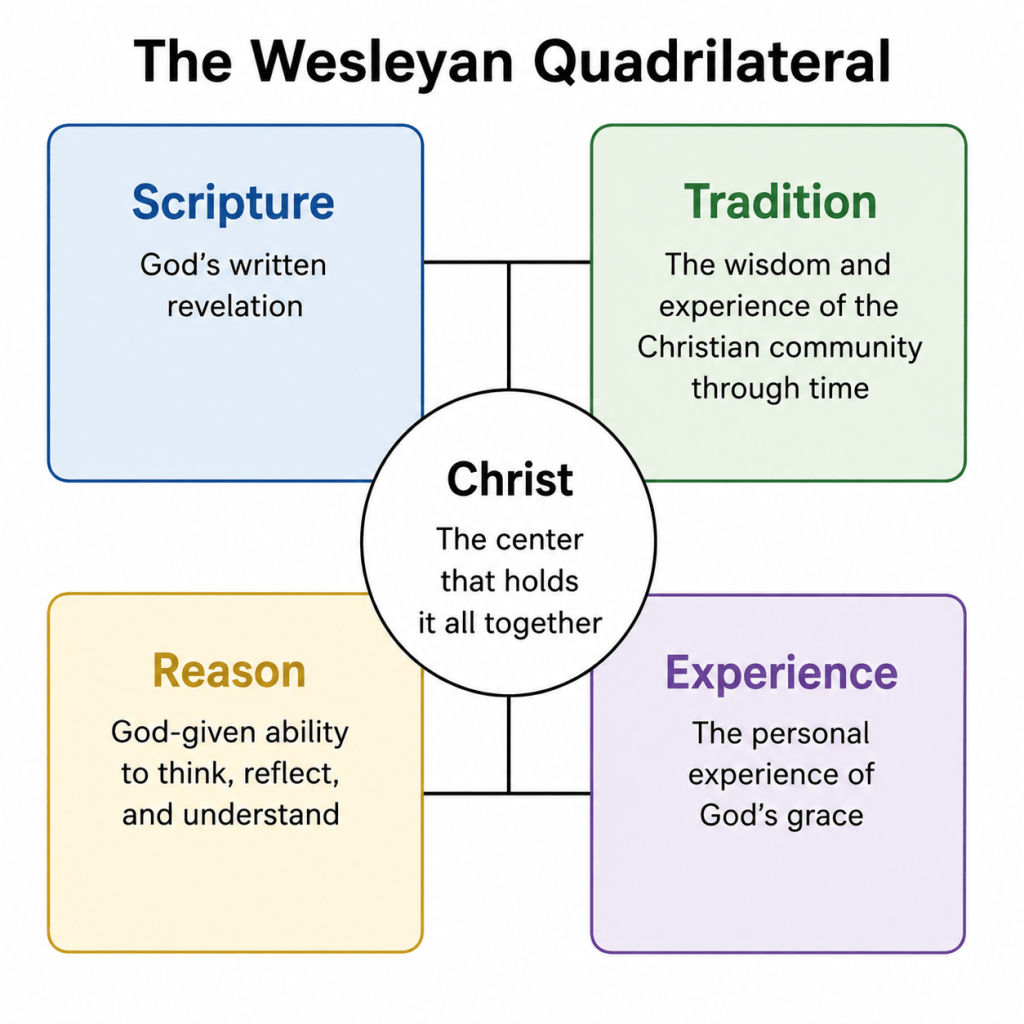
I kind of like this one. It seems the most honest description of how most of us assess our beliefs, whether we admit it or not. I place Jesus at the center because every Christian belief must ultimately be measured against the God revealed in him.
Interpreting Scripture
Whatever our tradition, Scripture is central to how Christians come to know God. The difficult question is usually not whether Scripture is authoritative, but how it should be understood.
Over the past several years, I have come to realize that reading the Bible is not as straightforward as I once assumed. It cannot simply be read as a modern news article, history book, or instruction manual.
Scripture was written over many centuries in Hebrew, Aramaic, and Greek for particular communities living in particular times and places. Its authors used poetry, parable, prophecy, wisdom, apocalypse, narrative, law, letters, and other literary forms while assuming scriptural and cultural knowledge that modern readers can easily miss. Jesus and the apostles entered a conversation that had already been unfolding for centuries. Reading Scripture always involves interpretation.
Scripture is also remarkably interconnected. Its authors echo, quote, interpret, and build upon earlier writings. Jesus’ teaching is saturated with the Torah, the Prophets, and the Psalms, while the apostles interpret Jesus through Israel’s story. The New Testament repeatedly assumes that readers will recognize those connections. A passage rarely stands alone; its meaning is shaped by the larger story in which it appears.
This changed the way I approached scripture and in this case the idea of hell. I could no longer begin with a disconnected verse, or few English words and assume that their meaning was obvious. I needed to ask what kind of writing I was reading, what its words meant in their original setting, what earlier Scriptures it echoed, and how Jesus’ first hearers might have understood it.
No one—including me—approaches Scripture without assumptions, traditions, experiences, and questions. Throughout this article, I have tried to recognize those influences, listen across both Jewish and Christian traditions, and let Jesus remain the lens through which I understand Scripture and the character of God.
With these interpretive guardrails in place, I could turn to the next question: What do we actually mean when we use the word hell?
Article Guide
SECTION 3: What Is Hell?
Or, What the Hell Is Hell?
If Christians have been discussing hell for nearly two thousand years, we should at least agree on what the word means. I assumed we did. As it turns out, we do not.
For most of my Christian life, I assumed there was only one doctrine of hell: God finds a person guilty, and they suffer forever. I simply called it “hell,” though theologians call it Eternal Conscious Torment (ECT).
I assumed the system worked like this:
Definition: An irreversible state where unrepentant sinners endure unending conscious separation and suffering under divine judgment.
Systemic Logic: Because God is infinitely holy, any rebellion against Him is an infinite offense—demanding an infinite, conscious sentence.
A key distinction began to matter to me: judgment is not the same thing as punishment. What we commonly call divine judgment involves three distinct movements:
1. JUDGMENT
Truth is brought to light and is fully exposed.
2. VERDICT
A determination is made about what that truth reveals.
3. SENTENCE
The punishment following from the verdict.
These belong to the same process, but they are not interchangeable. A biblical passage that announces judgment does not, by itself, tell us what sentence follows—much less establish Eternal Conscious Torment as the sentence imposed upon “the wicked.”
The Disputed Vocabulary of “Hell”
Much of our modern confusion stems from English translations that historically collapsed several distinct Hebrew and Greek terms into a single catch-all English word: Hell. When we examine the biblical languages, a far more nuanced map emerges:
Biblical Term Language
Basic Sense and Biblical Context
Sheol
Hebrew
The grave or shadowy realm of the dead; the common destination of all humanity, not exclusively the wicked.
Gehenna / Gehinnam
Hebrew / Aramaic
The Valley of Hinnom outside Jerusalem; historically associated with child sacrifice, covenant curse, national destruction, and prophetic judgment.
Hades
Greek
The unseen realm of the dead, broadly corresponding to Sheol; an intermediate holding place, not the final lake of fire.
Tartarus (tartaroō)
Greek
A subterranean place of confinement for rebellious spiritual beings; used only once in the New Testament (2 Peter 2:4).
Aiōnios
Greek
Pertaining to an aiōn (an “age”) or enduring through an age; frequently translated “eternal,” though its qualitative vs. quantitative force is determined by context.
Kolasis
Greek
Punishment, pruning, or chastisement; historically carried connotations of corrective discipline rather than pure retributive vengeance.
Defining the Sentence: The Early Architects
How did these varied biblical terms get synthesized into the single, absolute definition of Eternal Conscious Torment?
It did not happen overnight, nor was it imported intact from pagan mythology. It developed as early church thinkers tried to define the exact mechanics of the sentence. Two North African Latin thinkers were foundational in establishing the definitions the Western church would inherit:
Tertullian of Carthage (c. 155-220 CE): The Definition of Unending Penalty. Writing in a Latin intellectual world shaped by legal categories, Tertullian provided one of the earliest explicit definitions of hell as an everlasting, conscious physical penalty. He insisted that the soul’s inherent immortality required a sentence that never ceases, defining hell’s fire as a unique divine fire that simultaneously burns and preserves.
Augustine of Hippo (354-430 CE): The Definition of Absolute Retribution. Two centuries later, Augustine codified this definition within a comprehensive theological architecture of original sin, absolute human guilt, and sovereign predestination. For Augustine, the definition of final punishment was strictly retributive: it was not designed to heal, reform, or correct the sinner. Final death did not mean cessation of existence, but an eternal state of conscious ruin.
What Major Traditions Mean by Final Punishment
Because Christian traditions have prioritized different strands of Scripture, history, and philosophy, they arrived at fundamentally different definitions of what follows an adverse verdict:
| Tradition / Perspective | Nature of Hell or Final Punishment | Key Characteristics & Mechanics |
| Roman Catholic | Eternal state of definitive self-exclusion | Characterized by the loss of communion with God; official catechisms affirm both punishment and eternal fire. |
| Reformed / Calvinist | Everlasting conscious punishment | Grounded in divine justice and holy wrath; historic confessions explicitly describe eternal torment of body and soul. |
| Lutheran / Evangelical / Baptist | Everlasting conscious punishment | Variously emphasized as divine retribution, active inflicted suffering, or permanent exclusion from God’s favor. |
| Wesleyan / Methodist | Eternal adverse destiny | Affirms a sober warning of final loss, while official sources are traditionally less prescriptive about mechanical details than high-Reformed confessions. |
| Influential Eastern Orthodox view | Anguish within God’s unveiled presence | Hell is not divine absence or active judicial torture, but the painful subjective experience of God’s uncreated love by one who rejects it. |
| Anglican / Anabaptist | Broad internal diversity | Encompasses a range of views across traditions, including classical ECT, conditional immortality, and forms of hopeful or restorative judgment. |
| Conditional Immortality (Annihilationism) | Literal “second death” and cessation | Immortality is a conditional gift of grace; adverse judgment culminates in permanent destruction and the end of conscious existence. |
| Universal Reconciliation (Apokatastasis) | Severe but remedial judgment | Divine judgment functions as restorative discipline (kolasis) directed toward ultimate repentance, healing, and cosmic renewal. |
| Common rabbinic view | Temporary purification (Gehinnom) | No direct equivalent to Christian eternal conscious torment; judgment is typically understood as finite cleansing before entering the World to Come (Olam Ha-Ba). |
A Doctrine That Developed
This comparison makes one reality undeniable: Eternal Conscious Torment is not synonymous with divine judgment. It is merely one particular definition of the sentence—a definition formulated by early Latin thinkers, cemented by Western theologians, and eventually treated as the only possible orthodox view.
Understanding how this definition was constructed frees us to examine its history, and ultimately to ask: Does this definition of hell faithfully reflect the character of God revealed in Jesus?
Article Guide
SECTION 4: Jesus—God With Us in a Jewish World
The Human World in Which God the Son Lived and Spoke
Before asking what Jesus taught about judgment or hell, we must hold two truths together.
Jesus was fully human. He was born into a Jewish family, grew within a Jewish community, learned Israel’s Scriptures, prayed Israel’s prayers, and spoke through the language, symbols, and hopes of his people. Luke tells us that he “grew in wisdom and stature, and in favor with God and man” (Luke 2:52).
But Jesus was not merely the product of that world.
Christians confess that Jesus is God the Son—the eternal Word who “was God” and “became flesh” (John 1:1, 14). He was sent by the Father, is one with the Father, and declared, “Anyone who has seen me has seen the Father” (John 14:9).
His humanity means that his life and teaching were genuinely situated within first-century Judaism. His divinity means that he did not merely tell us about God. He revealed God.
The Jewish world gives Jesus’ words their language and historical meaning; his identity as the Son gives those words their ultimate authority. Gehenna, for example, already carried meaning for his first listeners, although many modern English Bibles translate it as “hell.” To understand what Jesus revealed through such words, we must attend both to the world in which he spoke and to the divine authority with which he spoke.
Jesus the Jewish Teacher—as the Son of God
Jesus did not appear as the founder of a new religion.
But he did take a direct, intentional path into the work of God—a journey rooted in his calling and shaped by the story of his people from the very beginning.
He was born into the covenant people of Israel. He was circumcised according to the Law of Moses, presented at the Temple, and raised in Nazareth. Like every observant Jewish child, he grew up hearing the Torah and the Prophets read in the synagogue. He learned the stories of Abraham, Moses, David, Isaiah, Jeremiah, and the other prophets. He celebrated Passover, Pentecost, and the other great festivals that reminded Israel of God’s faithfulness throughout its history.
Raised in Nazareth, Jesus was formed in Galilee—a predominantly Jewish region whose villages were shaped by Torah, synagogue life, pilgrimage festivals, and Israel’s covenant story. The precise form of Jesus’ education cannot be reconstructed. What the Gospels reveal unmistakably, however, is someone profoundly formed by Israel’s scriptures and capable of reading, interpreting, debating, and imaginatively reworking them before his hearers.
When Jesus began his public ministry at about thirty years of age, people addressed him as Rabbi—teacher. The formal rabbinic academies and ordination structures of later Judaism had not yet developed, but recognized teachers interpreted scripture, debated other teachers, and gathered disciples around them.
That is precisely how the Gospels portray Jesus.
He taught in synagogues. He interpreted the scriptures. He debated Pharisees and scribes. He spoke with a personal authority that astonished his hearers, gathered disciples, invited them to follow him, and eventually sent them out to continue his work. Whatever formal or informal preparation preceded his ministry, the Gospels portray Jesus unmistakably as a Jewish teacher whose life and message emerged from Israel’s story.
Yet the Gospels present an authority that cannot be explained merely by education, tradition, or recognition as a teacher. Jesus did not simply cite earlier authorities or offer another interpretation for consideration. He declared, “You have heard that it was said … but I say to you.” He forgave sins, declared himself Lord of the Sabbath, commanded sickness, death, and unclean spirits, and spoke as the Son sent by and one with the Father.
Jesus challenged many interpretations offered by other teachers, but he never rejected Israel’s Scriptures. Instead, he consistently claimed that God’s promises were reaching their fulfillment in him.
The Story Jesus Grew Up With
The story Jesus inherited began with creation.
God created humanity in his image to live in fellowship with him and to care for his creation. Human beings were made for life, relationship, and flourishing.
When sin entered the world, death, alienation, and violence followed. Yet the biblical story did not become one of abandonment. Instead, it became the story of God’s determination to redeem what had been broken.
He called Abraham.
He formed Israel into a covenant people.
He delivered them from slavery.
He gave them the Torah as a way of life.
Again and again, Israel experienced both God’s blessing and the painful consequences of abandoning the covenant through idolatry, injustice, and violence. The prophets repeatedly warned that rejecting God’s ways would lead to judgment. Yet those same prophets also proclaimed God’s faithfulness, promising forgiveness, renewal, and restoration beyond judgment.
This was the story every Jewish child knew. It was the story Jesus knew.
Why Jesus’ Words Already Had Meaning
When Jesus later spoke about judgment, Gehenna, the kingdom of God, resurrection, or the age to come, he was not introducing unfamiliar ideas. His hearers had grown up with these words just as he had.
Take Gehenna, for example. Long before Jesus was born, the Valley of Hinnom had become a powerful symbol in Israel’s history. Through the prophet Jeremiah, it represented the devastating consequences of Judah’s idolatry and covenant unfaithfulness. The valley became forever associated with Jerusalem’s destruction and exile—a sobering reminder that turning from God ultimately leads to ruin.
By the first century, Gehenna had also become an image some Jewish teachers used when speaking about God’s final judgment. Whatever nuances existed among different Jewish groups, Jesus’ audience did not hear the word as a blank slate. It already carried centuries of scriptural memory.
The same was true of other expressions Jesus used: Judgment. The Day of the Lord. Resurrection. The Kingdom of God. The Age to Come. These were not new concepts; they were part of the shared language and imagination of first-century Judaism.
The Hope Jesus Shared
The story Jesus inherited did not end with judgment or punishment. It ended with hope.
Israel looked forward to the day when God would finally fulfill his promises—Olam HaBa—when evil would be defeated, the dead would be raised, his people would be restored, and his kingdom would be established over all creation.
Different Jewish groups disagreed about how these promises would unfold, but they shared the conviction that God would ultimately set the world right.
That was the hope Jesus announced when he proclaimed, “The kingdom of God has come near.”
Before we examine what Jesus actually said about judgment and humanity’s final destiny, we should remember that he spoke as a Jewish rabbi to people who shared this story. His words were spoken into centuries of Scripture, memory, covenant, and hope.
Only by hearing Jesus within the Jewish world can we begin to hear him as his first disciples did. But Jesus cannot be reduced to that world. Those disciples eventually confessed that the Jewish teacher they had followed was Israel’s Messiah, the Son of the living God, and the Word made flesh.
Jesus did not merely repeat Israel’s hope. He claimed that Israel’s God was bringing it to fulfillment in him.
Article Guide
SECTION 5: What Did Jesus Actually Say?
Judgment, Gehenna, the Kingdom—and the One Who Spoke
Earlier, I mentioned that someone confidently told me Jesus talked more about hell than almost anything else. I couldn’t dismiss the claim—but I couldn’t defend it either. I simply didn’t know whether it was true.
That realization sent me back to the Gospels with a much simpler question: Did Jesus ever actually use the word “hell”?
The answer is no.
We cannot separate Jesus’ words from the languages and world in which he spoke. Jesus did not use a single term corresponding to the fully developed Christian doctrine later called hell. He spoke instead through a range of Jewish images—Gehenna, destruction, exclusion, fire, darkness, judgment, and the age to come. Those images were serious, but they did not by themselves constitute a systematic teaching of Eternal Conscious Torment.
If Jesus Didn’t Say “Hell,” What Did He Say, and for What Purpose?
Many of Jesus’ warnings functioned as urgent cause-and-effect declarations: “If you stay on this path, you are headed toward disaster.”
When Jesus referenced Gehenna, his first-century audience heard an image already freighted with Israel’s prophetic history—idolatry, covenant unfaithfulness, national crisis, destruction, and divine judgment. The word did not arrive as a blank label for a fully developed afterlife system.
Scholars differ over whether particular Gehenna sayings point primarily to Jerusalem’s approaching catastrophe, to final judgment, or to an overlap of the two. What those sayings do not provide is a systematic account of human beings consciously tormented without end.
Even in Matthew 25, where many English translations speak of “eternal punishment,” the language requires care. Aiōnios is related to aiōn (“age”), and its precise force must be determined by context; kolasis carries a lexical history rooted in pruning, restraint, or corrective discipline. Neither word, by itself, establishes a doctrine of endless retributive torment.
Jesus’ warnings were real, and they were urgent. But they were given within the larger context of God’s invitation to repentance and the coming of his kingdom.
The Center of His Proclamation
When you read the Gospels with fresh eyes, one pattern becomes impossible to ignore: Jesus certainly issued warnings, but when you weigh his words on a scale, the contrast is staggering.
Gehenna appears eleven times on Jesus’ lips in the Synoptic Gospels. By contrast, in the Synoptic Gospels alone, Jesus speaks of the Kingdom of God or Kingdom of Heaven more than one hundred times[1]. He offers more than thirty distinct parables specifically designed to illustrate what this Kingdom is like—comparing it to a mustard seed, a hidden treasure, a feast, and a father running out to welcome a lost son home.
Jesus did not spend his ministry warning people away from an afterlife torture chamber. He spent his life inviting people into a present reality.
His message was not “Agree to these doctrines so you don’t go to hell.” His message was “The reign of God’s justice, healing, and peace is breaking into the world right now—turn around, step in, and live this way today.”
Everywhere he went, he embodied this invitation:
He sat at dinner tables with tax collectors and outcasts before they changed their behavior.
He touched the untouchable and declared forgiveness freely.
He warned that the greatest tragedy wasn’t being sentenced to an executioner, but standing outside arms-crossed while the feast was already going on inside.
Gehenna and the Catastrophe of 70 CE
To understand the prophetic world within which Jesus used Gehenna, we should consider a moment that reveals both his warning and his heart. Luke does not use the word Gehenna in this passage, but he records Jesus approaching Jerusalem for the final time, looking upon the city, and weeping:
“If you, even you, had only known on this day what would bring you peace—but now it is hidden from your eyes. The days will come upon you when your enemies will build an embankment against you and encircle you and hem you in on every side . . . because you did not recognize the time of God’s coming to you.” (Luke 19:41–44)
These are not the detached pronouncements of someone describing an abstract sentence. They are the tears of a Jewish prophet lamenting the catastrophe approaching his people.
Jesus was warning real people living in a real city about a real crisis on the horizon. Jerusalem was caught between Roman domination, corrupt leadership, social unrest, and growing currents of violent resistance. Jesus warned that rejecting the way of peace would end in national ruin.
Within a generation, that warning became history. In 70 CE, Roman forces under Titus besieged Jerusalem, breached its defenses, destroyed much of the city, and burned the Temple. Enormous numbers of people were killed, enslaved, displaced, or left to endure starvation and disease. The dead became so numerous that, according to Josephus, bodies were cast from Jerusalem’s walls into the valleys below. The catastrophe transformed Jewish life forever.
Where Does This Leave Us?
Jesus’ warnings were real and serious. He warned Israel’s authorities—and the people themselves—that catastrophe awaited if they refused to repent, return to God, and follow the way of peace, justice, and covenant faithfulness.
But Jesus’ use of Gehenna did not amount to the threat many of us later inherited: Change your beliefs or behavior, or God will judge you unworthy and condemn you to an eternity of conscious torment.
His hearers would have recognized Gehenna as a prophetic image rooted in Israel’s story—an image of covenant unfaithfulness, devastating judgment, and the destruction that follows from rejecting God’s way. Some of Jesus’ sayings may reach beyond Jerusalem’s approaching catastrophe toward a wider or final divine judgment. But none provides a systematic description of human beings preserved in conscious torment forever.
We should therefore neither dismiss Jesus’ warnings nor make them say more than they do. They warn urgently of judgment, exclusion, destruction, and ruin. They do not clearly describe the otherworldly torture chamber that later Christians would call hell.
But we must also remember who is speaking.
Jesus was not merely one Jewish rabbi contributing another interpretation to an existing debate. He was God the Son—the Word made flesh, sent by and one with the Father. His Jewish world gives his words their historical meaning; his identity as the Son gives them their ultimate authority.
The one who warned of judgment also forgave sinners, welcomed outcasts, confronted oppressive religious power, wept over Jerusalem, loved his enemies, and gave his life for those who killed him. Jesus did not merely tell us what God’s judgment is like. He showed us what God is like.
If Jesus is the fullest revelation of the Father, then every Christian claim about God’s final judgment must be measured against him—his words, his life, his death, his resurrection, and his character. The question is not merely whether passages can be assembled into a doctrine. The question is whether that doctrine tells the truth about the God revealed in Jesus.
Eternal Conscious Torment was not a doctrine Jesus explicitly or systematically taught.
So how did his prophetic warnings become part of it?
That is where the story goes next.
Article Guide
Section 6: The History of Hell
How Christians Came to Believe in Eternal Conscious Torment and Why Many Still Do
When I first began asking where the doctrine of hell came from, I expected to find something definitive.
I began by looking outside Christianity. Had another society in the ancient Near East developed Eternal Conscious Torment and passed it along? Or elsewhere in the world?
Apparently not.
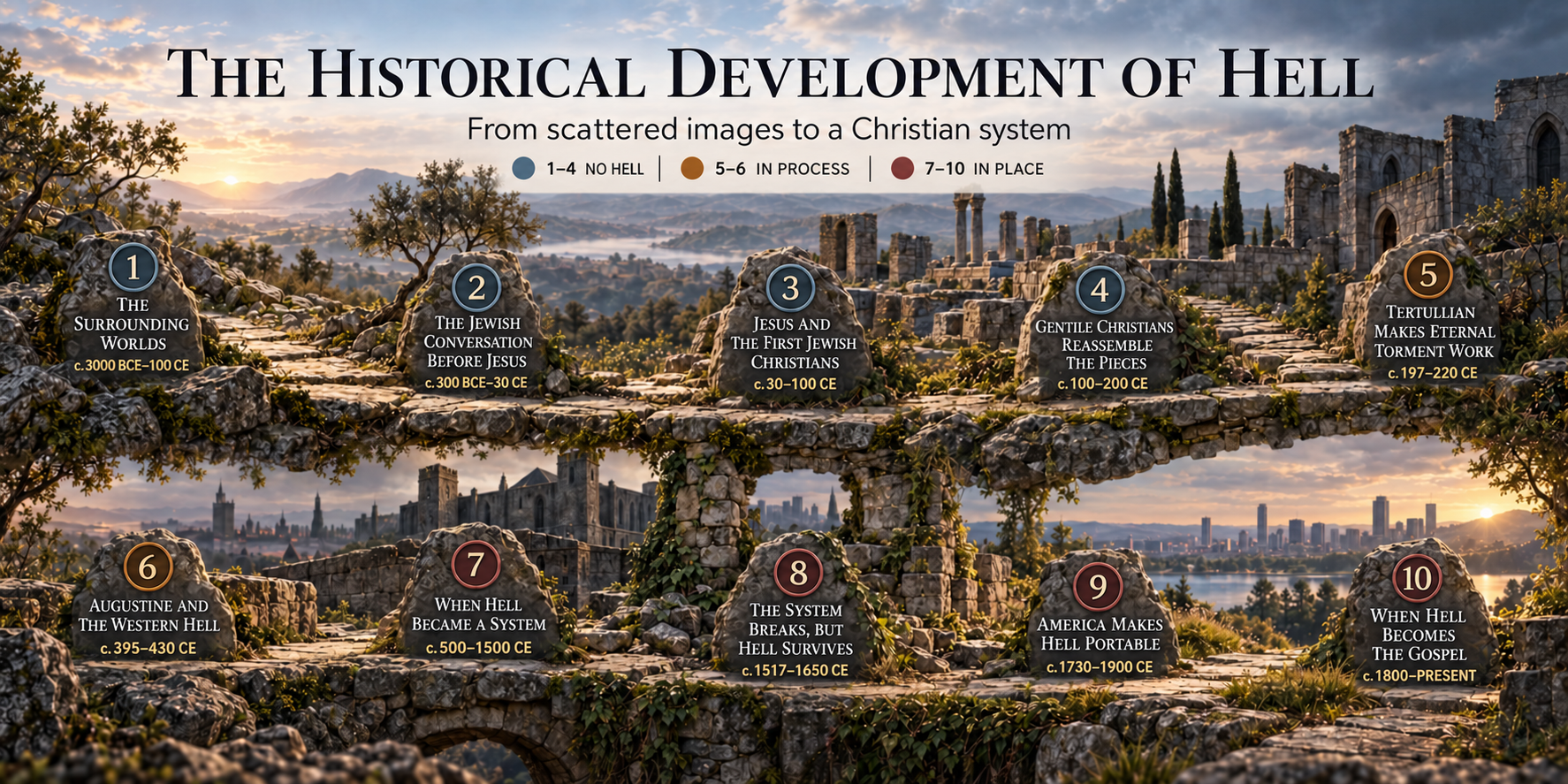
The Surrounding Worlds
I found no clear evidence that a pre-Christian society handed off a ready-made doctrine of Eternal Conscious Torment. But several cultures supplied images and ideas that would later become recognizable parts of hell.
- Mesopotamia supplied the bleak underworld—a dark destination shared by nearly all the dead.
- Egypt supplied moral judgment followed by continued life or annihilation.
- Zoroastrianism supplied cosmic judgment, resurrection, punishment, and the final restoration of creation.
- Greece supplied Tartarus, endless punishment for exceptional offenders, and the influential philosophical idea of the deathless soul.
- Rome intensified the punitive geography and supplied the language of crime, sentence, and penal retribution.
- Jewish apocalyptic writers reworked—and disputed—some related ideas within their own theological world, without producing a settled Jewish doctrine.
These societies provided a storehouse of images: an underworld, judgment after death, separated destinations, punitive fire, immortal souls, resurrection, retribution, and even endless punishment for exceptional offenders. Direct lines of influence are not always demonstrable, and the traditions frequently contradicted one another.
What none supplied was the complete Christian system that eventually emerged: a final judgment after which every condemned person would be kept consciously alive in an indestructible body and punished without possibility of death, restoration, or release.
Christianity did not inherit that doctrine fully formed.
It would construct it.
What I Found Was a History
What I found instead was a history—a uniquely Christian history.
Christianity did not invent the questions. Ideas about death, judgment, underworlds, punishment, resurrection, and the continuing existence of the dead circulated throughout the ancient world.
But those ideas did not arrive as one coherent doctrine. They came from different societies, rested upon different understandings of human nature, and offered conflicting answers. Christians gradually selected some of them, combined them, and used them to interpret biblical judgment texts.
Hell developed through that process.
The Jewish Conversation Before Jesus
The Hebrew Scriptures do not present a doctrine of Eternal Conscious Torment.
Human beings are embodied creatures whose life comes from God. The dead descend to Sheol, generally portrayed as a place of silence and powerlessness rather than conscious punishment. Isaiah pictures unquenchable fire consuming corpses. Daniel anticipates resurrection to everlasting life for some and shame and everlasting contempt for others. Neither describes immortal souls or resurrected bodies being tortured forever.
During the centuries surrounding Jesus, however, some Jewish apocalyptic writers began imagining the afterlife in greater detail. Texts such as 1 Enoch, 4 Ezra, and 2 Baruch described intermediate destinations for the dead, resurrection, final judgment, fiery punishment, and the vindication of the righteous.
These writings matter because they demonstrate that postmortem punishment was being considered within parts of the Jewish world. But they did not speak with one voice. Some anticipated destruction. Some described temporary punishment. Some imagined continuing punishment. Jewish groups also disagreed about whether the dead would be raised or whether conscious existence continued after death at all.
These writings never became a unified Jewish teaching. The texts containing the most developed afterlife schemes were not included in the rabbinic Jewish Bible, and their speculations never became a settled or universally accepted Jewish doctrine.
The distinction matters.
An idea could arise within Judaism without representing Judaism. It could circulate during the time of Jesus without being taught by Jesus. And it could later be adopted by Christians without coming from the Hebrew Scriptures.
Jesus and the First Jewish Christians
Jesus and his earliest followers emerged from this diverse Jewish world.
Their Scriptures told the story of creation and covenant, slavery and liberation, exile and return, judgment and restoration. Their hope was not escape from embodiment into another world. It was resurrection: God would raise the dead, confront evil, vindicate those who had been harmed, restore Israel, and renew creation.
Jesus spoke seriously about judgment. He warned about Gehenna, destruction, exclusion, darkness, and fire. But judgment is not itself hell. Judgment brings truth to light, confronts evil, and renders a verdict. Eternal Conscious Torment is one particular claim about what follows an adverse verdict: that God keeps every condemned person consciously alive under punishment forever.
Jesus never constructed that doctrine.
The earliest Jewish Christians proclaimed that God had raised Jesus from the dead and would ultimately defeat sin and death. They announced forgiveness, resurrection, the restoration of creation, and the arrival of God’s kingdom. No apostolic sermon recorded in Acts warns its hearers that God will preserve the condemned in fire forever.
The New Testament writers warned of judgment, death, destruction, exclusion, eternal punishment, unquenchable fire, and the lake of fire. But they did not combine these expressions into a unified description of final punishment.
Revelation contains the New Testament’s most terrifying imagery. Worshippers of the beast experience torment with “no rest day or night,” and the devil, beast, and false prophet are tormented “day and night forever and ever.” Condemned human beings enter the lake of fire, which Revelation calls “the second death” (Revelation 14:9–11; 20:10–15).
Yet Revelation ends with death defeated, God dwelling with humanity, the nations walking by the New Jerusalem’s light, its gates never closing, and the tree of life healing the nations. Its images create genuine tension, but they do not provide a systematic explanation of Eternal Conscious Torment.
The New Testament never explains how a resurrected human being could remain alive while being burned forever.
Gentile Christians Reassemble the Pieces
As the Jesus movement spread beyond its Jewish birthplace, its writings entered new philosophical, linguistic, and political settings.
Greek philosophy was diverse, but one influential tradition understood the soul as the person’s enduring essence, capable of conscious existence apart from the body. This was not the embodied understanding of humanity found in the Hebrew creation story. Nor was it something Jesus had taught.
Christians did not simply adopt Plato intact. They retained the Jewish hope of bodily resurrection and insisted that created life depended upon God. But continued consciousness after death provided one piece the developing doctrine would need. The dead could suffer before resurrection, and—if God preserved them—they could remain capable of suffering afterward.
Some noncanonical Christian writings carried the imagery further. The second-century Apocalypse of Peter described elaborate punishments inflicted upon different kinds of sinners. It demonstrates that some Christians were already imagining continuing torment in graphic detail. But it was not written by Peter, was not finally received as Christian Scripture, and cannot be treated as authoritative teaching from Jesus or the apostles.
Individual Gentile Christian thinkers also began turning judgment imagery into theological conclusions.
Justin Martyr was born into a pagan Gentile family in Roman Palestine and was formed in Greek philosophy before becoming a Christian. He continued to call himself a philosopher and presented Christianity to the Greco-Roman world as the “true philosophy.”
Justin spoke of resurrection followed by everlasting punishment in fire. He appears to have reached this conclusion principally through his reading of passages such as Matthew 25:41–46. Yet Justin did not teach that the soul was naturally indestructible. Souls continued because God willed them to continue. He asserted everlasting punishment without fully explaining how embodied torment could continue forever.
Irenaeus also spoke of resurrection, judgment, and eternal fire. But his theology does not fit cleanly into Eternal Conscious Torment. Formed in the Greek-speaking churches of Asia Minor, he emphasized the goodness of creation, bodily resurrection, and immortality as a gift from God. His writings leave genuine uncertainty about whether the condemned remain consciously alive forever or are finally deprived of life.
By the end of the second century, then, the major pieces were in circulation:
- Jewish and Christian images of judgment and fire.
- Greek ideas about conscious existence after death.
- Resurrection of the body.
- Noncanonical depictions of postmortem torment.
- Christian assertions that punishment could be everlasting.
But these elements did not yet form a settled Christian doctrine. Their meanings remained disputed, and a practical problem remained unanswered:
How could a resurrected human being burn forever without eventually dying or being consumed?
Tertullian Makes Eternal Torment Work
Tertullian supplied an answer.
Born during the second century in Carthage, in Roman North Africa, Tertullian came from a pagan Gentile background and converted to Christianity as an adult. He was trained in Latin rhetoric and thoroughly familiar with Roman legal language, Greek philosophy, and earlier Christian apologetic writing. Although he is often called a lawyer, his education in forensic rhetoric is more certain than an actual legal career.
Tertullian knew the writings of Justin and Irenaeus and named them as respected predecessors in another theological controversy. But we cannot demonstrate that he simply adopted his understanding of hell from either man.
Tertullian worked with materials already available to him: biblical judgment texts, disputed Jewish and Christian apocalyptic imagery, earlier Gentile Christian interpretations, and Greco-Roman ideas about the soul, the body, punishment, and justice.
He then made them work together.
First, conscious identity continued after death. Tertullian used the story of the rich man and Lazarus to argue that the dead remained individually conscious and capable of pleasure or anguish in Hades while awaiting resurrection.
Second, the flesh was resurrected. The same embodied person who had lived and acted would stand before God and receive judgment.
Neither idea was uniquely Tertullian’s. But together they still left a problem. Fire destroys bodies. If the condemned were resurrected and cast into fire, why would they not simply die again?
In his Apology, Tertullian supplied the crucial mechanism: divine fire continually restores what it consumes. The fire does not merely fail to finish its work. It actively preserves the condemned so that its work can continue.
In On the Resurrection of the Flesh, Tertullian described the resulting punishment as an eternal “killing.” The condemned are always being destroyed, but their destruction never reaches its end.
The system now worked:
- Conscious identity survives death.
- The body is resurrected for judgment.
- Divine fire burns the body while continually restoring it.
- Death never arrives.
- Destruction is never completed.
- Suffering can therefore continue forever.
Tertullian did not invent every component of Eternal Conscious Torment. He assembled inherited images, disputed Christian interpretations, and Greco-Roman assumptions into one of Christianity’s earliest explicit explanations of how endless embodied suffering could work.
His distinctive contribution was brutally simple:
The fire perpetuates the person it punishes.
Christianity did not invent postmortem judgment, punitive afterlives, fire imagery, resurrection, or belief in conscious existence after death. Few doctrines emerge from nothing.
Steve Jobs was celebrated less for inventing technologies than for recognizing how existing technologies could be combined into products that felt new. Christianity did something similar with hell. Gentile Christians brought older images and ideas together, interpreted biblical judgment texts through them, and gradually developed something new: hell as an authoritative doctrine of endless conscious punishment.
Never say that Christians aren’t inventive.
Tertullian had made the machinery explicit. Augustine would give it enormous authority in the Western church.
Augustine and the Western Hell
Augustine did not invent hell. Christians had already proposed different answers to what God ultimately does with evil—destruction, restoration, and continuing punishment. What Augustine did was give Eternal Conscious Torment its most influential systematic theological defense in the Western church.
Augustine’s argument grew from a larger understanding of God, sin, grace, the soul, and justice. He understood humanity’s rebellion against God as guilt deserving severe divine punishment. For those finally condemned, punishment was not intended to correct, heal, or restore them. Everlasting conscious punishment was itself a just outcome. It was what their guilt deserved.
By Augustine’s time, several biblical passages could be read together within this developing system. But one text became especially important: Matthew 25:46.
Jesus says that the condemned will go away into “eternal punishment” and the righteous into “eternal life.” Augustine recognized the strength of the grammatical parallel. If eternal life has no end, he argued, eternal punishment must have no end. To make one everlasting and the other temporary seemed to him an obvious contradiction.
This became one of the most enduring arguments for ECT. But even here, the verse does not describe what the punishment consists of. It does not say that every condemned person possesses an immortal soul, that the person must remain conscious throughout eternity, that the punishment takes the form of continuing torment, or that God must perpetually preserve the person’s capacity to suffer. Those conclusions come from fitting Matthew 25:46 into the larger theological system.
Augustine understood the obvious moral objection. In The City of God, he acknowledged that “eternal punishment seems hard and unjust to human perceptions.” His answer was that human beings failed to comprehend the seriousness of rebellion against God. Humanity was guilty, its punishment was “just and due,” and those not rescued by grace could therefore justly remain under punishment without end.
Other Christians disagreed. Origen, Gregory of Nyssa, and others understood God’s actions against evil as ultimately directed toward setting things right, not preserving the guilty under punishment forever. Augustine’s answer was still one among several.
What made Augustine’s answer so consequential was both the breadth of his theology and the historical influence of his writings. As the Western Roman world changed, Latin Christianity preserved and taught his integrated account of sin, grace, election, salvation, justice, and punishment. Greek learning became less accessible in much of the Latin West, while Augustine’s authority grew. Centuries later, both Catholic theologians and Protestant Reformers would draw deeply from him.
The Western church inherited Augustine’s answer.
But Christianity did not develop everywhere along the same path. Augustine never acquired comparable authority in the Greek-speaking East. Important streams of Eastern Christianity continued to understand God’s work through healing, transformation, restoration, and theosis—participation in the life of God—rather than through the increasingly juridical categories characteristic of the Latin West.
This distinction matters. We are not tracing something Christianity simply believed everywhere from the beginning. We are tracing how one interpretation of scripture, human immortality, and divine punishment became dominant within the branch of Christianity that would shape Western Europe and, eventually, much of Protestant Christianity.
And that branch was acquiring something enormously consequential: political power.
In 313, the Edict of Milan legalized Christianity within the Roman Empire. In 380, Emperor Theodosius I went much further, making Nicene Christianity the official imperial orthodoxy. Within less than seventy years, Christianity had moved from a persecuted religion to one backed by the power of the Roman state.
That changed the stakes of theological disagreement. Emperors became involved in Christian disputes, councils defined the boundaries of orthodoxy, bishops acquired increasing political as well as spiritual authority, and theological ideas could now be not merely debated but officially authorized or condemned.
When Empire Narrowed the Alternatives
By the sixth century, debates about humanity’s final destiny were no longer taking place through interpretation and persuasion alone. Emperor Justinian opposed a collection of teachings attributed to Origen, including the preexistence of souls and a particular form of apokatastasis—the eventual restoration of all rational beings. Around 543, he sponsored their condemnation and required leading bishops to affirm it.
A decade later, Justinian convened the Fifth Ecumenical Council in Constantinople. The council’s principal controversy concerned Christology, not hell, and historians dispute whether the fifteen anathemas against Origen were formally adopted by the council itself. Those anathemas also targeted an entire Origenist system—including preexistent souls and their return to an original spiritual condition—not simply the hope that God might ultimately reconcile everyone.
It would therefore be inaccurate to say that the church gathered in 553 and “voted universal reconciliation out.”
But the controversy still mattered. A prominent Christian alternative to endless punishment became associated with condemned Origenism, and imperial authority stood behind that condemnation. Justinian’s willingness to use political power in theological disputes was unmistakable. During a separate controversy, he had Pope Vigilius forcibly brought to Constantinople and kept under pressure for years; the council eventually proceeded without the pope’s participation.
The treatment of Vigilius did not concern universal restoration. It reveals the kind of power now operating within Christian theology. Emperors could summon councils, shape their agendas, require assent, punish resistance, and help determine which interpretations remained publicly acceptable.
Augustine’s defense of everlasting punishment was already becoming authoritative in the Latin West. The condemnations associated with Origen did not create ECT, but they helped discredit and marginalize one of its major alternatives. The range of acceptable answers was narrowing through a combination of theological argument, ecclesial authority, and imperial power.
The next transformation would make it part of an entire religious system.
When Hell Became a System
By the time the Fourth Lateran Council met in 1215, the Western church could formally declare that Christ would return to judge humanity, with the wicked receiving perpetual punishment and the righteous everlasting glory.
Lateran IV did not invent hell. Its importance is that by then everlasting punishment was established enough to sit inside the authoritative doctrinal structure of the Western church.
At this point the relationship between doctrine and scripture had also changed. The biblical passages had not changed, but the theological system surrounding them had. Matthew 25 was now read as a direct description of endless punishment. Mark’s “unquenchable fire” could be heard as fire that burns people without consuming them. Luke’s rich man could be treated as evidence of conscious punishment immediately after death. The lake of fire could be understood as the location of unending life in torment rather than as the “second death” Revelation calls it.
The doctrine increasingly determined how the texts were heard.
Hell was also becoming part of an interconnected system governing sin, forgiveness, punishment, death, and the afterlife.
The pieces had developed separately and over centuries. Nobody sat down and designed the entire system. But eventually they functioned together. There was hell for the finally condemned and purgatory for those destined for salvation but still requiring purification. There was confession and absolution, penance, indulgences addressing temporal punishment, and prayers and masses for the dead.
It was quite a system.
The same Lateran council that affirmed perpetual punishment also required Christians to confess their sins to a priest at least annually. For people living within Latin Christendom, questions of sin, forgiveness, punishment, and eternity were woven deeply into ordinary life.
We need to remember what that ordinary life looked like. Medieval Western Europe was overwhelmingly agrarian and hierarchical, and disease, childbirth, famine, violence, and childhood mortality made death far more immediate than it is for most Western people today. The church was not simply somewhere people went on Sunday. Its bells marked time, its calendar ordered the year, and its clergy baptized children, solemnized marriages, heard confessions, cared for the sick, and buried the dead.
The peasant could see the Last Judgment depicted in the church and hear preaching about the fate of the condemned. The merchant worried about wealth, honesty, restitution, and provisions in his will. The noble worried about violence, political enemies, sexual conduct, and sudden death. The priest could sincerely believe that failing to warn people about eternal punishment endangered their souls. A dying person might wonder whether serious sins remained unconfessed, while a grieving family arranged prayers or masses for someone they loved.
The theology had acquired rituals, images, money, institutions, and authority. Hell had entered the imagination.
Medieval Christianity was far richer than fear. It produced extraordinary charity, scholarship, art, architecture, music, community, and spirituality, and there is no reason to imagine that most clergy were cynically manipulating people with something they did not believe.
That actually reveals the deeper problem. A system does not require malicious people to become coercive. If everlasting conscious punishment is genuinely possible, almost nothing matters more than avoiding it. If the church possesses divinely authorized means of reconciliation with God, its authority becomes enormous. If false belief can contribute to someone’s eternal ruin, suppressing it can even begin to look compassionate.
Fear follows naturally from the stakes.
Measured against the Shalom–Flourishing Framework used later in this article, I see parts of medieval Western Christianity displaying characteristics associated with empire: concentrated authority, enforced conformity, control over belonging, fear of punishment, and coercion justified by a supposedly higher good.
The church had begun beneath empire. Increasingly, parts of the church had learned how to behave like one.
The System Breaks, but Hell Survives
Then came the Reformation.
Martin Luther’s challenge to indulgences struck at the machinery surrounding the medieval beliefs of the afterlife. What began as a dispute over the church’s claimed power to reduce punishment widened into a revolt against papal authority, purgatory, masses for the dead, and the penitential system.
The Reformers took tremendous risks. In a world where religious dissent could bring condemnation, exile, imprisonment, or death, they challenged institutions that had governed Western Christianity for centuries. They translated Scripture, rejected doctrines they believed could not be established from it, and placed reconciliation with God in the saving work of Christ rather than in merits administered by the church.
But they kept hell.
Luther rejected the church’s claimed power to release souls from punishment, yet he retained everlasting conscious punishment itself. Purgatory was removed. The dead could no longer be helped by indulgences, masses, or priestly intervention. Those justified by grace through faith received eternal life; the condemned remained under everlasting punishment.
The medieval machinery broke. Hell survived.
John Calvin gave the surviving dogma an even more rigorous place within Protestant theology. Augustine had already taught that humanity was fallen, guilty, and dependent upon divine grace. Calvin sharpened that inheritance and integrated it into a tightly ordered system of original guilt, election, atonement, grace, and punishment.
Calvin’s training in civil law did not create his theology, but it contributed to the precision with which he treated sovereignty, guilt, verdict, and punishment. In Calvin’s account, human beings were not born innocent and able to choose their way toward God. Every person entered life already guilty in Adam and condemned to hell. No human choice or effort could overturn that verdict. Only God’s sovereign intervention could save the elect; everyone else remained condemned to conscious punishment without end.
These teachings were later summarized as TULIP: Total Depravity, Unconditional Election, Limited Atonement, Irresistible Grace, and Perseverance of the Saints.
Hell is not one of the five points, but it is fundamental to the system. Humanity begins life under condemnation, and God alone chooses whom to save. The elect are rescued; everyone else remains condemned to hell. Within the Calvinist tradition I inherited, the prevailing view was that most of humanity would be damned.
This was the Reformation’s decisive change to hell. Everlasting punishment no longer stood within a Roman Catholic system where you could get out of it through purgatory, indulgences, confession, masses for the dead, or papal authority. The church no longer claimed to manage escape from punishment through its sacraments. Every person began condemned, and God alone determined whom would be rescued.
Calvin’s theology did not remain in Geneva. It spread through books, refugee communities, universities, churches, and political alliances. It moved into France and the Netherlands, traveled with John Knox into Scotland, and returned with Protestant exiles to England, where it helped shape Puritan Christianity.
And then hell crossed the Atlantic.
America Makes Hell Portable
New England Puritanism carried Reformed teachings about hell into the English colonies, where they became deeply embedded in conversion preaching. Jonathan Edwards gave that tradition unforgettable language in his 1741 sermon Sinners in the Hands of an Angry God:
“The God that holds you over the pit of hell, much as one holds a spider, or some loathsome insect over the fire, abhors you.”
The unconverted person was not simply headed in the wrong direction. They hung helplessly over eternal fire, preserved from catastrophe only by God’s moment-to-moment restraint.
The Great Awakenings spread this message through traveling evangelists, frontier revivals, and camp meetings. Something important happened to hell in America: it became portable, binary, and extraordinarily effective at creating urgency.
The medieval Catholic Christian had inhabited an elaborate sacramental universe. American revivalism reduced the eternal question to something much simpler: Are you saved? If you died tonight, where would you spend eternity—heaven or hell?
The proof texts were portable too. Removed from their literary and historical settings, they could be arranged into a short and apparently unmistakable argument:
Jesus said “eternal punishment.”
He warned of unquenchable fire.
The rich man suffered after death.
Paul promised everlasting destruction.
Jude spoke of eternal fire.
Revelation described torment whose smoke rises forever.
Read through the inherited system, the conclusion seemed unavoidable. Every person was born depraved, guilty before God, and unable to repair the breach. Yet everyone also possessed a soul that must exist forever. Those saved through Christ would live eternally with God. Everyone else would remain consciously alive under punishment without end.
The assumption that every soul must exist forever was rarely identified or defended. It was simply there. Once everyone must live forever somewhere, the central question becomes where.
It was the question I learned to ask in my own evangelical Christian settings.
Fear Becomes the Doorway
The message followed the familiar structure, what became the Four Spiritual Laws. This is what those laws said—and how they worked inside me.
The first said that God loves you and has a wonderful plan for your life. It began with a promise: God loves me. Something good is being offered.
The second said that humanity is sinful and separated from God. That meant: I am depraved, already guilty, and condemned to hell. I cannot save myself. I could die at any moment, and hell never ends. The promise gave way to fear: Unless something changes, this will happen to me. I must act now.
The third said that Jesus Christ is God’s only provision for sin. Once the danger had been established, “only” closed every other door: Jesus is my one escape from hell. My only solution.
The fourth said that to be saved, each person must receive Christ. By then, the response carried the pressure of everything preceding it: Confess, repent, believe, accept Jesus—and do it now, because tomorrow is not promised.
The sequence resembles an old-fashioned coercive sales pitch: begin with a promise, make the danger personal, offer one solution, and demand a decision before time runs out. Hell made the threatened loss infinite; death supplied the deadline.
Within this sequence, fear became the doorway to faith. God’s love might be proclaimed as infinite and unconditional, but the operating logic of the message said something different: respond correctly before you die, or suffer without end. Jesus appeared first not as the fullest revelation of God’s love, but as the means of rescue from what God would otherwise do to you – Jesus was the transactional glue.
Do Not fear
This sits uneasily beside one of Jesus’ most repeated instructions: “Do not be afraid.” Jesus did not deny evil or judgment. He warned that God could destroy both body and soul in Gehenna. Yet in that same teaching, he repeatedly told his disciples not to fear. God sees every sparrow. Every hair on their heads is numbered. “You are worth more than many sparrows” (Matthew 10:26–31). Elsewhere he told them, “Do not be afraid, little flock, for your Father has been pleased to give you the kingdom” (Luke 12:32).
The movement of Jesus’ teaching is from fear toward trust. His warnings call people to take God, evil, and their choices seriously. They do not make terror of God the basis of relationship with God.
Years later, I briefly worked for a business leader who liked to say, “Fear is the greatest motivator of human behavior we know of.” He was talking about selling: establish a serious danger, make it personal, offer a means of escape, and people become strongly motivated to act. Every time I heard him say it, I cringed.
Fear can produce an immediate decision. It cannot by itself cultivate trust, love, or a flourishing relationship. A person can submit to a threat without trusting the one who makes it.
I am not suggesting that revivalists cynically invented a sales technique. Most believed what they preached – they were also afraid. If you genuinely believe that the person before you could die tonight and suffer forever, frightening that person into responding can feel compassionate. That sincerity helps explain the method’s power. Fear creates urgency, urgency demands a decision, and the decision promises escape. When the threatened catastrophe is infinite, no amount of pressure can appear excessive.
Hell could travel wherever the evangelist traveled: into fields and tents, churches and auditoriums, printed tracts, radio and television, stadium crusades, and eventually the internet.
More importantly, hell began to reorganize the gospel around itself.
When Hell Becomes the Gospel
The biblical story describes an enormous human crisis: good creation, sin, oppression, alienation, violence, death, the corruption of God’s good creation. It announces an equally expansive salvation: liberation, forgiveness, healing, reconciliation, resurrection, the Kingdom of God, and the restoration of creation.
Popular revivalism compressed that story into a smaller formula: humanity is depraved, God has pronounced the verdict, hell is the punishment, Jesus provides the escape, and conversion determines who receives it.
To be “saved” increasingly meant being saved from hell—saved from damnation.
This helps explain why hell became so difficult to question. Once the gospel has been organized around hell, removing hell appears to remove the problem for which Jesus is the solution. The objections come immediately: Then what are we being saved from? Why did Jesus have to die? Why evangelize?
But those questions reveal how much of the biblical story has disappeared. Jesus did not come merely to rescue individuals from punishment after death. He announced God’s Kingdom, confronted the powers of sin and death, healed what evil had damaged, reconciled humanity to God and one another, and began the renewal of creation.
When hell becomes the problem and Jesus becomes the escape, the God whose nature is love becomes the danger from whom we need to be rescued. The good news no longer begins with God’s love. It begins with what God will do to us if we fail to accept the offered escape in time.
Jesus uses the noun sōtēria—“salvation”—only twice in the canonical Gospels: “salvation is from the Jews” in John 4:22, and “salvation has come to this house” in Luke 19:9. Neither passage describes the later evangelical transaction of saving an individual soul from eternal hell. Even when Jesus uses the related verb sōzō, it frequently means healing, rescue, preservation, or restoration. Jesus certainly addressed individuals, but he rarely described his mission as saving isolated individuals from a postmortem hell. Instead, salvation in the Gospels means:
– The lost are found and brought home.
– Sinners are forgiven and restored.
– The sick are healed and made whole.
– People are freed from powers that enslave them.
– The excluded are returned to community.
– Death is ultimately overcome through resurrection.
Jesus’ salvation is restorative: God finds, heals, forgives, liberates, reconciles, and gives life. And it is intertwined with his main message: “The Kingdom of God is here. Join me.”
By the time this Christianity reached me, I could say without hesitation, “You have an eternal destiny no matter what. Where do you want to spend it?”
I thought I was summarizing Christianity.
I was repeating the final formula of a long Western Christian story—but not the gospel story of Jesus.
Why the System Persists
I think the simplest answer is that we inherit worlds.
Parents teach children, pastors teach congregations, seminaries teach traditions, confessions preserve conclusions, hymns give them emotion, and preachers give them urgency. Eventually an inherited interpretation becomes simply “what the Bible says.”
Belief in hell remains widespread across American Christianity. In Pew Research Center’s 2023–24 Religious Landscape Study, majorities within every large Christian tradition it analyzed affirmed a hell in which unrepentant people are eternally punished. The survey did not ask whether they accepted every element of Eternal Conscious Torment, but it shows how deeply the basic belief remains embedded.
For many Christians who affirm ECT, it is not presented as one interpretation among several. They sincerely believe it is what Scripture plainly teaches. They can point to eternal punishment, unquenchable fire, the rich man in anguish, everlasting destruction, eternal fire, and the smoke of torment rising forever.
What they may not have been shown is the interpretive history connecting those passages. The texts did not originally appear as one systematic description of hell. They were progressively gathered into a structure that supplied what Scripture itself never clearly stated: that every human soul must remain conscious forever and that death and destruction therefore describe endless existence rather than an end to life.
After centuries of use, the structure becomes invisible. The interpretation looks identical to the text.
Hell also contains its own enforcement mechanism. Once people are taught that rejecting the truth places their eternal destiny at risk, questioning hell becomes frightening. What if they are right? What if asking these questions puts me in danger? What if I teach my children differently and they go there?
I have also heard evangelical leaders asked what would happen if hell were not real. Their answer was that society and the church would collapse into moral anarchy. In that argument, hell is not merely a doctrine about the future. It is an instrument of social control. People must believe in ultimate punishment so that they will behave now.
That is a recognizably imperial argument: order must be maintained through fear of overwhelming punishment.
For some readers, this fear is not abstract. It lives in the body as dread: fear that a parent or child is suffering forever, terror that an intrusive thought or unconfessed failure has placed one’s own soul at risk, or anxiety that questioning the doctrine could provoke the punishment it describes.
If that is part of your story, I do not want to use your fear as another argument. I want to acknowledge the weight you may have carried and make room to examine the doctrine without threat or shame.
Meanwhile, millions of Americans are leaving the religious identities in which they were raised. Pew’s 2023–24 study found that more than one-fifth of American adults were raised Christian but no longer identify as Christian. For every person entering Christianity through religious switching, six are leaving it. The research does not show that hell is the primary cause, and we should not claim that it does. It does show that inherited authority and fear are no longer sufficient to prevent millions of people from questioning or leaving the faith they received.
This brings the moral conflict into full view.
When American Christianity makes hell the foundation of its message—accept the offered escape or suffer forever—it adopts the logic of empire. Authority declares everyone guilty, threatens punishment without limit, demands the required response, and calls the resulting submission salvation. This is Roman justice in its most absolute form, imposed upon the person and work of Christ.
The problem is not merely that this message frightens people. It is that it risks making fear the foundation of faith, punishment the center of the gospel, and God the danger from whom Jesus must save us.
Christianity teaches that God is love, cruelty is evil, mercy is good, enemies should be loved, and forgiveness is divine. It then asks us to believe that this same God will preserve human beings in conscious suffering forever—after that suffering can no longer correct, restore, reconcile, protect, or heal anything.
The question is no longer whether hell can motivate people. It can.
The question is what kind of faith it creates, what kind of church it sustains, and what kind of God it asks us to worship.
More and more people are willing to ask whether that God looks like Jesus.
I am.
Article Guide
SECTION 7: One Final Test
Does Eternal Conscious Torment Lead Toward Shalom?
For many of us, shalom simply means peace. In the Hebrew Scriptures, however, it means something far more expansive: wholeness, well-being, and life flourishing within just and rightly ordered relationships. Genesis establishes this direction. God repeatedly calls creation good, calls humanity “very good,” and blesses living creatures to be fruitful and multiply. Throughout Scripture, that original fruitfulness develops into the wider vision of shalom—life-giving relationship with God, neighbor, self, and creation.
For several years, I have been exploring what allows human beings to flourish. That work began with contemporary research, especially the Human Flourishing Program at Harvard. More recently, I came to see a remarkable convergence between that research and the biblical vision of shalom, particularly as it emerges from the Torah. This convergence forms the basis of what I call the Shalom–Flourishing Framework.
I began turning that convergence into a working model by identifying essential attributes of flourishing, developing ways to measure them, and locating relevant sources of evidence. AI-assisted research helped me refine and test the framework, gather data, and analyze contrasting cases. This became a journey through societies, communities, and ideologies. I began with biblical Israel during periods when its communal life most closely reflected the covenant and, at the opposite extreme, Nazi Germany. I have since applied the framework to close to thirty other cases.
Shalom and flourishing together describe the fullness of life for which we were created. Does everlasting conscious punishment move creation toward that fullness—or preserve part of creation in suffering forever?
Before applying the framework to ECT, I will briefly explain its core elements and how they relate to one another.
THE SHALOM–FLOURISHING FRAMEWORK
| 01 Body & Vitality Physical Health Mental Health Happiness & Life Satisfaction | 02 Meaning & Character Meaning & Purpose Character & Virtue | 03 Relationships & Belonging Close Relationships Communal Belonging |
| 04 Vocation & Agency Material Sufficiency Vocation Agency | 05 Justice & Society Justice & Inclusion Institutional Integrity Knowledge & Wisdom Temporal Integrity | 06 Creation & Spirit Ecological Embeddedness Spiritual Groundedness |
Figure 7.1 • Six domains and sixteen attributes combine as one integrated whole
How the Assessment Works
The Shalom–Flourishing Framework applies this integrated vision across six domains and sixteen attributes. Each attribute receives a score from 1 to 5. A score of 1 indicates a severe contradiction of shalom; a score of 5 indicates the strongest alignment with it.
The framework evaluates the whole web of relationships, paying particular attention to the vulnerable and to the lowest level of flourishing within the system. Strong performance in some areas cannot offset severe harm in another. A high average cannot compensate for a collapsing floor.
| 1 Severe contradiction of shalom | 2 Substantial obstruction of flourishing | 3 Mixed or limited alignment | 4 Strong promotion of flourishing | 5 Structural alignment with shalom | ||
| The final test: If Eternal Conscious Torment describes God’s final ordering of creation, how well does that final order align with the flourishing God intends? | ||||||
Two Distinct Assessments
I use the Shalom–Flourishing Framework to assess hell from two related but distinct perspectives.
The Doctrine: Living In Hell
The first assessment considers Eternal Conscious Torment as a doctrine—the final order it describes. It asks: If ECT is true, and this everlasting condition is established or sustained by God, how does it compare with the shalom and flourishing that scripture presents as God’s purpose for creation? Put more vividly, what would existence be like from inside hell itself?
This framework does not claim to prove whether Eternal Conscious Torment is true. It asks a narrower question: whether the final condition ECT describes aligns with the biblical vision of shalom. Because Eternal Conscious Torment cannot be observed or measured directly, this assessment takes the doctrine at its word. ECT describes permanent conscious suffering or exclusion, without relief, escape, healing, reconciliation, or restoration. The question is straightforward: How do those conditions compare with the framework’s vision of creaturely flourishing?
The Ideology: Living Under Hell
The second assessment considers hell as an organizing ideology. It asks: What happens to people, communities, and institutions when everlasting punishment becomes central to how they understand God, humanity, judgment, salvation, and one another?
This is not an assessment of living in hell. It is an assessment of living within a culture that takes hell as seriously as such a fate would demand if it were true. A danger that is both infinite and everlasting cannot easily remain one belief among many. When given the weight of its own claims, it can reshape priorities, relationships, religious practices, institutions, and communal life.
Here we have historical and contemporary evidence to examine. Medieval Western Christianity offers one setting in which everlasting punishment profoundly influenced theology, preaching, pastoral discipline, art, public imagination, and social life. Contemporary communities that make hell foundational to faith, evangelism, education, parenting, or social order offer others.
This does not mean that belief in hell is the sole cause of every associated practice or harm. Nor is this an assessment of Christianity as a whole, every person who believes in hell, or every community that teaches it. People and communities can affirm the doctrine while resisting many of its harmful tendencies.
The assessment asks a narrower question: What does belief in hell tend to produce when people and institutions give it the weight that its own terrifying claims demand?
Shalom–Flourishing Framework: Domain Scores
| Domain and Attributes | ECT as Final Order | Hell as Organizing Ideology |
| 01 Body and Vitality Physical Health Mental Health Happiness and Life Satisfaction | 1 — Severe Contradiction | 2 — Substantial Obstruction |
| 02 Meaning and Character Meaning and Purpose Character and Virtue | 1 — Severe Contradiction | 2–3 — Obstructed to Mixed |
| 03 Relationships and Belonging Close Relationships Communal Belonging | 1 — Severe Contradiction | 2 — Substantial Obstruction |
| 04 Vocation and Agency Material Sufficiency Vocation Agency | 1 — Severe Contradiction | 2 — Substantial Obstruction |
| 05 Justice and Society Justice and Inclusion Institutional Integrity Knowledge and Wisdom Temporal Integrity | 1 — Severe Contradiction | 1 — Severe Contradiction |
| 06 Creation and Spirit Ecological Embeddedness Spiritual Groundedness | 1 — Severe Contradiction | 2–3 — Obstructed to Mixed |
| Overall Assessment | 1 / 5 — Severe Contradiction of Shalom | 2 / 5 — Substantial Obstruction of Flourishing |
Source: Shalom–Flourishing Framework Master Scorecards, revised September 2026. Scores are structured interpretive judgments for comparative analysis, not empirical measurements or rankings of moral evil.
Eternal Conscious Torment – Living in Hell
What the Diagnostic Reveals:
The Permanent Foreclosure of Flourishing
Imagine being found “guilty” as God’s verdict on your life. Perhaps you died with unrepented sin, rejected God, or failed to place saving faith in Christ—the precise condition varies among Christian traditions. The sentence, however, is the same: Eternal Conscious Torment—hell.
Now try to imagine what that existence would be like. Some traditions portray physical agony in fire; others emphasize complete and irreversible separation from God, the source of love and life. Whatever imagery is used, the essential claim remains: conscious suffering or exclusion without relief, escape, or any future possibility of restoration.
I can hold that thought for only a few moments before it becomes unbearable. But hell does not describe a few moments, a lifetime, or even an unimaginably long age. It describes a condition that never ends. It is difficult to conceive of a more devastating fate. The result of the assessment should therefore not be surprising.
Across every domain of creaturely flourishing measured by this framework, Eternal Conscious Torment stands in direct opposition to shalom. Set beside Revelation’s vision of God wiping away every tear, defeating death, and making all things new, hell does not merely fall short. It preserves forever the suffering, alienation, and relational rupture that the biblical story moves toward overcoming.
This conclusion does not rest on emotional revulsion alone. It follows from the final conditions the doctrine itself describes. The domain-by-domain assessment shows why.
Permanent Harm Without Restoration
Until this assessment, Nazi Germany had produced the lowest measurement in my use of the Shalom–Flourishing Framework. Eternal Conscious Torment now supplants it. Hell receives the lowest possible score across all sixteen attributes of creaturely flourishing.
That does not make Eternal Conscious Torment and Nazi Germany historically or morally equivalent. It identifies what the framework is measuring: the extent to which an order permits or forecloses flourishing. Nazi Germany was a historical society that ended. ECT describes a final order that never ends.
The score tells us how completely flourishing has been destroyed, but it cannot fully show what it means for that destruction to last forever. This is the crucial difference. Even the worst human regimes eventually ended. Some people escaped or survived, and later generations could remember what happened, seek justice, and begin rebuilding. Hell has no afterward. No one escapes, nothing changes, and nothing is ever healed. The suffering described by ECT is not only complete; it is endless.
Eternal Conscious Torment is not the act of judgment itself. Judgment brings truth to light, determines guilt, and renders a verdict. ECT is the sentence imposed after an adverse verdict—the punishment that, according to the doctrine, continues forever.
That sentence forecloses every dimension of flourishing. Conscious suffering continues without healing or relief. Anguish and alienation are never resolved. Repentance can never lead to restoration. No growth, reconciliation, or constructive future remains possible. Relationships with God, neighbor, and loved ones are permanently severed. The condemned can never again participate meaningfully in the life of creation, while creation itself forever contains persons whose brokenness will never be healed.
A leading psychologist told me once that human beings have psychological limits and that those limits become visible under extreme suffering. A person in unbearable pain may become suicidal—not necessarily because death itself is desired, but because death appears to offer the only way to make the pain stop. Eternal Conscious Torment removes even that final possibility of release. There is no healing, no escape, and no death capable of bringing the suffering to an end.
Defenders of ECT may regard it as a coherent retributive order in which guilt receives its just punishment. They may argue that such punishment displays divine justice even though it offers no restoration to those who experience it. The Shalom–Flourishing Framework does not settle every question about guilt or punishment. It asks what kind of final creation this sentence produces.
Its answer is unmistakable. Suffering is not finally defeated but perpetuated. Exclusion is not healed but made everlasting. Relational rupture is not overcome but preserved within the final order. For some, the final condition is flourishing; for others, it is permanent devastation.
ECT therefore describes more than a creation in which restoration remains incomplete. It makes the impossibility of restoration everlasting. Suffering does not simply fail to end. For part of God’s creation, suffering becomes the end.
Hell as an Organizing Ideology – Living With Hell
The second assessment produces a more varied result. Hell as an organizing ideology receives an overall score of 2 out of 5—a substantial obstruction of flourishing.
Belief in hell can generate urgency, purpose, strong communal identity, and comfort for those confident of salvation. It does not necessarily damage every dimension of life in every person or community. Yet when the threat of everlasting punishment becomes an organizing force of faith, fear can displace trust, freely chosen love, and honest inquiry.
Anxiety about damnation can strain close relationships. A strong sense of belonging among insiders can be created or reinforced through the exclusion of outsiders. Human purpose can narrow to escaping hell or rescuing others from it, while present suffering, material need, justice, and care for creation become secondary.
The infinite stakes can also transform religious authority. When disagreement is believed to carry everlasting consequences, coercion can appear compassionate. Pressure, control, and enforced conformity can be justified as necessary to save souls. Under such conditions, meaningful consent becomes difficult. A person may outwardly affirm a belief not because it appears true or good, but because questioning it has been made psychologically, socially, or eternally unbearable.
These effects are neither universal nor inevitable. Many who believe in hell also cultivate love, humility, generosity, intellectual openness, and concern for justice. The framework does not erase those realities or treat belief in hell as the sole cause of every associated harm. It asks what the doctrine tends to produce when its threat becomes central enough to govern how people understand God, themselves, and others.
The two assessments therefore lead to different but related conclusions. As a final order, ECT represents the complete and permanent foreclosure of flourishing. As an organizing ideology, belief in hell can substantially obstruct flourishing by reorganizing faith, authority, relationships, and moral attention around an everlasting threat.
Any doctrine of hell must finally answer one question: Does God’s judgment restore shalom—or eternally preserve its opposite?
The full rationale, methodology, evidence standards, and comparative assessments for the Shalom–Flourishing Framework are available on the SeePhas Flourishing Journey page.
Article Guide
Section 8: Recovering the Story
This whole exploration began with a feeling. It became a trauma.
Hell was one of several doctrines I had believed because I thought Christianity required it. But when I stopped treating hell as a theological word and confronted what it actually meant—the everlasting conscious torment of actual human beings—something felt wrong.
So, in my usual way, I set about learning as much as I could.
I studied scripture. I explored the Jewish world in which Jesus was raised. I examined what Jesus said about judgment, Gehenna, destruction, and the age to come. I traced Christian beliefs through the early church, Augustine, imperial Christianity, the medieval church, the Reformation, and American revivalism.
I initially thought I would find a simple answer: Christians had borrowed hell from pagan mythology, and that would settle the question.
It did not.
The history was much more complicated. Hell was not imported wholesale from one pagan religion. Eternal Conscious Torment developed through a long interaction among scripture, Jewish judgment traditions, Greco-Roman ideas, Latin legal thought, theological disagreement, imperial authority, medieval institutions, artistic imagination, Reformation confessions, and revivalist preaching.
The more I studied, the more I learned—but I was still left with uncertainty.
Another part of my seminary formation has involved confronting the myth of certainty: the belief that mature faith means possessing airtight answers to every theological question. I have been learning that doubt is not necessarily the opposite of faith. Sometimes doubt is what remains when we stop pretending to know more than we do. Faithfulness may require living honestly with questions that cannot be completely resolved.
But I still was not satisfied.
This question involved more than the mechanics of the afterlife. It involved the character of God. It involved whether the God revealed in Jesus could create and eternally sustain a place of irreversible suffering. It involved the fear and spiritual trauma produced by that belief. And it involved the story Christians tell the world about who God is.
So here we are.
My questions have not all disappeared, but my doubts about rejecting Eternal Conscious Torment have become much smaller. In fact, I may now be more emphatic about my own beliefs—which is not always an improvement. When I become convinced that I am right, I can become an arrogant pain in the ass.
I do not want to replace one rigid certainty with another. I do not want to leave one theological system only to build a new one in which I possess all the answers and everyone else is wrong.
I hope this is different.
I hope removing hell—defined as Eternal Conscious Torment—from my belief system does not make me more certain of myself. I hope it helps me become more trusting of God.
Perhaps it will help me:
- Trust the God revealed in Jesus’ love.
- See all my neighbors with compassion, rather than as the saved and the damned.
- Seek restoration rather than retribution.
- Understand salvation as healing and reconciliation.
- Address suffering here and now.
- Offer Jesus as an invitation of love, not a threat.
- Hold my beliefs with humility.
And perhaps I can communicate this differently in a way that helps others do the same.
Recovering the Larger Story
For some Christians, hell carries so much theological weight that removing it seems to threaten the entire faith. If there is no Eternal Conscious Torment, why did Jesus come? What are we saved from? Why do sin, repentance, discipleship, or evangelism matter?
Those questions reveal how thoroughly hell has come to organize the Christian story.
The answer is not to replace hell with a religion in which nothing matters, evil is ignored, and everyone simply “gets in.” The answer is to recover the larger story that was there all along.
Christianity does not begin with hell. It begins with creation.
God created the world and called it good. Human beings were created in God’s image and entrusted with the care of creation. The story became distorted by mistrust, violence, domination, and death—but God did not abandon what God had made.
God called Abraham so that all the families of the earth might be blessed. God heard the cries of enslaved people and delivered them from Egypt. God formed Israel to practice justice, mercy, Sabbath, generosity, and care for the vulnerable. The prophets confronted oppression and proclaimed that God would judge evil, restore the people, reconcile the nations, and renew creation.
Judgment was part of that story—but judgment was never its destination.
The destination was restoration through shalom.
Jesus entered that story announcing that the Kingdom of God had drawn near. He healed sick bodies, restored excluded people to community, confronted oppressive power, forgave sins, welcomed children, ate with people labeled unworthy, and taught his followers to love their enemies.
Jesus warned of judgment. His warnings were real and severe. But they belonged to his announcement that God was confronting everything opposed to life. Judgment exposed hypocrisy, defended those being harmed, called oppressors to repentance, and warned about the consequences of continuing in violence, greed, exclusion, and domination.
At the cross, Jesus embodied enemy-love when it became costly. In the resurrection, God vindicated Jesus and announced the defeat of evil, sin and death. Resurrection was not an escape from creation. It was the beginning of creation renewed.
This is the gospel: not that God saves us from God, but that God, in Jesus the Messiah, has entered the world to rescue humanity and creation from evil, sin, violence, corruption, and death.
Recovering Judgment and Salvation
Rejecting Eternal Conscious Torment does not require rejecting divine judgment.
A world without divine judgment would not be a world of love. Love cannot remain indifferent to abuse, exploitation, cruelty, or the suffering of victims. Shalom requires God to confront whatever destroys shalom.
The question is not whether God judges. The question is what God’s judgment is like and what it intends to accomplish.
The judgment revealed in Jesus exposes what is hidden, tells the truth about evil, vindicates those who have been harmed, restrains violence, and confronts those who cause harm. Restorative judgment is not permissive. It requires truth, accountability, repentance, restitution, protection, and transformation. Some things must be stopped. Powers, patterns and systems that perpetuate violence, domination, and dehumanization must be brought to an end. Some identities, allegiances, and ways of living must die.
But the destruction of evil is not the same as the everlasting destruction of the person trapped within it.
God’s judgment may be more severe than I imagine because divine love refuses to leave us captive to what is destroying us and others. Yet if Jesus is the clearest revelation of God, whatever judgment ultimately means must be consistent with Jesus—with the God who searches for the lost, welcomes the prodigal, forgives enemies, confronts oppressors, heals wounds, and overcomes death with life.
I cannot explain with certainty what every person experiences after death, how long judgment lasts, or how human freedom and God’s restorative purpose are finally reconciled.
But uncertainty about the process does not require uncertainty about God’s character.
Once hell is no longer the center of the story, salvation also becomes larger. Salvation is not avoiding punishment after death. It is deliverance from everything preventing us from becoming fully human. It is liberation from sin, shame, violence, fear, corruption, death, and the powers that deform us. It is reconciliation with God, neighbor, self, and creation.
Repentance still matters. But repentance is not groveling before a God eager to punish us. It is turning away from death and toward life.
Following Jesus still matters. But discipleship is not a transaction securing admission to heaven. It is learning to live now as a citizen of God’s Kingdom. As Jesus said, “Follow me.”
Evangelism still matters. But the gospel is not a threat followed by an escape clause. It is the announcement that God has not abandoned the world and that everyone is invited to participate in its healing.
What I Now Believe
I began this journey wanting a definitive answer about hell.
I did not find certainty about every aspect of final judgment. But I found no clear, systematic teaching of Eternal Conscious Torment from Jesus. I found that the earliest Christians proposed more than one outcome following judgment. I found that ECT became dominant gradually rather than emerging as the unanimous belief of Christianity.
And when I tested ECT against the logic of shalom, it failed at the deepest level. It requires suffering, exclusion, hopelessness, and broken relationship to remain permanent features of God’s completed creation.
I no longer believe in hell.
I do believe in judgment. I believe evil will be exposed, confronted, and defeated. I believe those who have been harmed will be vindicated and healed. I believe those who cause harm will face the truth of what they have done. I believe repentance, accountability, restitution, and transformation matter.
And I have come to hope—confidently, even while questions remain—that God’s judgment serves God’s larger purpose of restoration.
That hope is not based on the belief that sin is insignificant. It is based on the belief that God’s love is stronger than sin.
It is not based on the belief that death is unreal. It is based on the resurrection of Jesus.
It is not certainty about every detail of the age to come.
It is trust in the character of the God revealed in Jesus.
The Invitation I Would Offer Now
A decade ago, I found myself repeating the standard revivalist formula:
“You choose. You’re going to spend eternity in one place or another.”
I would not say that today.
If someone asked me why they should consider Christianity, I would begin somewhere else.
I would begin with who God is.
God is love, and Jesus embodies that love in our world.
I would tell them that Jesus shows us what God is like. I would tell them that God has not abandoned the world, that evil and death will not have the final word, and that another kind of life is possible.
I would invite them to follow God by following Jesus—to learn enemy-love, forgiveness, courage, generosity, justice, mercy, and trust.
I would tell them that salvation is not rescue from a God who might otherwise torment them. It is God’s rescue of all of us from everything that is destroying us.
I would tell them that the Kingdom of God has drawn near.
I would invite them to come and participate in it.
This is the story I thought I might lose when I began questioning hell.
Instead, it is the story I recovered.
The story does not end with part of creation flourishing while another part suffers forever. It ends with evil brought to an end, death overcome, tears wiped away, creation renewed, and God dwelling forever with all humanity—the people God loves.
It ends not in everlasting torment, but in the fulfillment of God’s purpose.
It ends in shalom.
Article Guide
Selected Sources and Notes
The sources below identify the principal primary texts, official statements, datasets, and historical studies supporting the article. They are grouped for readers who wish to trace a particular part of the argument.
Biblical Texts and Language
- Primary biblical texts discussed: Genesis 1–3; Isaiah 25 and 65–66; Jeremiah 7 and 19; Daniel 12; Matthew 5, 10, 13, 18, and 25; Mark 9; Luke 12, 16, and 19; John 4; Romans 2 and 6; 1 Corinthians 15; 1 Timothy 6; 2 Thessalonians 1; Jude 7; and Revelation 14 and 20–22.
- Liddell, Henry George, Robert Scott, and Henry Stuart Jones. A Greek-English Lexicon. Entries for aiōn, aiōnios, kolazō, and kolasis.
- Bauer, Walter, Frederick William Danker, William F. Arndt, and F. Wilbur Gingrich. A Greek-English Lexicon of the New Testament and Other Early Christian Literature. 3rd ed. University of Chicago Press, 2000.
- Rahlfs, Alfred, and Robert Hanhart, eds. Septuaginta. 2nd rev. ed. German Bible Society, 2006.
Jewish Context and the Ancient World
- Plato. Gorgias 523a–527a; Phaedo 107c–115a.
- Josephus. The Jewish War, especially Books V–VI.
- Charlesworth, James H., ed. The Old Testament Pseudepigrapha. 2 vols. Yale University Press, 1983–1985.
- Bernstein, Alan E. The Formation of Hell: Death and Retribution in the Ancient and Early Christian Worlds. Cornell University Press, 1993.
- Hezser, Catherine. Jewish Literacy in Roman Palestine. Mohr Siebeck, 2001.
- Wright, N. T. Jesus and the Victory of God. Fortress Press, 1996.
Early Christian Writers and the Development of Hell
- Justin Martyr. First Apology, especially chs. 8, 17, and 52; Second Apology, chs. 7–9.
- Irenaeus. Against Heresies, Book V, especially chs. 27 and 35.
- Tertullian. Apology, ch. 48.
- Tertullian. On the Resurrection of the Flesh, especially chs. 17 and 35.
- Origen. On First Principles, especially I.6, II.10, and III.6.
- Gregory of Nyssa. On the Soul and the Resurrection.
- Augustine. The City of God, Book XXI.
- Daley, Brian E. The Hope of the Early Church: A Handbook of Patristic Eschatology. Cambridge University Press, 1991.
Councils, Creeds, and Christian Traditions
- Edict of Milan (313), preserved in Lactantius, On the Deaths of the Persecutors, ch. 48.
- Edict of Thessalonica (380), Codex Theodosianus 16.1.2.
- Second Council of Constantinople (553), acts and historical materials concerning the Origenist anathemas.
- Fourth Lateran Council (1215), Constitutions 1 and 21.
- Catechism of the Catholic Church, §§1033–1037.
- The Augsburg Confession, Article XVII.
- Westminster Confession of Faith, Chapter XXXIII.
- Orthodox Church in America. Heaven and Hell, in The Orthodox Faith, Volume IV.
- Fudge, Edward William. The Fire That Consumes: A Biblical and Historical Study of the Doctrine of Final Punishment. 3rd ed. Cascade Books, 2011.
- Ramelli, Ilaria L. E. A Larger Hope? Universal Salvation from Christian Beginnings to Julian of Norwich. Cascade Books, 2019.
Reformation, Medieval Christianity, and American Revivalism
- Calvin, John. Institutes of the Christian Religion, Book III, especially chs. 21–24.
- Edwards, Jonathan. Sinners in the Hands of an Angry God.
- Bright, Bill. Have You Heard of the Four Spiritual Laws? Campus Crusade for Christ, 1965.
- McGinn, Bernard. Visions of the End: Apocalyptic Traditions in the Middle Ages. Columbia University Press, 1998.
Contemporary Evidence and the Shalom Flourishing Framework
- Pew Research Center. Religious and Spiritual Beliefs, 2023–24 Religious Landscape Study (2025).
- Pew Research Center. Decline of Christianity in the U.S. Has Slowed, May Have Leveled Off (2025).
- Pew Research Center. Why Some Americans Leave Their Religion While Others Stay (2025).
- PRRI. Unveiling the Exodus: Americans’ Reasons for Leaving Religious Traditions (2023).
- VanderWeele, Tyler J. On the Promotion of Human Flourishing. Proceedings of the National Academy of Sciences 114, no. 31 (2017): 8148–8156.
- SeePhas. Flourishing Journey: Shalom–Flourishing Framework, methodology, and comparative assessments.
- Shalom–Flourishing Framework Master Scorecards, revised September 2026.
[1] Counts vary slightly according to whether parallel sayings and equivalent expressions are included. Counting occurrences of “Kingdom of God,” “Kingdom of Heaven,” and directly equivalent expressions in the Synoptic Gospels produces more than one hundred references—approximately 104 by a common concordance count.

