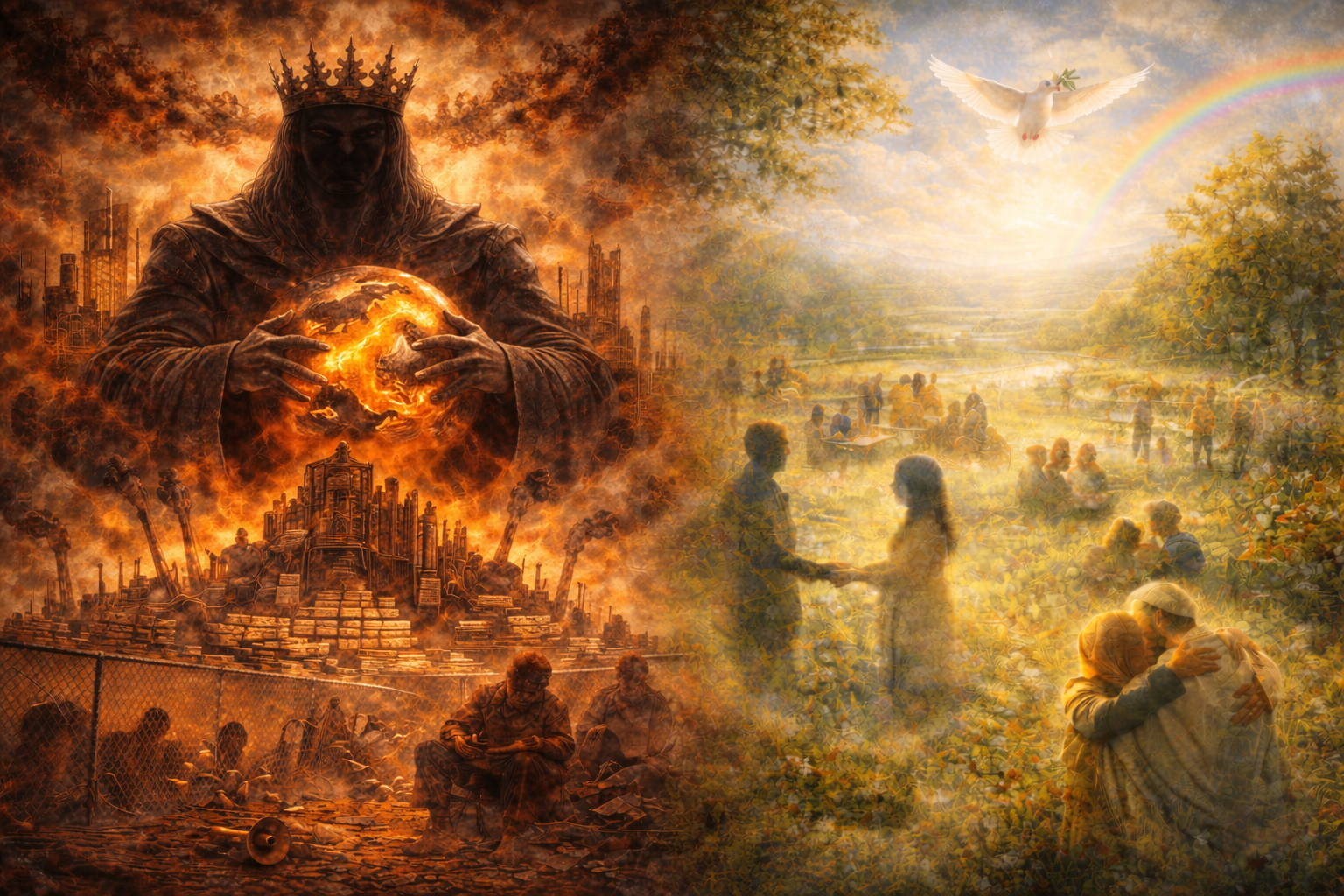
You may or may not have a faith. That’s fine. What I’m asking for is simpler — just a willingness to see through a particular lens for a few minutes.
The lens is called shalom. It’s an ancient Hebrew idea that means something like: the world as it was meant to be. Not just peace — but every person fed, seen, protected, and free. The full flourishing of every human being. The way God would have it.
The prophets wrote about it. Jesus lived it. And both of them got in serious trouble with the political powers of their day for doing so — because shalom, taken seriously, is a direct threat to empire.
That’s what this is about.
What follows is a parable drawn from what is happening right now, in plain sight. It is theology. It is politics. It has always been both — and the moment we separate them is the moment power wins.
This is the way God wouldn’t have it.
The Way God Wouldn’t Want It
“When the righteous flourish, the people rejoice.
When the wicked rule, the people groan.”
Proverbs 29:2
In the beginning, there was enough.
Not excess. Not empire. Just enough — and the knowledge that enough, shared, becomes abundance. A table where all are fed. A field where the edges are left unharvested, because the hungry are coming and the land belongs to the One who made it, not to the one who works it. A community where the strong carry what the weak cannot, not as charity but as covenant. Where the stranger is welcomed because you were once a stranger. Where the widow is seen because God sees her. Where the child sleeps without fear because the village has decided: this child belongs to all of us.
This is shalom.
Not the shallow peace of an empty battlefield. Not the silence of people too tired or too afraid to speak. Shalom is the deep, systemic, relational rightness of a world ordered around the flourishing of every human being made in the image of God. It is what the Torah was building toward. What the prophets were mourning the loss of. What Jesus was announcing the arrival of, in a Roman-occupied backwater, to people who had almost forgotten it was possible.
The ancient Hebrews had a word for its opposite.
They called it Egypt or Empire
The First Step Away
It begins, as it always does, not with a tyrant but with a fear.
A people look around and see their edges fraying. Their towns quieting. Their children leaving. Their certainties dissolving. The world they understood — the world that had a place for them, that honored what they knew how to do — seems to be disappearing. And no one in power seems to notice or care.
This is real. This is not invented. The fear is legitimate.
But fear, left unattended, does not stay still. It moves. It looks for somewhere to land, something to blame, someone to name as the cause. And in that searching, it becomes something other than fear. It becomes hunger — for a simple answer, a clear enemy, a strong hand, a return to a world that felt ordered and safe and ours.
This is the first step away from shalom. Not wickedness. Just fear, looking for relief in the wrong direction.
The Second Step Away
Into that fear walks a voice.
It is loud. It is confident. It has never, as far as anyone can tell, been afraid of anything — though this is a performance, not a truth. It says: I see you. I know what was taken from you. I know who took it. And I alone can fix it.
The voice does not come from nowhere. It has been built, carefully, over decades — first by money that should not have been lent, from sources that should have raised questions no one wanted to ask. Then by a camera and a script and an editor’s careful hand, cutting away every moment of confusion or weakness or failure, leaving only the image of mastery. A fiction, broadcast into ten million living rooms, repeated until it felt like memory.
The voice is not what it claims to be.
But the fear is real. And real fear will reach for almost anything that promises relief.
This is the second step away from shalom. Not the voice. The reaching.
The Third Step Away
The voice is given power.
Not unlimited power — not yet. There are still walls, still rules, still people who say no, this is not how it works, this is not who we are. And so for a time, the voice chafes. It tests the walls. It learns which ones hold and which ones bend. It watches. It waits.
And when the moment comes — when the people are asked to choose again — it does something no one in this tradition of self-governance has ever done. It refuses the verdict. It tells the crowd that the only legitimate outcome is its own victory. It sends the crowd toward the place where the counting happens.
An insurrection. In the land of the free. Broadcast live, like everything else.
And still — still — the people choose it again.
This is the third step away from shalom. Not the insurrection. The choosing, after.
The King
There is a king now.
Not in name — the old names are still used, the old ceremonies still performed. But in function, in intention, in the daily exercise of power: a king. And kings, as the prophet Samuel warned with terrible precision three thousand years ago, do one thing above all else.
They take.
They take your sons for their armies. Your daughters for their households. Your fields for their courtiers. Your harvest for their treasury. Your dignity for their spectacle. Your future for their dynasty.
Watch what is taken.
A tariff tax on foreigners, they call it. A formula is invented — not by real economists, but by a desire for a conclusion that works backwards into a justification. The formula adds a $2,100 tax on every ordinary household.
The family elected is now entitled to take. In their first year they take $4 billion for themselves.
This is not coincidence.
This is the mechanism of empire, operating exactly as designed.
Foreign powers come bearing gifts. They receive, in return, the advanced tools of war and technology that keep smaller nations dependent on the largest one. This is not diplomacy. This is tribute flowing in both directions — and the king’s family stands at the center of every transaction, skimming the passage of power.
In the king’s domain gold goes up on the walls. Entertainment is king-directed. A grand ballroom is planned to be filled with cronies who have paid to be near the sun. An arch is planned for the boulevard of the republic.
Somewhere else, a family waits at a border. A woman is turned away from care. A child’s school lunch disappears from a budget. A coastal nation watches the water rise with no one answering its calls.
The king is busy. The king is counting.
What Dies in the Taking
Here is what shalom requires that empire cannot tolerate:
Shalom requires that every person counts. Empire requires a category of people who do not.
Shalom requires that the powerful carry the vulnerable. Empire requires the vulnerable to carry the powerful.
Shalom requires that the stranger be welcomed. Empire requires the stranger be feared — because a people busy fearing the stranger will not notice what is being taken from them.
Shalom requires that the land rest, that accumulation have a limit, that no dynasty can corner what belongs to the community. Empire requires the opposite: that the dynasty never rest, that the accumulation never stop, that the limit be moved, then moved again, then removed entirely.
Shalom requires truth — because a community that cannot agree on what is real cannot care for one another. Empire requires the management of reality: the invented formula called reciprocal, the fiction called the greatest businessman, the insurrection called a tourist visit, the taking called a gift.
When shalom dies in a society, it does not die all at once. It dies the way a language dies — one speaker at a time. One family that stops gathering. One neighborhood that stops knowing itself. One generation that grows up not knowing what was lost, because no one alive can remember it well enough to describe it.
This is the deepest implication of empire: not the poverty it creates, devastating as that is. Not the wars it starts, ruinous as those are. But the imagination it kills. The capacity of a people to believe that another way is possible. That the strong are not entitled to the harvest. That the stranger belongs at the table. That enough, shared, is abundance.
Empire teaches the opposite lesson so thoroughly, for so long, that the lesson begins to feel like nature.
The Question the Parable Asks
Jesus told parables and rarely explained them.
He trusted that a story, told truly, would find the place in a person that argument cannot reach. The parable of the prodigal son does not end with a systematic theology of forgiveness. It ends with a father running down a road, and an older brother standing in a field, unwilling to come in.
Which of these, Jesus asked after the Good Samaritan, was a neighbor?
He did not answer his own question. He let it land.
So here is the question this parable asks:
When a people have been given a vision of shalom — a world where every person counts, where the stranger is welcomed, where the powerful carry the weak, where enough is shared until it becomes abundance — and they are shown, plainly and repeatedly, a king who takes, who names enemies, who builds monuments to himself while cutting bread from the table of the hungry —
What does it mean that we chose him?
Not once. Twice.
What is it in us that preferred the king to the covenant? The taking to the giving? The strong hand to the open one?
This is not a political question. It is a formation question. It is a question about what we have come to believe, in the deepest places, about what human beings are for.
The Torah said: care for one another as you wish to be cared for, and you will be free.
The king says: there is not enough, and only I can protect your share of it.
One of these is shalom.
The other is Egypt.
We have chosen. The question is whether we know what we have chosen — and whether, knowing it, we are willing to choose differently.
The father is still running down the road.
The door is still open.
Index to Supporting pages for: The Way God Wouldn’t Want It
- the-greatest-failure
- The-resurrection
- The-laundering
- How the King-in-Making Won the First Time
- the-insurrection
- The-second-win
- The-taking-begins – Day One, and the Deals That Followed
- The-corrupt-tariff – the Tariff Formula Nobody Had Ever Seen Before
- The-fraud-of-fraud – Claiming Fraud While Committing I
- Four-billion – The Accounting: $4 Billion in One Year
- The-gilding – Everything Gold
- The-ballroom-and-the-arch – Building Monuments to Himself — Without Permission
Supporting pages for: The Way God Wouldn’t Want It
PAGE 1
the-great-failure
The Greatest Failure in American Financial History
He went bankrupt six times.
Not once — the kind of misfortune that can befall any honest entrepreneur — but six times. Each time, he walked away. Each time, the people left holding the wreckage were the contractors he hadn’t paid, the investors he’d made promises to, the workers who lost their jobs, the bondholders who received pennies on the dollar.
His own tax records, confirmed by his accountant and obtained from documents postmarked at his own building, told the full story. Between 1985 and 1994, his businesses lost $1.17 billion. The New York Times, comparing his filings against IRS data on the country’s highest earners, found he appeared to have lost more money than nearly any other individual American taxpayer in history. In both 1990 and 1991, his losses exceeded $250 million each year — more than double those of any other high-income filer in the country that year.
The losses were so catastrophic that he paid no federal income taxes for eight of those ten years.
Meanwhile, the investors who trusted him watched their shares collapse from $35.50 to 17 cents. Casino bondholders received pennies on the dollar. Scores of contractors went unpaid for completed work.
He called this “sport.”
When the New York Times reported the figures in 2019, his lawyer called the information “demonstrably false” — but could not identify a single specific number that was wrong.
By the mid-1990s, virtually every major American bank had closed its doors to him. He was, in the language of finance, toxic. A man who had inherited a fortune, leveraged it into an empire, and lost nearly all of it — not through bad luck, but through a decade of overreach, overconfidence, and the consistent failure to pay his debts.
This is the man who would go on to brand himself the greatest dealmaker in American history.
This is the man who told a nation: only I can fix it.
← Return to The Way God Wouldn’t Want It
PAGE 2
The Resurrection
How the King Was Rescued — and By Whom
By the mid-1990s, he was finished. Every serious American financial institution had refused him. He had no credible lender, no credible partners, and a reputation in the business world that had become a punchline.
Then Deutsche Bank stepped in.
Deutsche Bank, a German institution that would later be fined $630 million for its role in a massive Russian money laundering scheme, became his lender of last resort. Over the following years, the bank extended him roughly $2 billion in loans — keeping him operational when no one else would. Journalist David Enrich, who spent years investigating the relationship, concluded: “I think that’s a big part of the reason that he is president today — because of the financial support he received over many years from his lender of last resort.”
What made this arrangement remarkable was what Deutsche Bank was doing simultaneously. The bank was laundering money for wealthy Russians and people connected to Putin and the Kremlin — through the same U.S. legal entity that handled his accounts. Congressional investigators later flagged the overlap, asking whether his accounts had any ties to Russia’s money laundering operations. The bank never fully answered.
Russian money was also flowing in through real estate. Dozens of Russian buyers purchased nearly $100 million in properties at his branded Florida buildings. A 2008 sale of a Palm Beach mansion to a Russian oligarch — purchased for $95 million, roughly double the market rate — raised questions that were never resolved. As one former business associate put it: “He was on the Titanic heading down. The only people willing to buy what he was selling were Russians who liked the ostentatious gold-leaf lifestyle.”
Who exactly pulled him from the water remains partially obscured. He has never released his tax returns.
What we know is this: a financially ruined man with no credible American backers was kept alive by a bank with deep Russian connections, at the same time Russian money was flowing into his properties. Whether those threads connect is a question that has never been fully answered — because the full records have never been seen.
← Return to The Way God Wouldn’t Want It
PAGE 3
slug: the-laundering
How a Reality Show Made a Fiction Feel Real
The rehabilitation didn’t come from the boardroom. It came from a soundstage.
By the early 2000s, he was a “garish figure of local interest — a punch line on Page Six,” as one journalist put it. His business reputation had not recovered. His finances remained dependent on a single foreign bank. But he had one asset no creditor could repossess: a famous name, and a persona.
A British TV producer named Mark Burnett saw the opportunity.
Their first meeting was at Wollman Rink in Central Park, which carried a Trump-branded lease. Burnett was filming a segment there. Spotting him in the front row with his girlfriend, Burnett sized him up in seconds and addressed the crowd by repeating his name over and over — “Welcome to the Trump Wollman skating rink… the Trump Wollman skating rink is a fine facility built by Mr. Donald Trump…” He had barely stepped offstage before he was being told: “You’re a genius.”
Burnett also told him that as a young man, a stranger had handed him a copy of The Art of the Deal and it had changed his life. His first wife later told a reporter she had no memory of him reading that book. “He liked mystery books,” she said.
The deal was struck. The Apprentice premiered in 2004.
For fourteen seasons, Burnett’s editors built a fictional version of him from raw footage. The show’s supervising editor later said: “We knew he was a fake — but under Burnett’s direction we made him out to be the most important person in the world. We made the court jester the king.” Every moment of confusion or weakness was cut away. Every declaration was amplified. The camera fetishized his buildings, his helicopter, his name in gold letters on everything.
Tens of millions of Americans watched it and believed what they saw.
Tony Schwartz, who ghostwrote The Art of the Deal and has since disowned it, said: “The Apprentice was the single biggest factor in putting him in the national spotlight. Mark Burnett’s influence was vastly greater than mine.”
The $916 million loss was forgotten. The bankruptcies faded. The fiction was more compelling than the facts. The King-in-making was born — not in a boardroom, but in an editing suite.
Burnett’s reward: he was appointed Special Envoy to the United Kingdom in the second term.
← Return to The Way God Wouldn’t Want It
PAGE 4
slug: the-first-win
How the King-in-Making Won the First Time
He read the room with savage precision.
Millions of Americans — white, working-class, rural — had spent decades watching their towns hollow out as corporations offshored their jobs and globalization rewarded elites. They had watched their cultural centrality erode as civil rights progress, immigration, and demographic change reshaped the country they thought they knew. They felt unseen, disrespected, abandoned by people in power who had gotten richer while they had gotten poorer.
This was real. The grievance was legitimate. The economy had genuinely left many of these communities behind, and the political establishment of both parties had largely failed to address it.
He gave their anger a name and their resentment a direction. He told them the system was rigged — and on that one point, he was not entirely wrong. He just left out the part about who was doing the rigging, and what he planned to do with the keys once they handed them over.
Behind the rallies, a network was assembling. Oligarchs. Billionaires. A foreign government — Russia — with decades of experience in disinformation, propaganda, and the weaponizing of social division. The Internet Research Agency, a Kremlin-linked operation, ran thousands of fake American social media accounts targeting exactly the communities he was speaking to — amplifying his message, deepening their grievance, steering their anger. The Senate Intelligence Committee later concluded Russia’s interference was “extensive and sophisticated.”
He didn’t build this coalition. He was useful to it. And it to him.
On election night 2016, most of the country was shocked.
They shouldn’t have been. The conditions had been building for years. He was not a cause. He was a symptom — the most dangerous kind, the kind that accelerates the disease while claiming to be the cure.
← Return to The Way God Wouldn’t Want It
PAGE 5
slug: the-insurrection
The Day He Tried to Stop the Counting
For four years in office, he was reined in — by staff, by courts, by institutions that bent without breaking. When he asked officials to do things that were illegal, most refused. When he fired people, others took their place. The republic held, barely, through a thousand small acts of institutional resistance.
Then came November 2020. The voters said no.
He refused to accept it.
What followed was not confusion or grief. It was a coordinated, multi-front campaign to overturn a legitimate election. False claims of fraud were filed in court after court — more than sixty cases in total — and dismissed in every single one, including by judges he had appointed. His own Attorney General told him the claims were false. His own Cybersecurity official called the election “the most secure in American history” — and was fired for saying so.
When the legal strategy failed, the pressure campaign began. He called the Georgia Secretary of State and asked him to “find” enough votes to change the result. He pressured the Vice President to refuse to certify the Electoral College count — a role the Vice President does not have the constitutional authority to perform. When the Vice President refused, he told a crowd of tens of thousands assembled on the National Mall that the Vice President had “let us down.”
On January 6, 2021, that crowd marched to the Capitol. They broke windows. They beat police officers with flagpoles. They chanted threats against elected officials. They occupied the Senate chamber. They hunted the halls for the Vice President. The certification of the election was interrupted for hours.
He watched it on television from the White House.
He did not call off the crowd for hours.
No American president had ever done anything like it.
He was impeached for it — for the second time. He was acquitted by a Senate that lacked the political will to convict. He went on to call it “a beautiful day” and the participants “hostages” and “patriots.”
Four years later, the voters gave him another chance.
← Return to The Way God Wouldn’t Want It
PAGE 6
slug: the-second-win
How He Won Again — and What It Cost the Truth
The 2024 campaign was built on a foundation of lies so large and so repeated that they eventually ceased to feel like lies and began to feel like atmosphere.
The central lie: that the 2020 election had been stolen from him. This claim had been rejected by over sixty courts, by his own Justice Department, by his own election security officials, by Republican governors and secretaries of state in the contested states. It was not a disputed interpretation of ambiguous facts. It was a fabrication. And he repeated it, without variation, at every rally for four years.
The secondary lies accumulated around it like barnacles: that immigrants were eating pets, that crime was at record highs, that the economy under his predecessor was the worst in history, that he had the greatest record of any president — claims that were individually, verifiably false, repeated so consistently that fact-checkers eventually stopped counting.
His campaign also benefited from a media environment that had fractured along tribal lines, where large portions of the electorate consumed information almost entirely from sources that validated his version of reality. Social media algorithms rewarded outrage and confirmation. Foreign disinformation operations — more sophisticated than in 2016 — continued to operate in the background.
He also had something he hadn’t had in 2020: a martyr narrative. The criminal indictments — ninety-one felony counts across four cases — became, in his telling, proof of persecution. His mug shot became a campaign image. Every legal proceeding was recast as political warfare by his enemies. His base, already primed to distrust institutions, accepted the framing completely.
He won. Not narrowly.
And arrived in office with a single animating intention: this time, no guardrails.
← Return to The Way God Wouldn’t Want It
PAGE 7
slug: the-taking-begins
Day One, and the Deals That Followed
He moved quickly — not with the speed of governance, but with the speed of extraction.
The deals began before he even took the oath. Days before the inauguration, the family sold nearly half of its crypto business — World Liberty Financial — to a company linked to the UAE royal family. The price: $500 million. Weeks later, the administration reversed a Biden-era restriction and granted the UAE access to advanced American technology that had previously been withheld on national security grounds.
A second UAE entity invested $2 billion into the family’s stablecoin venture. The founder of a major crypto exchange — a man who had pleaded guilty to allowing criminals to move money connected to child sex abuse, drug trafficking, and terrorism — received a presidential pardon shortly after.
Saudi Arabia announced a $7 billion family-branded luxury real estate development in Riyadh and Jeddah — hotels, golf courses, residences — following the Saudi Crown Prince’s White House visit, after which the U.S. announced the sale of advanced F-35 fighters to the Kingdom and lifted restrictions on AI chip exports.
Vietnam received tariff relief. Qatar received access to advanced U.S. technology — and a $400 million Boeing 747 was accepted from the Qatari royal family as a gift, later to be transferred to his presidential library foundation.
The pattern in every case was the same: a foreign government wanted something from America. The family received something in return. Whether those two facts were connected was, in each case, described by the White House as coincidence.
The New Yorker’s David Kirkpatrick tracked every dollar. His methodology was deliberate: he excluded legacy businesses — the hotels, the golf courses, anything that would have made money regardless. He counted only money made because of the office. His conservative estimate for the first year alone: $4 billion.
The subjects — ordinary American taxpayers — funded his ascent. And were asked to absorb his losses.
← Return to The Way God Wouldn’t Want It
PAGE 8
slug: the-corrupt-tariff
The Tariff Formula Nobody Had Ever Seen Before
On April 2, 2025 — “Liberation Day,” the White House called it — sweeping tariffs were announced on virtually every nation in the world. The justification: reciprocity. Other countries were cheating America on trade. These tariffs would level the playing field.
The formula used to calculate them was unlike anything economists had ever seen.
The method was simple: take the U.S. trade deficit with a country, divide it by that country’s total exports to the U.S., then cut the result in half. The resulting number became the tariff rate.
“Before yesterday, 99% of trade economists had never seen a formula like this before,” said one economist at Michigan State the morning after the announcement. A senior fellow at the Peterson Institute for International Economics called it “not a legitimate way to calculate trade barriers” and said she would “wager that more than 99% of international economists would reject this methodology as profoundly flawed.”
An economist at the American Enterprise Institute — a conservative institution — was more direct: “This whole thing was rigged. It was a manipulated way to get very high tariffs because very high tariffs were what was wanted.”
What the formula left out was decisive. Services — where the U.S. runs a significant surplus — were entirely excluded. So were supply chains, geography, capital flows, and comparative advantage. Bananas can’t be grown in the U.S. A country that exports bananas will always run a trade surplus with the U.S. in bananas. That is not a trade violation. The formula treated it as one anyway.
The result: an estimated $2,100 tax increase on every American household. Paid by ordinary people. While exemptions flowed to companies and countries with proximity to power — those that had donated to the right funds, hired the right lobbyists, or offered the right opportunities to the right family members.
This is what “economic patriotism” looked like from the inside.
← Return to The Way God Wouldn’t Want It
PAGE 9
slug: the-fraud-of-fraud
Claiming Fraud While Committing It
The central claim of his political career — the one he has repeated without variation since November 2020 — is that the election was stolen from him through fraud.
It was not.
Over sixty courts examined the evidence and found none. His own Attorney General said so publicly. His own Cybersecurity and Infrastructure Security Agency called it “the most secure election in American history.” Republican governors and secretaries of state in contested states certified the results. Recounts in multiple states confirmed them. Hand audits in Arizona and Georgia — conducted by firms hired by his own allies — confirmed them again.
The fraud claim was not a disputed interpretation of ambiguous evidence. It was, in the assessment of virtually every court and official who examined it, a fabrication.
And yet the fabrication became the justification for everything that followed.
The fabrication justified the insurrection. It justified the pressure campaign on state officials. It justified the effort to find “alternate electors.” It justified the removal of voting infrastructure officials. It justified the gutting of the agencies responsible for election security in the second term.
Meanwhile, the actual fraud was elsewhere.
A New York court found that he had committed financial fraud by systematically overstating the value of his assets to obtain favorable loans and insurance terms — for years, across multiple properties. He was fined $454 million. The fine was later reduced on appeal.
He was convicted on 34 felony counts related to falsifying business records to conceal payments made to suppress damaging stories before the 2016 election.
A man convicted of fraud, running on the claim that everyone else was committing fraud, won the presidency.
And then used the machinery of the state to cut the spending, oversight, and regulatory structures that might have held him accountable.
← Return to The Way God Wouldn’t Want It
PAGE 10
slug: four-billion
The Accounting: $4 Billion in One Year
The New Yorker assigned investigative journalist David Kirkpatrick to track the money.
His methodology was deliberate and transparent. He excluded the hotels. He excluded the golf courses. He excluded every legacy business asset that would have generated income regardless of who held the office. He asked one question of every income stream: Would this money exist if he were not president?
If the answer was no, he counted it.
His finding, published in February 2026: $4.05 billion since the second inauguration, from ventures that fundamentally depend on the presidency. He described the figure as conservative.
The breakdown included: hundreds of millions from the TRUMP memecoin, launched three days before the inauguration and generating $320 million in its first four months — with buyers able to purchase anonymously, creating what one analyst described as an untraceable influence-purchasing mechanism. More than $1.4 billion from World Liberty Financial, the family crypto venture, including the $500 million UAE investment made days before the inauguration. Tens of millions from licensing deals — Bibles, watches, guitars, sneakers, fragrances — all operating under the implicit endorsement of the presidency. A $7 billion Saudi real estate project announced after the Kingdom received advanced U.S. weapons and technology.
The New York Times editorial board, on the one-year anniversary of the second inauguration, placed the family’s take at a minimum of $1.4 billion in direct cash and gifts — a more conservative figure that excluded paper gains from volatile crypto and stock prices.
To put the $4 billion in perspective: the New York Times noted that the figure amounted to 16,822 times the median U.S. annual household income. Earned in a single year. While in office.
Meanwhile, ordinary investors who bought the presidential memecoin saw it fall 89%. Those who bought shares in the family media company saw them fall 67%. The broader market gained 18% over the same period.
The subjects funded the king’s ascent. And absorbed his losses.
← Return to The Way God Wouldn’t Want It
PAGE 11
slug: the-gilding
Everything Gold
When he returned to the White House for his second term, the renovation began immediately.
Gold curtains replaced the existing window treatments in the Oval Office. Gold fixtures were installed throughout. The aesthetic — ostentatious, imperial, modeled on the interiors of his private properties — was not decorative. It was declarative. It announced, without words, a theory of power: I am above the normal constraints. The rules that applied to others do not apply here.
This aesthetic has followed him his entire adult life. His apartment in Trump Tower has been described by visitors as resembling a French palace — gold leaf on virtually every surface, marble floors, painted ceilings. His private club at Mar-a-Lago, which functions simultaneously as his residence, his political base, and a venue where members can pay for proximity to power, carries the same visual vocabulary.
The gold is not taste. It is theology.
It communicates the same thing that Nebuchadnezzar’s golden statue communicated, that Pharaoh’s architecture communicated, that the courts of every empire in history have communicated through their material excess: here is a man of a different order. Here is a man who answers to no one.
The prophets read the architecture correctly. Amos walked into Bethel and saw the ivory houses and the expensive couches and the feasts and the music and named what he saw: a system that extracted from the poor to fund the luxury of those at the top. He did not merely criticize the decor. He called it a sign of structural injustice.
The gold on the walls is a sign. It has always been a sign.
What it signals, what it has always signaled across every empire and every era: the taking is not over. The taking has only just begun.
← Return to The Way God Wouldn’t Want It
PAGE 12
slug: the-ballroom-and-the-arch
Building Monuments to Himself — Without Permission
The Ballroom
In July 2025, he announced plans to demolish the White House East Wing — a historic structure — and replace it with an 89,000-square-foot ballroom. For context: the entire White House Executive Mansion is 55,000 square feet. The new ballroom would be larger than the building it adjoined.
The estimated cost began at $200 million. By December 2025 it had grown to $400 million. Construction began in September 2025 — before submitting plans for legally required federal review. When the Washington Post noted that the approval process typically takes years and had not been initiated, the White House said the commission “will be a part of that process at the appropriate time.”
He had stacked the relevant oversight commissions with loyalists. He fired all six sitting members of the U.S. Commission of Fine Arts and replaced them with appointees “more aligned with President Trump’s America First Policies.” He appointed his former personal lawyer as chair of the National Capital Planning Commission.
In March 2026, a federal judge — a George W. Bush appointee — issued a ruling halting construction. “The President of the United States is the steward of the White House for future generations of First Families,” Judge Richard Leon wrote. “He is not, however, the owner.” He found that no statute “comes close” to granting the authority claimed, and that the project required congressional approval that had never been sought.
The administration appealed immediately.
Architects who reviewed the design noted numerous problems: a grand exterior staircase leading to a wall with no door, columns that would block interior daylight, fake windows, and a layout that would destroy the symmetry Frederick Law Olmsted designed into the White House grounds in the 1930s.
When asked about the project at a press conference, he told reporters: “The military is building a massive complex under the ballroom. The ballroom essentially becomes a shed for what’s being built under.”
A $400 million shed.
The Arch
In October 2025, he showed reporters a model sitting on his Oval Office desk of a proposed triumphal arch to be built on the National Mall — at the end of Arlington Memorial Bridge, between the Lincoln Memorial and Arlington National Cemetery.
A reporter asked: “Who is it for?”
He replied: “Me. It’s going to be beautiful.”
The proposed arch stands 250 feet — taller than the Arc de Triomphe in Paris, taller than North Korea’s Arch of Triumph in Pyongyang, nearly half the height of the Washington Monument. It would be topped with a gilded winged figure, flanked by eagles and lions. He said the winged figure represented Lady Liberty.
Architects noted it would dwarf every surrounding monument and destroy historic sightlines between the Lincoln Memorial and Arlington National Cemetery — where America’s war dead are buried.
A group of Vietnam War veterans filed a lawsuit to stop it.
The Commission of Fine Arts — packed with his appointees — approved it.
A king does not ask permission to build his monuments. A king builds, and calls it beautiful, and asks you to agree.
← Return to The Way God Wouldn’t Want It
All pages are supporting material for the Flourishing Journey at SeePhas.com. Peter Brandt | SeePhas.com
 SeePhas