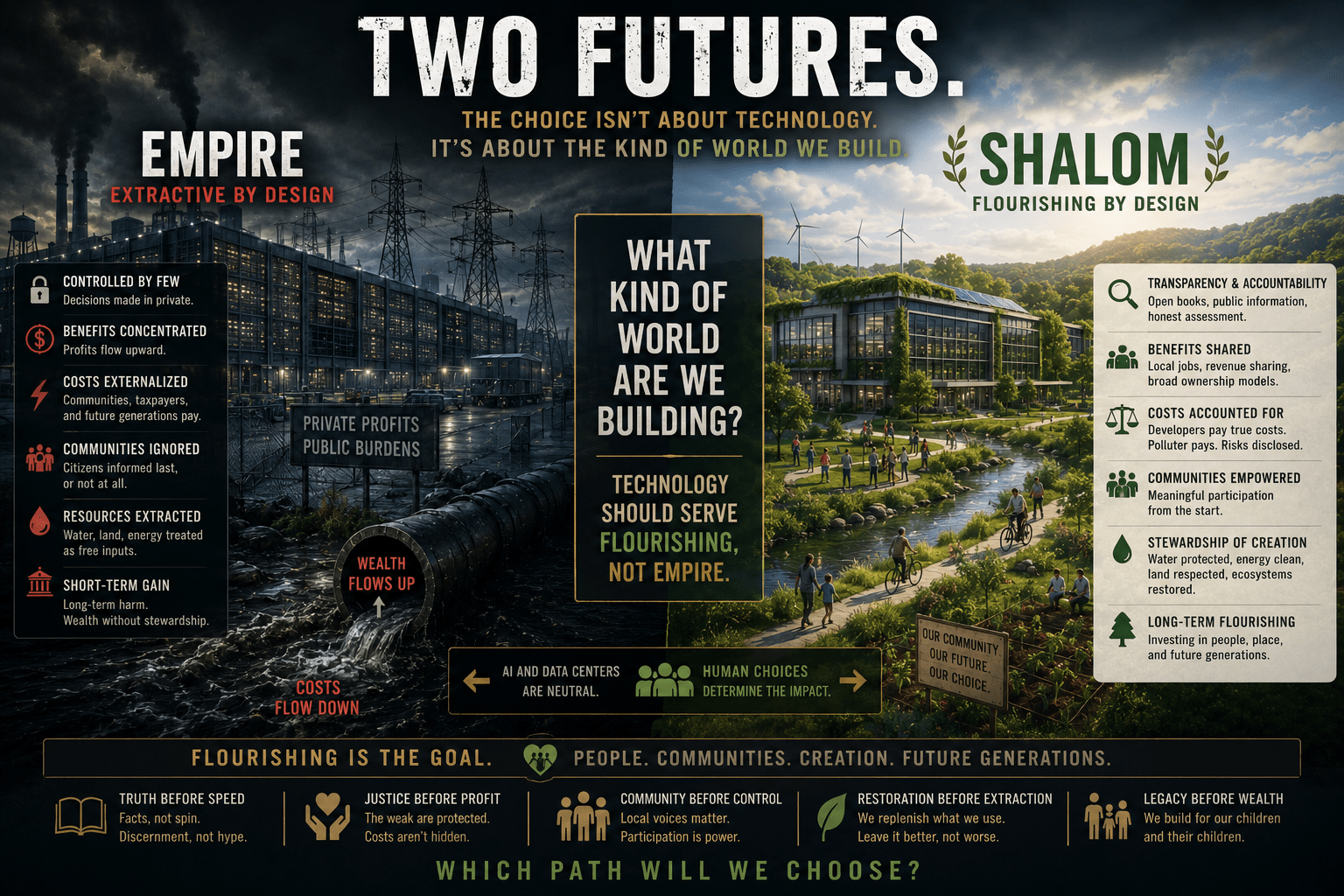
What Kind of World Are We Building?
The debate over artificial intelligence is usually framed as a debate about technology. It can also be framed as a debate about economics, the environment, energy, innovation, or public versus private benefit.
All of those are important conversations.
But I think the deeper question is something else.
It is a question about what kind of society we are becoming.
Across the United States, enormous data centers are being built to power the AI economy. The public conversation focuses on innovation, investment, competitiveness, growth, and technological progress.
Those things matter.
But other questions matter too.
Who benefits?
Who pays?
Who bears the risks?
Who makes the decisions?
How?
The deeper I have studied the data-center boom, the less interested I have become in the technology itself and the more interested I have become in the way it is being developed.
Again and again, the same pattern appears.
- Costs shifted onto communities.
- Benefits concentrated among owners, investors, and those positioned closest to the deal.
- Decisions made before citizens understand what is happening.
- Political influence operating behind the scenes through lobbying, campaign contributions, regulatory relationships, and sometimes outright conflicts of interest.
- Resources treated as inputs to be consumed rather than gifts to be stewarded.
The pattern is not new.
Throughout history, transformative economic initiatives have often followed similar paths. Railroads. Mining. Oil. Land speculation. Industrial agriculture. Again and again, society has faced the same question: who receives the benefits, and who bears the costs?
The Hebrew prophets had a name for what happens when wealth, power, and decision-making become increasingly concentrated while costs are distributed elsewhere.
They called it empire.
Empire is not primarily about armies.
It is about extraction.
It is about systems that pull wealth, resources, and influence toward the center while pushing costs toward the edges.
The alternative is not the rejection of technology.
The alternative is shalom.
Shalom asks different questions.
Not merely:
Can we build it?
But:
- Should we build it?
- Who benefits?
- Who pays?
- What is consumed?
- What is restored?
- Does this move us toward greater flourishing?
The Future
Artificial intelligence may prove enormously beneficial.
Data centers may prove necessary.
Technology itself is not the issue.
The issue is whether we organize it around extraction or stewardship.
Around concentration or participation.
Around empire or shalom.
That is the question beneath the question.
And it may turn out to be the most important one of all.

